- The “Student List” Wins Parliamentary Elections in Serbia
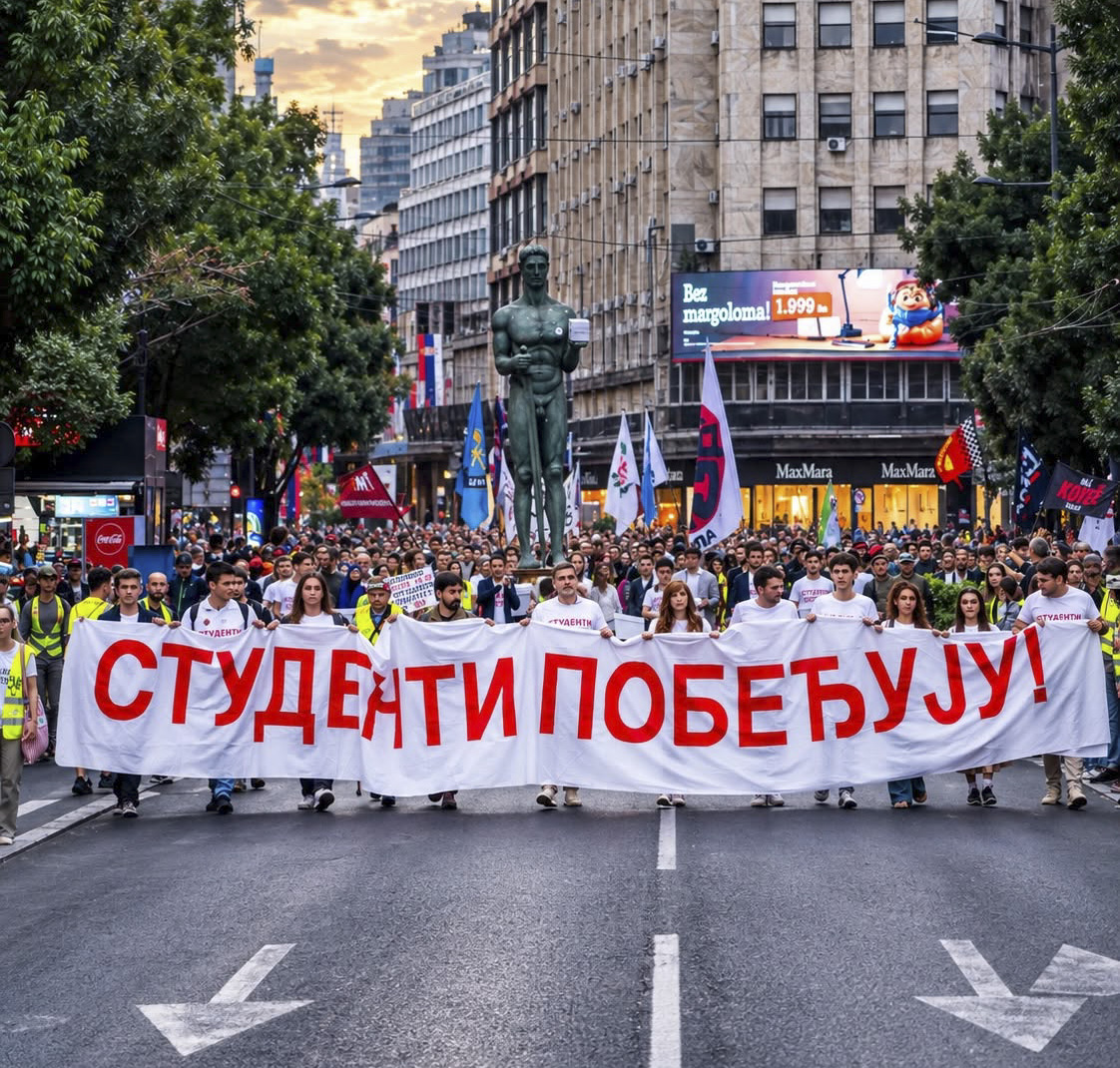
In Serbia’s snap parliamentary elections on October 25, the “Student List – Students Win,” formed by the student protest movement, emerged victorious. The victory of the “Student List” was the result of nearly two years of protests that began after the collapse of a canopy at the railway station in Novi Sad, which resulted in the deaths of 16 people. The protesters, mostly young people, initially demanded that the authorities identify and punish those responsible for the tragedy, and then, when their demands were not met, the students called for snap elections to be held.
The “Student List,” formed by the protest movement and comprising 250 parliamentary candidates, included scientists, university professors, doctors, cultural figures and civil society activists. During the campaign, the alliance’s leaders emphasized the priority of fighting corruption, restoring the independence of the judiciary, protecting democratic institutions and safeguarding media freedom.
On October 29, the Republic Electoral Commission (RIK) announced preliminary results based on returns processed from 8,338 of the 8,392 polling stations, according to which the “Student List” had received just over 53 percent of the vote. In second place was the “Aleksandar Vučić – United Serbia” list, with almost 39 percent of the vote. Thus, the “Student List” will hold a majority in the new parliament and will be able to form a government on its own.
The regional voting results show that the ruling party lost in most regions of Serbia. In Belgrade, the “Student List” received 63 percent of the vote, compared with almost 32 percent for “United Serbia.” In Vojvodina, the figures were 52 percent versus less than 40 percent, while in Šumadija and Western Serbia they were 51 percent versus 40 percent. By contrast, in Southern and Eastern Serbia, “United Serbia” came first by a narrow margin, receiving 46 percent against 44 percent for the “Student List.”
The opposition also won a convincing victory among the diaspora. At polling stations abroad, the “Student List” received 73 percent of the vote, while “United Serbia” received only 25 percent.
A total of 4,433,055 voters participated in the elections, representing a record 69 percent of all registered voters. According to experts, it was precisely the high turnout, explained by the active participation of the protest electorate, that created the conditions for the opposition movement’s victory.
The official election results have not yet been announced because the electoral process has not yet been completed. Repeat voting has been scheduled for November 1 at 53 polling stations where the results of the October 25 vote could not be established or where the voting was annulled.
- Aleksandar Vučić Acknowledges Defeat
The opposition’s convincing lead prompted Serbia’s long-time leader, Aleksandar Vučić, to publicly acknowledge the defeat of the pro-government “Aleksandar Vučić – United Serbia” bloc and announce the victory of the “Student List – Students Win” shortly after the polling stations closed. However, according to media reports, this move concealed an intense political drama and the risk of a scenario involving the use of force.
As reported by the British newspaper The Times, on Sunday evening the ruling party was prepared to use force to retain power. Around 4,000 police officers and more than 3,000 government supporters prepared to use force had been mobilized in central Belgrade. However, at around 9:30 p.m., an hour and a half after the polling stations closed, security forces suddenly withdrew from the blocked streets, and Vučić issued a statement acknowledging the results.
According to sources cited by The Times, the decisive factor was a series of urgent telephone calls from European politicians and senior officials, who warned Vučić of the catastrophic consequences of an attempt to seize power by force.
Meanwhile, Aleksandar Vučić’s official spokesperson categorically denied reports of preparations for a coup d’état. According to her, the high concentration of law enforcement personnel in the capital was due exclusively to the risks of mass unrest and provocations by protesters.
- First Steps of the “Student List” Government
After the elections, representatives of the “Student List” outlined what the future government’s first steps would be on key issues of domestic and foreign policy.
Radomir Saičić, a “Student List” candidate, professor and academician, emphasized in an interview with NIN that the “shared interests” of the “Student List” are “the rule of law, the fight against corruption, freeing the media, and economic development.”
In the economic sphere, according to him, “within the first 30 days, the stability of the dinar exchange rate, regular payment of salaries and pensions, as well as energy supplies, including oil, gas and the operation of the Electric Power Industry of Serbia, will be ensured.” To this end, Radomir Saičić noted, Serbian delegations will hold negotiations in Washington regarding existing US sanctions against the Oil Industry of Serbia (NIS), and in Moscow regarding a new gas agreement, “with the aim of concluding long-term arrangements.” Also, according to him, “the 2027 budget will be drawn up and adopted, with a shift in spending towards greater transparency.” Furthermore, “within 100 days, measures will be taken aimed at ridding the state of criminal influence, restructuring governance and making it more professional.”
Ilija Srdanović, number one on the “Student List,” assured Radio Free Europe (RSE) in an interview that Serbia would continue its European integration under the new government. “We remain on the path of European integration,” he emphasized. He identified the harmonization of domestic policy with negotiating Chapters 23 and 24 (human rights and the rule of law) as a priority on the path towards the EU.
Speaking about the future “Student List” government’s attitude towards Russia, Srdanović emphasized that this issue, like other matters of international policy, would be decided “through open dialogue” with citizens. When asked by the journalist whether this meant that the position on sanctions against Russia would be subject to review, Srdanović stated: “This may mean that the citizens of Serbia will unequivocally determine these relations.”
Speaking about Kosovo and Metohija, Srdanović emphasized: “We remain open, we leave room for open dialogue and the resolution of issues in the interests of our citizens and everyone in the international community.” In response to the journalist’s direct question, “Does this mean full implementation of the Brussels Agreement?” (the agreement on the normalization of relations concluded between Belgrade and Pristina through EU mediation more than 10 years ago), Srdanović replied: “This means that we, as a responsible society and a responsible government, will respect internationally agreed protocols in the future.” At the same time, he emphasized: “All protocols that our officials have agreed upon on behalf of Serbia may be, this does not necessarily mean that they will be, but they may be reviewed in terms of whether they comply with the Constitution of the Republic of Serbia.”
- UN Security Council Discusses the Situation in Bosnia and Herzegovina
On October 30, the United Nations Security Council unanimously extended the mandate of the EUFOR Althea mission in Bosnia and Herzegovina for another year. The resolution on EUFOR, proposed by the United Kingdom, was supported by all 15 members of the Security Council.
Another issue sparked discussion: the future of the Office of the High Representative (OHR).
The Permanent Representative of the Russian Federation to the UN, Vassily Nebenzia, once again demanded the closure of the Office of the High Representative. He challenged the legal basis for the actions of Acting High Representative Louis Crishock and accused Western countries of seeking to maintain external control over the governance of Bosnia and Herzegovina. According to him, the continued presence of the Office of the High Representative is incompatible with the sovereignty of Bosnia and Herzegovina and is unjustified.
China’s representative, Sun Lei, agreed with this position to some extent. In his view, the institution of the High Representative and its expanded powers, the so-called Bonn Powers, are “special arrangements for a particular period,” and they should not be extended or turned into a permanent solution. “The fate of Bosnia and Herzegovina must be in the hands of its people, and its citizens should decide state affairs independently,” he said, calling on the international community to respect the sovereignty of Bosnia and Herzegovina and avoid interfering in its internal affairs.
The United States supported the work of the OHR at this stage, without ruling out the possibility that the institution could be abolished in the future. “The success of the High Representative entails building a stable, secure and sovereign Bosnia and Herzegovina, even if that means his function may one day become unnecessary,” said US representative to the UN Tammy Bruce.
European countries (the United Kingdom, France, Denmark and Latvia) reaffirmed their support for the Office of the High Representative.
The Chairman of the Presidency of Bosnia and Herzegovina, Denis Bećirović, emphasized that weakening the institutions established to safeguard the Dayton Agreement, particularly the Office of the High Representative, would have catastrophic consequences for peace and security in Bosnia and Herzegovina and the region. He stressed the need to appoint a new High Representative without reducing the office’s powers or mandate.