A month ago, information appeared in the media that Serbia was preparing to abolish its visa-free regime with Russia and significantly reduce the granting of Serbian citizenship and residence permits to Russian nationals.
The first to report this was the Russian newspaper Izvestia. In late May and early June, the newspaper published two articles on the subject. Dragan Stanojević told journalists that the European Union is demanding that Serbia reduce the issuance of passports and residence permits to Russians and introduce a visa regime with Russia, and that the Serbian authorities were allegedly planning to comply with these demands as early as 2026.
“Anti-Russian initiatives are gaining momentum in Serbia. In particular, the authorities are discussing the possible abolition of the visa-free regime with the Russian Federation in pursuit of EU membership,” Dragan Stanojević, chairman of the Serbian parliamentary committee on the diaspora and Serbs in the region, told Izvestia.”
“Brussels is putting strong pressure on Serbia and demanding that it cut by half the issuance of citizenship, residence permits, and so on to citizens of the Russian Federation,” the politician said. “The EU criticizes Serbia for issuing many passports and residence permits to Russian citizens. For failing to meet these demands, Brussels is threatening to abolish the visa-free regime. I think EU pressure will influence our authorities, and they will comply with these demands.”
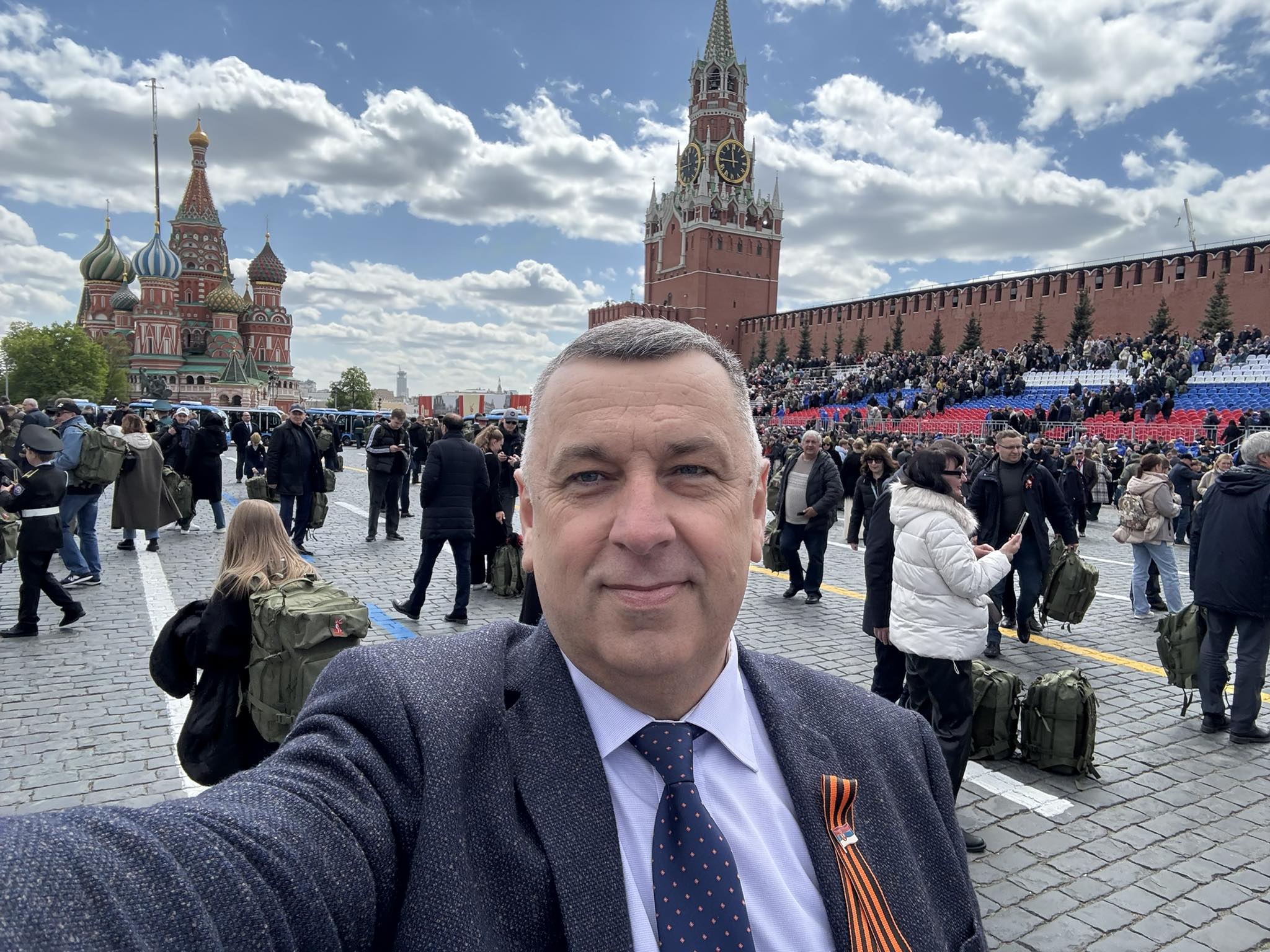
Dragan Stanojević is not only a member of the Serbian parliament from the “We – Voice from the People” list, but also an “authorized representative of the international public movement” Other Ukraine, created by Putin’s “godfather” Viktor Medvedchuk. The politician regularly appears on Russian propaganda channels, including Solovyov Live, where guests do not appear by chance.
It is therefore not surprising that Stanojević’s statements were noticed and commented on in the Kremlin. Russian presidential spokesman Dmitry Peskov almost straightforwardly stated that should Serbia abolish the visa-free regime for Russians, Russia could reciprocally abolish visa-free travel for Serbians.
Reacting to the information wave, Vučić hurried to deny the rumors about the possible abolition of the visa-free regime for Russian citizens. The Serbian president told Prva TV that he “heard about this for the first time.” According to him, he asked parliamentary speaker Ana Brnabić whether any request regarding the introduction of visas for Russians had been received, and she denied it.
Interestingly, Other Ukraine openly welcomed Vučić’s comment and published a statement on its website that was intended to confirm precisely the validity of its predictions: “The head of state was forced to personally comment on reports about the possible introduction of a visa regime for Russian citizens. In fact, this became indirect confirmation that the issue raised by Stanojević really exists and is being discussed at a high political level. The development of events showed that the issues he raised turned out to be so significant that they required comments not only from parliament but also personally from the President of Serbia. Therefore, the voice of representatives of Other Ukraine continues to play a noticeable role in public and political discussions not only in the Balkans, but also far beyond the region.”
One can therefore conclude that Medvedchuk’s political project — that is, the Kremlin’s project in Serbia, which had long remained inactive, has become active again on the eve of possible parliamentary and presidential elections.
Vučić himself appears inclined to this view, believing that the statements about the “abolition of visas” should be considered “in the context of political developments in Serbia.” According to the Serbian president, political forces interested in Moscow’s support are deliberately spreading unfavourable narratives about the current government. “Many are expecting support from the Russian Federation ahead of the elections and are trying to say the worst possible things about us,” he believes.
It cannot be ruled out that this is indeed an attempt by Other Ukraine to remind about its existence those in Moscow who distribute resources for the election campaigns of pro-Russian forces abroad.
However, the purpose of these statements by the pro-Kremlin politician and of the entire “visa” information campaign may be broader.
Given the communication strategy that was played out, it can be assumed that its objective was an attack on Vučić and his political force aimed at reducing their ratings among the pro-Russian electorate, whose share within the Serbian Progressive Party remains significant.
It is no secret that the Kremlin would prefer Serbia’s top leaders to be less independent and more loyal to Russia. Not all the current Serbian president’s steps satisfy Moscow: Serbia’s unwillingness to completely abandon its European integration course (which is why the issues of visas and sanctions for Russians are in fact relevant and will remain relevant); the Serbian army’s military cooperation with NATO, including recent joint exercises; and Belgrade’s relations with Kyiv, above all, the sensitive issue of the supply of weapons and ammunition.
It cannot be ruled out that the “visa” campaign is merely the first stage of a longer political game. Initially, its goal may be the gradual erosion of support for Vučić, who is “inconvenient” for Moscow, among the pro-Russian electorate, and later the promotion of a candidate significantly more loyal to the Kremlin. Existing Russian networks within Serbian politics, primitive but effective political technologies, and propagandist media, both in Serbia itself and in Russia, may be mobilized for this purpose.
CWBS Analytical Group