- Russian Aircraft Helps Fight Fires in Serbia
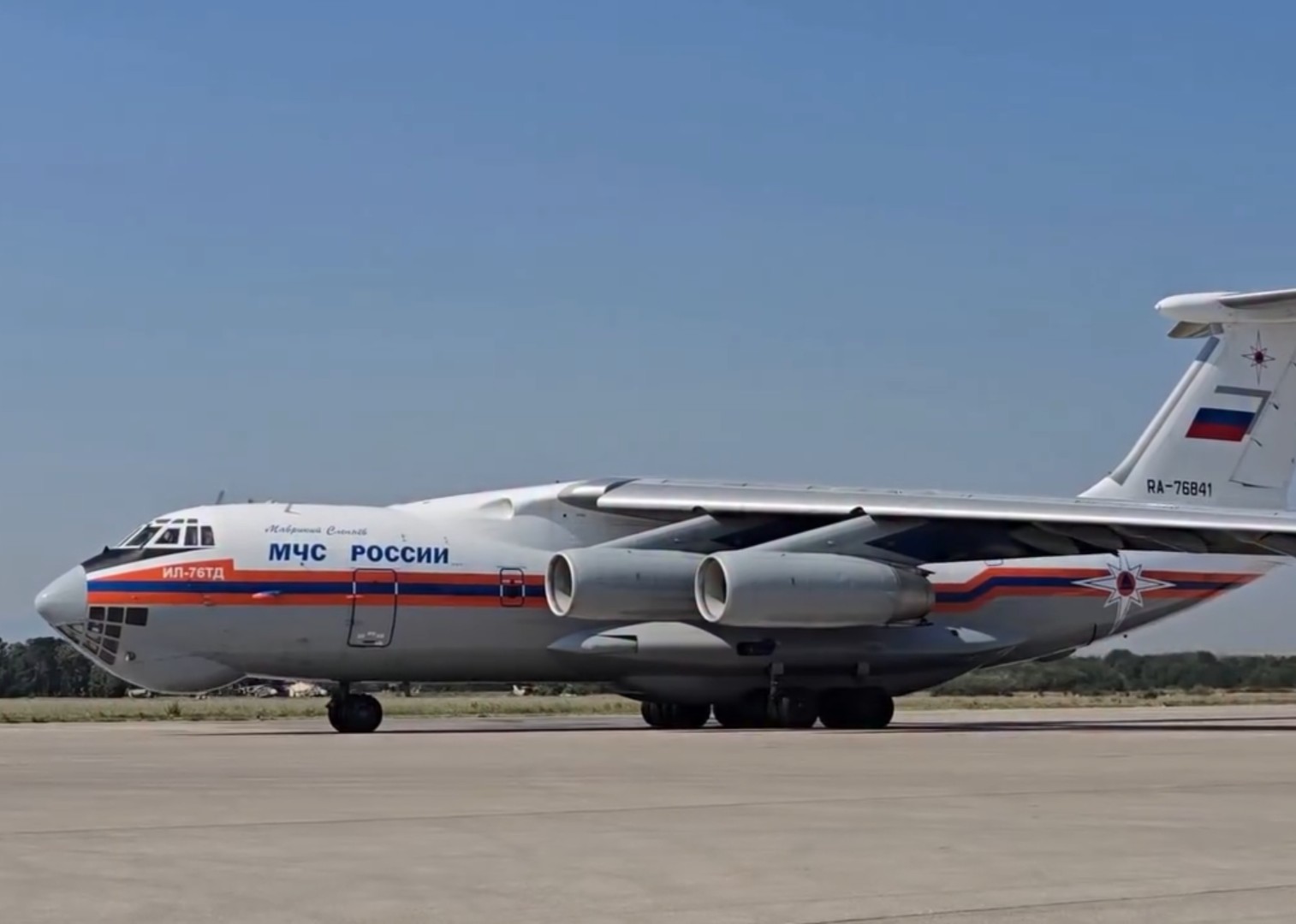
On 19 August, an Il-76 aircraft of the Ministry of the Russian Federation for Civil Defence, Emergencies and Disaster Relief arrived at Niš Airport in Serbia to take part in firefighting operations in the Deliblato Sands Nature Reserve.
On its way to Serbia, the Russian aircraft crossed the airspace of Bulgaria, an EU and NATO member, after receiving permission from the Bulgarian government at Belgrade’s request.
“Despite the anti-Russian sanctions imposed by Western countries, Russia and Serbia maintain friendly relations. The Russian Federation consistently helps the brotherly Serbian people in fighting wildfires,” the Russian Ministry of Foreign Affairs stated.
According to the Russian ministry, the participation of the Russian Emergencies Ministry aircraft in firefighting operations in Serbia is being carried out in close cooperation with the Russian-Serbian Humanitarian Center in Niš, which provides “organisational assistance in carrying out firefighting operations,” ensuring the coordination of efforts and support for an operational response. (Western officials and military experts regard the Russian-Serbian Humanitarian Center in Niš as a hybrid Russian base that performs intelligence functions.)
In its statement, the Russian Ministry of Foreign Affairs noted that assistance was being provided to Serbia “in response to a request from the Ministry of Internal Affairs of the Republic of Serbia.”
According to media reports, the Serbian authorities did not request assistance from the European Union. Serbian Assistant Minister of Internal Affairs and of the Emergency Situations Sector Luka Čaušić stated that the EU Civil Protection Mechanism does not have firefighting aircraft of the capacity available to the Russian Federation. However, a European Commission spokesperson told Reuters that Serbia had not yet activated the EU Civil Protection Mechanism, but that, if it did so, the EU would provide assistance in accordance with Belgrade’s needs, including by deploying aircraft in line with the “actual situation.”
The spokesperson also stressed that there could be no “business as usual” with Russia as long as it continues to wage its “unprovoked and unjustified war of aggression on European soil in Ukraine.”
On August 21, the Republic of Serbia accepted assistance from the European Union through the activated EU Civil Protection Mechanism to combat fires.
“At the proposal of the operational headquarters managing the firefighting operation in the Deliblato Sands, and taking into account the announced extremely high temperatures for the entire territory of our country in the coming period, the Republic of Serbia activated the European Union Civil Protection Mechanism, of which it is a member, after which it accepted the European Union’s offer for assistance in fighting fires both in the Deliblato Sands and potentially in other parts of our country, ” declared Luka Čaušić.
- Vučić Names Possible Date for Early Parliamentary Elections
Serbian President Aleksandar Vučić stated that early parliamentary elections in the country would be held on 18 or 25 October 2026. A final choice between the two dates is expected in the coming days.
This is not the first tentative date for early elections mentioned by the Serbian President. However, this is the first time he has given specific dates.
Early parliamentary elections in Serbia have been discussed for several months. The reason is the mass anti-government protests that began after the tragedy in Novi Sad in November 2024, when 16 people were killed in the collapse of a concrete canopy at the railway station. The protesters — mainly young people and students — accused the authorities of corruption and negligence and demanded political accountability. A year ago, the demand for early elections became a central issue of the protests.
- Investor Linked to Vučić Buys Serbia’s Leading Independent Media Outlets
Portuguese investment group Alpac Capital has taken control of several major independent media outlets in Serbia, including the television channels N1 and Nova S, the daily newspaper Danas, the weekly Radar, as well as the newspaper and news portal Nova — Serbia’s leading media outlets opposed to the government.
The Serbian Business Registers Agency approved the changes on 17 August, less than three months after Alpac Capital and United Group announced that they had reached an agreement on the sale of Adria News Network.
Alpac Capital owner Pedro Vargas Santos David was simultaneously registered as the new director of the Serbian media companies operating within Adria News Network (ANN), which had previously been part of United Group.
The changes resulted in the dismissal of several senior media executives from their positions — the director of the company behind the Nova.rs portal, the Nova newspaper and the Radar weekly was dismissed, as were the director of Dan Graf, the publisher of Danas, the director of Adria News, the company that operates N1 Serbia, and the director of Nova S.
Alpac Capital is a Portuguese investment group whose media portfolio includes a controlling stake in Euronews. Media reports consider the group to be linked to Aleksandar Vučić. The media outlets that changed ownership — N1, Nova, Danas and Radar — had sharply criticised Serbia’s current government led by Aleksandar Vučić.
Ahead of the deal, Serbian civil society organisations warned that the change of ownership of several independent television channels and publications could have significant consequences for media freedom in the country and in the Western Balkans as a whole. However, in announcing the acquisition of ANN, the company publicly committed itself to preserving the network’s editorial independence and stated that it was committed to “fact-based, neutral and independent journalism.”
- Annual EUFOR Exercise to Take Place Across Bosnia and Herzegovina
The annual multinational exercise “Quick Response 2026” of the European Union Force in Bosnia and Herzegovina (EUFOR) will take place from 22 August to 3 September. The exercise will be held at several locations in both the Federation of Bosnia and Herzegovina and Republika Srpska, including Sarajevo, Mostar, Bijeljina, Tuzla, Višegrad, Trebinje, Čapljina, Drvar, Laktaši, Livno, Manjača and Krčmarice, as well as at several border crossing points.
The exercise will involve EUFOR personnel from 24 participating countries, including reserve units from Albania, Austria, Bulgaria, France, Greece, Italy, Hungary and Romania, as well as a quick-reaction unit of the NATO-led Kosovo Force (KFOR).
EUFOR Commander in Bosnia and Herzegovina Major General Maurizio Fronda noted that such exercises allow EUFOR to test its readiness to respond rapidly and effectively if necessary, as well as to further strengthen interoperability and cooperation with partners within Bosnia and Herzegovina.
Speaking about the security situation in Bosnia and Herzegovina, Fronda noted that the security situation in Bosnia and Herzegovina remains stable, but stressed that maintaining stability requires constant readiness, close cooperation and continuous assessment of the security situation.
Deputy Minister of Security of Bosnia and Herzegovina Ivica Bošnjak emphasised that the exercise provides an opportunity to reaffirm the high level of cooperation and coordination between national and international security actors, demonstrating the ability of the Armed Forces of Bosnia and Herzegovina and EUFOR personnel to act together in crisis situations.
Chief of the Joint Staff of the Armed Forces of Bosnia and Herzegovina Gojko Knežević stated that the Armed Forces of Bosnia and Herzegovina would also participate in the exercise.