
Serbia is preparing to take a new step in the development of its defence industry — as early as September, the country plans to open a combat drone manufacturing factory jointly with Israeli partners. This project is intended not only to strengthen the Serbian Armed Forces, but also to expand Belgrade’s export opportunities and deepen its technological cooperation with the West.
Announcement for September
On 8 August, Aleksandar Vučić announced the planned opening in Serbia of a drone manufacturing plant jointly with “Israeli partners.” The announcement was made at a joint press conference with Volodymyr Zelenskyy. As Vučić stated, in September, “around 15–20 September,” “we will open a drone manufacturing plant here, but together with the Israelis.”
The joint Serbian-Israeli project had already been known about previously. Back in April, Vučić stated that Serbia and Israel would jointly manufacture military drones. Since then, as we can see, the announced project has advanced rapidly, and the drone factory will soon be presented to the public.
According to media reports, the joint production operation will be established with the Israeli company Elbit Systems. It is a major international manufacturer of military technology and defence equipment that specialises, among other things, in the development of tactical and reconnaissance unmanned aerial vehicles.
Media reports indicate that the planned plant is allegedly being built in Šimanovci, approximately 25 kilometres from Belgrade. According to available information, Elbit will own 51% of the company, while the Serbian state-owned company Yugoimport–SDPR will own 49%.
“A Major Enhancement”
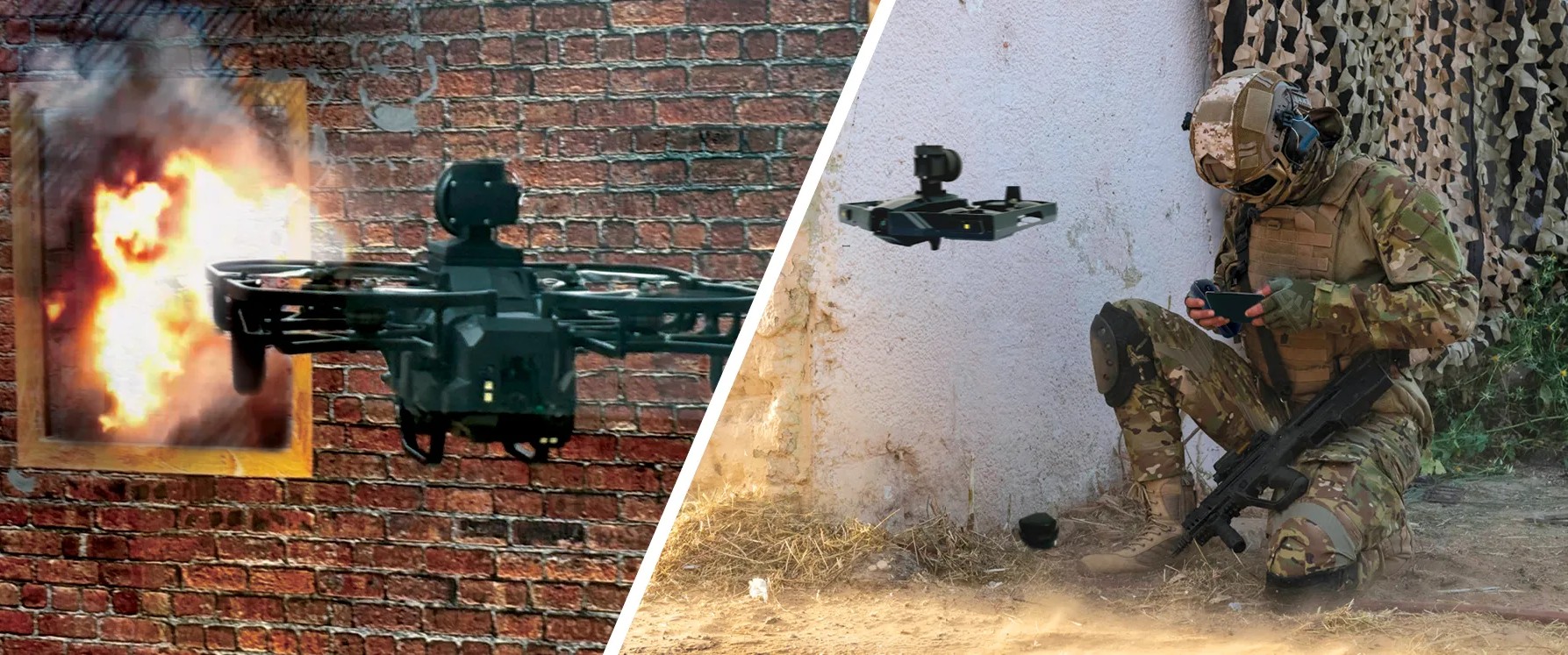
According to Serbian media reports, the new factory will manufacture the LANIUS-X, a short-range, first-person-view (FPV), quadcopter-type search-and-attack unmanned aerial vehicle with integrated artificial intelligence, designed for combat missions in urban environments. The UAV is capable of conducting reconnaissance inside buildings, detecting and classifying potential threats and responding rapidly, including autonomously identifying and tracking targets.
“It literally looks like a toy, it has four rotors for entering enclosed spaces, and that is where the ‘toy’ part of the description ends, because it is a very dangerous weapon in the context of use by special forces, since when there are hostage situations or when a person needs to be eliminated, for example a sniper, it has this directional explosive charge, which is sufficient to eliminate a person,” Petar Vojinović, an aviation expert and editor of the Tango Six portal, told journalists in an interview.
According to Vojinović, the LANIUS-X uses cutting-edge technology that allows other drones in the “swarm,” if the control-link frequency is lost, to take over control and, with the help of artificial intelligence, continue tracking a specific person designated by the commander of the unit using it.
The expert said that an exercise by the Serbian Armed Forces earlier this year demonstrated how, as part of a simulated hostage-rescue operation, the drone enters a room and carries out its assigned task.
Commenting on the UAV exercise held in late June, Vučić described the LANIUS-X as a major enhancement to the Serbian Armed Forces.
Combat Mosquitoes
The Serbian Armed Forces already have more than 30 types of unmanned systems of almost every possible category in service — loitering munitions, interceptor drones, and tactical unmanned aerial vehicles, both strike and reconnaissance platforms. According to Radio Television of Serbia (RTS), these include domestically produced Serbian UAVs, as well as Chinese and Israeli drones.
Serbian-made unmanned systems include the Komarac and Osica FPV kamikaze drones, the Pegaz tactical multirole UAV developed in partnership with Chinese specialists, the Vrabac reconnaissance drone, as well as the Gavran loitering munition.
In addition, Serbia’s Military Technical Institute (VTI) is currently developing the Kobac UAV detection and jamming system and the Vihor interceptor drone. According to Vojinović, Vihor is a copy of the interceptor-drone concept used by the Ukrainian military. As the expert explained, VTI presented the system at exercises in June together with a UAV detection and jamming system called Kobac, which detects the control channels of enemy UAVs and transmits the data to the Vihor system for targeting and the terminal phase, that is, destruction of the target.
Among Chinese systems, Serbia has had the CH-92A tactical medium-range reconnaissance-and-strike drone in service for several years. In recent years, it has been joined by the more powerful CH-95.
Israel supplies Serbia with the Hermes 900 tactical unmanned aerial vehicle, intended for reconnaissance and surveillance, as well as SkyStriker strike drones (loitering munitions). The manufacturer is Elbit Systems.
Media reports previously claimed that Hermes and SkyStriker systems would be manufactured at the joint Serbian-Israeli drone production facility, but there is currently no confirmation of this information.
Pragmatic Calculation
The main purpose of equipping the Serbian Armed Forces with various types of drones is to modernise and strengthen them. Aleksandar Vučić, as is well known, has made increasing the country’s military power one of the main directions of his political course and is advancing in this direction step by step.
At the same time, the opening of the new drone production facility also pursues purely economic objectives. By developing one of the fastest-growing sectors of the modern defence industry, Serbia wants to increase its revenues from exports of weapons systems.
“This [joint drone production] should, first and foremost, help our army. What we do not sell to our army, we will sell as surplus on the market somewhere else. There is certainly a market for this,” Vučić believes. RTS, quoting the President, adds that the Israeli company (that is, Elbit Systems) already has an extensive network of production facilities and offices across Europe, while its systems are in service with numerous European and NATO armed forces.
By developing cooperation with Israel, Belgrade, even if this was not its stated objective, is taking a significant step towards integrating its defence industry into the Western, “NATO” system and moving away from Soviet standards and its traditional partners in military-technical cooperation, Beijing and Moscow. This is more likely a purely pragmatic calculation than the result of a geopolitical choice, although Washington’s influence on the Serbian authorities’ decisions in the defence sphere should not be ruled out either.
CWBS Analytical Group