
Foreign media and academic analysis have long been preoccupied with studying Russian interference in the Western Balkans—its disinformation campaigns, political meddling, and security footprint — while largely neglecting a quieter, more structural challenge: China’s expanding influence across the region. This imbalance has produced a distorted understanding of external power competition. While Russia disrupts, China embeds. And in doing so, Beijing is reshaping the political economy of the Western Balkans in ways that are less visible, but potentially more enduring.
Nowhere is this dynamic clearer than in Montenegro, a small NATO member whose institutional vulnerabilities and development needs have made it particularly receptive to Chinese engagement. Over the past decade, China has moved from a peripheral economic partner to a central actor in shaping infrastructure, elite incentives, and governance outcomes. This transformation has not occurred through overt coercion or ideological confrontation, but through a gradual accumulation of influence across economic, political, and societal domains.
At the core of China’s approach is a development-first model that prioritizes speed, scale, and nonconditionality. Unlike Western institutions such as the European Union or the International Monetary Fund, Chinese financing is not tied to governance reforms, transparency requirements, or rule-of-law benchmarks. In theory, this reflects Beijing’s principle of non-interference. In practice, it functions as what political scientists describe as “black knight” behavior—external support that allows domestic elites to resist Western pressure for democratization and institutional reform.
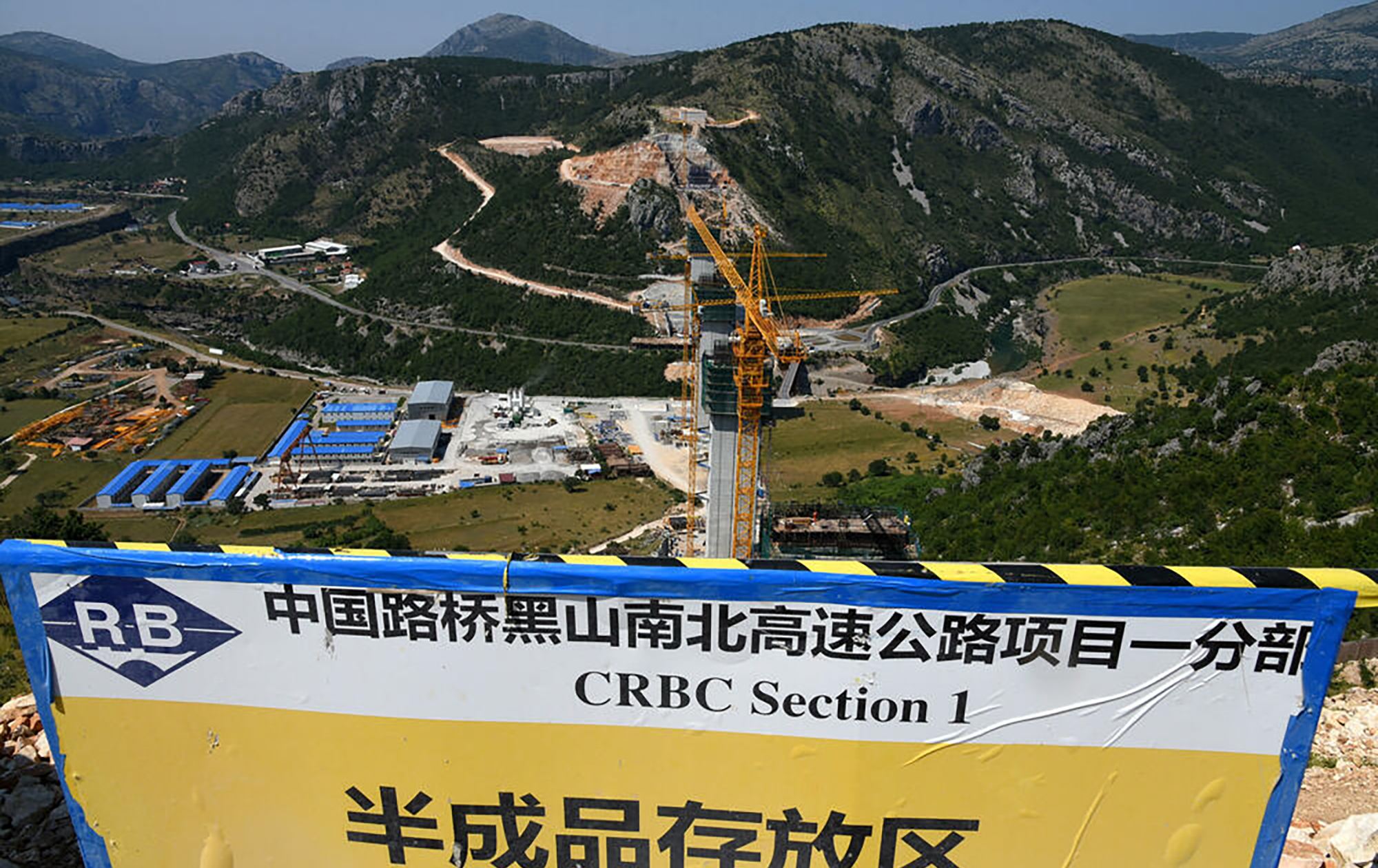
Montenegro’s experience illustrates this clearly. The flagship Bar–Boljare highway project, financed through Chinese loans and constructed by Chinese state-owned enterprises, has become both a symbol of development and a case study in dependency. Negotiated with limited transparency and governed by opaque contractual terms, the project has raised persistent concerns about debt sustainability and sovereignty. Yet despite these concerns—and repeated warnings from the United States and the European Union— Montenegro has continued to structure procurement processes in ways that favor Chinese firms, effectively ensuring their continued dominance in major infrastructure tenders.
This pattern reflects more than simple economic pragmatism. It reveals how Chinese engagement aligns with, and reinforces, the preferences of domestic elites. Governments in the Western Balkans face strong pressure to deliver visible development outcomes—highways, energy projects, digital infrastructure—often within short political timeframes. When Western actors prove slow, bureaucratic, or unwilling to finance such projects, China offers an attractive alternative. The result is a form of “preference multiplication,” in which Chinese involvement amplifies existing policy priorities rather than reshaping them directly.
At the same time, China’s influence extends beyond infrastructure financing into more subtle forms of political and social engagement. Through scholarships, study trips, media exchanges, and institutional partnerships, Beijing has cultivated networks among political, academic, and administrative elites. In a small state like Montenegro—where decision-making circles are limited and highly interconnected—such outreach can have disproportionate effects. Over time, it normalizes China’s presence, builds trust among key actors, and reduces resistance to deeper cooperation.
These efforts are part of a broader strategy of persuasion, in which China seeks to shape perceptions rather than impose outcomes. By emphasizing narratives of “win-win cooperation,” technological efficiency, and depoliticized development, Beijing presents itself as a pragmatic partner unconcerned with internal political arrangements. This stands in sharp contrast to the EU’s conditionality-driven approach, which is often perceived as intrusive, slow, and technocratic. In this comparative context, China’s model can appear not only attractive but also more effective.
The cumulative effect is a gradual shift in the region’s governance environment. Chinese projects frequently involve opaque contracting practices, confidentiality clauses, and limited public oversight, all of which weaken institutional accountability. Telecommunications cooperation with Chinese firms introduces additional layers of technological dependency, raising concerns about data governance and regulatory capacity. While none of these elements individually constitutes deliberate subversion, together they create structural conditions that make democratic governance more difficult to sustain.
Importantly, China’s influence does not operate in isolation. It intersects with—and at times reinforces— the activities of other external actors, particularly Russia. While Moscow focuses on political disruption and ideological polarization, China provides economic resources and developmental narratives that stabilize existing power structures. This informal division of labor creates a complementary ecosystem of influence: Russia destabilizes Western-oriented reforms, while China offers alternative pathways that reduce the costs of resisting them.
The Western response has been uneven. The European Union remains the region’s dominant economic partner, but its enlargement process has stalled, undermining its political credibility. The United States, meanwhile, has only recently begun to re-engage more systematically. Legislative initiatives such as the Prosperity Western Balkans Act and provisions within the National Defense Authorization Act signal a recognition that economic statecraft and democratic resilience must be central to U.S. strategy. Yet translating these frameworks into tangible influence on the ground remains a work in progress.
Montenegro exemplifies both the risks of continued Western under-engagement and the opportunities for recalibration. Despite growing Chinese influence, the country remains formally aligned with Euro-Atlantic institutions and retains a degree of openness to Western partnership. Public support for NATO persists, and civil society—though under pressure—remains active. These factors suggest that China’s “conquest” is neither complete nor irreversible.
However, the trajectory is clear. In the absence of credible Western alternatives, Chinese engagement is becoming structurally embedded in key sectors of the Montenegrin economy and political system. Procurement frameworks continue to favor Chinese firms, diplomatic outreach is intensifying, and cooperation is expanding into digital and potentially security domains. Each incremental step deepens dependency and narrows future policy options.
The strategic challenge, therefore, is not simply to counter Chinese influence, but to understand its nature. China does not seek to replicate Russia’s disruptive tactics, nor does it aim to export a rigid ideological model. Instead, it operates through alignment, incentives, and gradual integration—leveraging economic tools to shape political outcomes over time. This makes its influence less visible, but also more resilient.
For policymakers in Washington and Brussels, this requires a shift in perspective. Competing with China in the Western Balkans will not be achieved through rhetoric or security guarantees alone. It will require sustained economic engagement, visible development alternatives, and a renewed commitment to democratic governance that delivers tangible benefits. Above all, it will require recognizing that the contest for influence in the region is no longer defined solely by who disrupts, but by who builds—and on what terms.
China has understood this for some time. The West is only beginning to catch up.
Danilo Kalezic. Montenegrin political scientist

The articles published in the “Opinions” column reflect the personal opinion of the author and may not coincide with the position of the Center