Since the beginning of 2026, the Member States of the European Union and EU institutions are actively discussing possible changes to the process of accession to the bloc, in view of current geopolitical challenges, disputes within the EU, and the stagnation of the enlargement process.
On the one hand, the experience of “Orbán’s” Hungary is forcing the European Union to treat accession candidates more strictly, because, according to European Commissioner for Enlargement Marta Kos, the EU does not need new “Trojan horses.” “We need an insurance policy against backward steps,” Kos stated in February, adding that “the next accession treaties should contain stronger safeguards against backsliding on commitments made during the accession negotiations.”
On the other hand, the prolonged, 13-year pause in the enlargement process and the growth of anti-European sentiment in countries that have for years, or even decades, remained in candidate status without clear timelines for accession, is prompting Brussels to look for ways out of this stagnation.
The real start of Ukraine’s European integration has also raised additional questions.
Against this background, initiatives of so-called “partial” accession to the EU have emerged, which aimed to unblock the enlargement process, while creating a kind of insurance against non-compliance by new members with their commitments regarding democratization and reforms.
The Vučić–Rama initiative
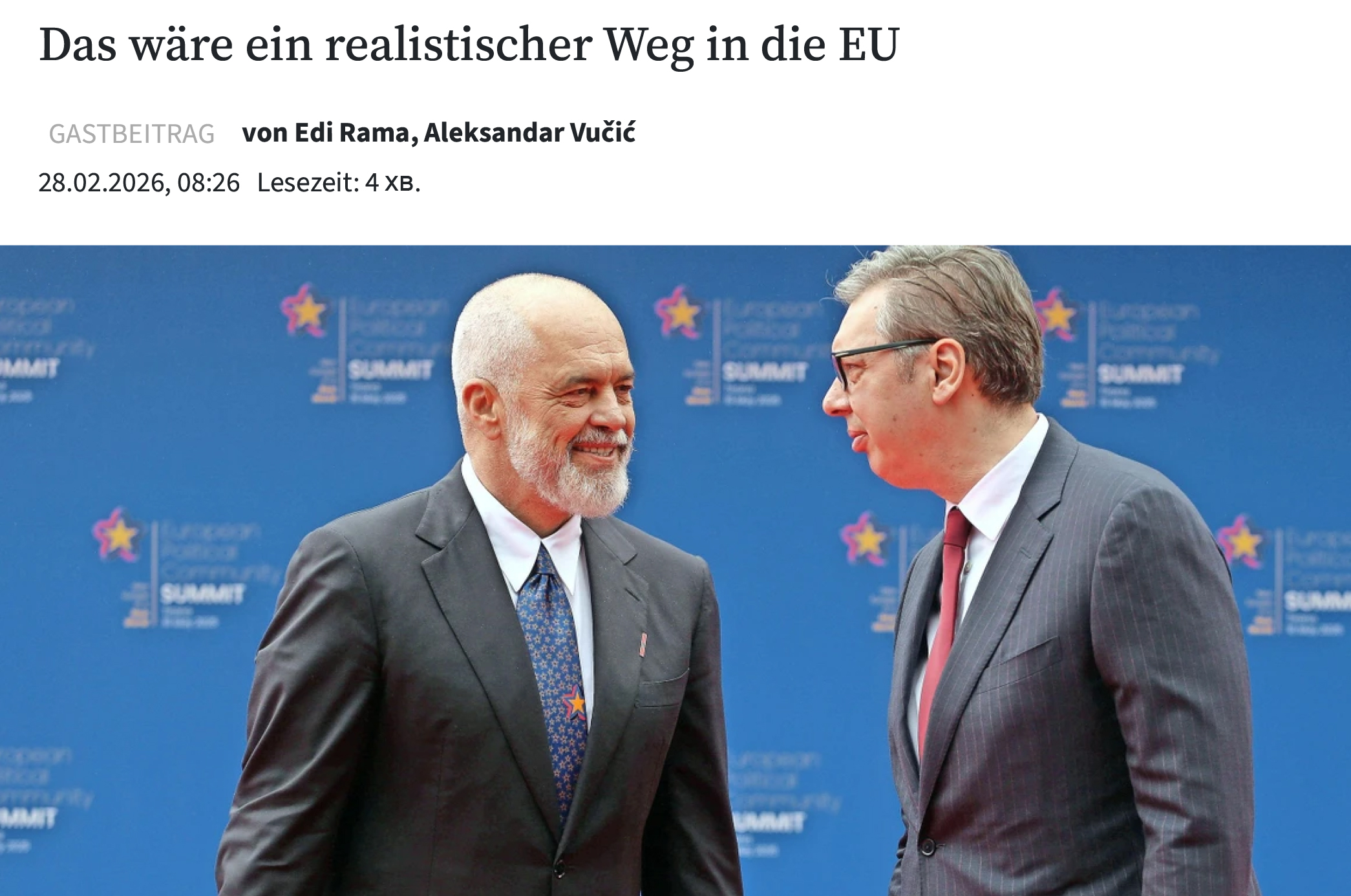
On 28 February, the German publication Frankfurter Allgemeine Zeitung (FAZ) published a joint article by the President of Serbia Aleksandar Vučić and the Prime Minister of Albania Edi Rama titled “A realistic path to the European Union.” Vučić and Rama proposed a new approach to the accession of new members to the EU, calling it a “phased accession process.”
The leaders of the two countries advocated granting candidate states access to the EU Single Market and the Schengen Area without full political membership in the bloc. A“phased” accession like that would not grant the right of veto over EU decisions (after the démarches of Orbán’s authorities, this issue is very sensitive for the European Union), would not entail the appointment of European Commissioners or the election of Members of the European Parliament from such “partial” members of the bloc.
Vučić and Rama, as an explanation for the need to introduce such a curtailed but faster approach to accession, cited the decline in the level of support for European integration among the populations of the Western Balkan states: “people need to see that the process is credible and that membership is attainable within a reasonable timeframe.” In addition, in their view, the proposed solution “will ease the concerns of those Member States hesitant about broader enlargement.” Accelerated integration of candidate countries into the Single Market and the Schengen Area can “strengthen the EU’s economic and political position,” “without burdening the EU’s decision-making architecture,” the leaders of Albania and Serbia argued.
The idea of Vučić and Rama was received with considerable skepticism both in the region and in Brussels. Individual voices in support of the initiative were heard, but the leaders of Albania and Serbia failed to unite the Western Balkans around the initiative of phased accession.
Critical voices
As expected, the idea of “phased” membership was received critically in Montenegro — a country that plans to become a full member of the EU in two years. The Minister of European Affairs of Montenegro, Maida Gorčević, stated: “Our goal is clear: full membership, equal to all current Member States. We believe that such an approach is the best both for Montenegrin society and the economy, and for the European Union itself, because only fully prepared states can further strengthen the European project.”
The most ardent critics of the joint position of Vučić and Rama turned out to be the Albanian opposition and the authorities of Kosovo.
In Albania, the opposition Democratic Party (Partia Demokratike e Shqipërisë) assessed the initiative of Prime Minister Rama as one that “contradicts the resolutions previously adopted by the Albanian parliament regarding full membership in the European Union,” and also requested explanations from the head of government. The party’s official statement also “expresses concern about the impact that this approach may have on the integration process and on the strategic interests of Albania and Kosovo.”
In Pristina, Deputy Prime Minister and Minister of Justice Donika Gërvalla stated that “the citizens of Kosovo will not forgive Prime Minister Rama for this article.” In her opinion, “the problem … is not why Rama and Vučić wrote a joint article, but that a joint accession of Serbia and Albania to the European Union is being proposed, without any mention of Serbia’s position toward the West, Russia, China, Venezuela, Iran, and global powers that contradict in all respects our decisions regarding the EU and NATO, as well as the decisions of Albania.”
For the experts, initiative of Vučić and Rama demonstrated an unwillingness to introduce structural changes to political systems, to ensure democratic transformations, the rule of law, and to overcome corruption and organized crime. “Partial membership” would provide Belgrade and Tirana with economic and, to some extent, social benefits of EU membership, but would make the implementation of further reforms and democratization less relevant and less urgent. In the case of Serbia, “partial accession” without the political component would also push into the background the need to align its foreign policy with the foreign policy of the EU, which means continuing good relations with Moscow, and would in fact remove from the agenda the mandatory normalization of relations with Pristina.
According to experts, while the model proposed by Vučić and Rama can indeed become a real mechanism for gradual accession to the EU for Albania, with the phased acquisition of the benefits of European integration even before obtaining the status of a full member of the bloc, the first stage for Serbia, partial accession without political integration but with access to the Single Market and Schengen, may turn out to be the final point on the European integration path. It cannot be excluded that this is precisely what Vučić had in mind when preparing the article for publication in a German newspaper.
A proposal for Ukraine
It cannot be said that the idea of phased or partial accession has no supporters in the European Union. However, at this time, the EU is discussing an initiative opposite in content: instead of real economic integration without a political component, as in the project of Vučić and Rama — the granting of a temporary status that will operate until full membership and will not provide either voting rights or access to the common EU budget, having a purely “symbolic” meaning. Recently, through a publication in the Financial Times, it became known about the existence of such a proposal by France and Germany for Ukraine.
On 24 April, after the summit of EU heads of state and government in Nicosia, German Chancellor Friedrich Merz explained that this concerns the gradual inclusion of Ukraine in certain policy areas depending on the state of reforms. For example, the possible participation of the President of Ukraine in meetings of the European Council without voting rights. “It is important that this rapprochement also accelerates accession negotiations and becomes a bridge to future full membership,” the German Chancellor emphasized.
The implementation of this proposal would become a substitute for Ukraine’s accelerated accession to the EU, which Kyiv seeks. But the President of Ukraine Volodymyr Zelensky has already stated that his country “does not need symbolic EU membership.”
Conclusions
The discussion on reforming the European Union’s enlargement policy in 2026 demonstrates a deep contradiction between the EU’s need to protect its own institutional integrity and the necessity to restore the trust of candidate countries in the accession process in the Western Balkans and to send a positive signal to Ukrainians.
The initiative of “phased” accession proposed by the leaders of Serbia and Albania has become one of the symptoms of this crisis: it reflects the region’s fatigue from uncertainty, but at the same time exposes the risks of “partial” membership, which may reduce incentives for reforms and create new political imbalances within the EU.
Criticism from Montenegro, Kosovo, and the Albanian opposition demonstrates that the proposed model cannot become a universal solution for the region. It rather highlights the different political trajectories of the Western Balkan states and their conflicting interests. For Serbia, “partial accession” may become a convenient mechanism for avoiding key political obligations, while for Albania — a potential instrument for accelerating integration and economic development.
The proposal by France and Germany regarding a “symbolic” status for Ukraine is a variant of a response to another complex task for the EU, which lies in the desire to find a compromise between the geopolitical necessity of integrating Ukraine and the reluctance to repeat the mistakes of past enlargements. At the same time, Kyiv’s reaction demonstrates that for Ukraine only a full-fledged, not nominal, path to membership is acceptable.
Ultimately, the debates around various models of partial or phased integration show that the EU is in a phase of rethinking its enlargement strategy. The ability of the European Union to find an optimal balance between strict standards and political expediency, between the need to ensure the unity of the bloc and to increase its influence, will determine not only the European integration path of the Western Balkans, Ukraine, and other candidate countries, but also the political future of the EU and the entire continent.
CWBS Analytical Group