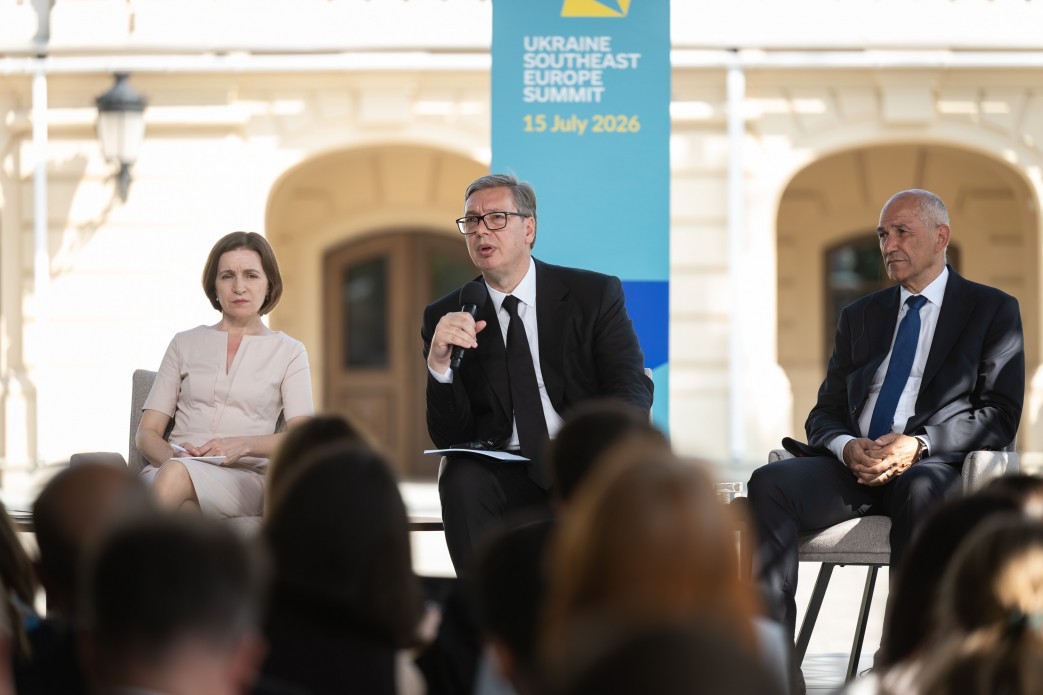
- Ukraine–South-East Europe Summit Held in Kyiv
The summit was attended by President of the European Commission Ursula von der Leyen; the presidents of Albania, Moldova, Romania, Serbia, and Greece, the latter participating online; the prime ministers of Slovenia and Croatia; the First Deputy Prime Minister and Minister of European Affairs of North Macedonia; the Deputy Prime Minister for Foreign and European Affairs of Montenegro; and the Minister of Foreign Affairs of Bulgaria.
The Kyiv Declaration was adopted, in which the summit participants, among other things:
- stressed that “there can be no lasting peace, security, stability, and prosperity in Europe without a sovereign and independent Ukraine” and affirmed their “unwavering commitment to provide Ukraine with comprehensive support”;
- reaffirmed their “condemnation of Russia’s illegal, unprovoked, and unjustified armed aggression against Ukraine” and called on Russia to “end the war immediately”;
- condemned “intensified regular massive attacks on Kyiv and other locations across Ukraine in blatant violation of international law”;
- reaffirmed their “unwavering support for the independence, sovereignty, and territorial integrity of Ukraine within its internationally recognized borders, including its territorial sea”;
- supported “international efforts to ensure accountability for crimes committed against Ukraine, including through the Special Tribunal for the Crime of Aggression against Ukraine”;
- called “for further strengthening sanctions pressure on the Russian Federation”;
- reaffirmed their “readiness to contribute actively to Ukraine’s recovery and reconstruction.”
Serbian President Aleksandar Vučić was the only person present at the meeting in Kyiv who did not sign the Declaration. He did not explain his decision and, after the summit, suggested that journalists read the text themselves, after which, he implied, his explanation would no longer be necessary. As observers noted, this reflected Belgrade’s unwillingness to worsen relations with Moscow and to sign a document that directly condemns Russian aggression, demands that Russia be held accountable for violations of international law, and calls for stronger sanctions against the Russian Federation.
The Declaration also bears no signatures from representatives of Bosnia and Herzegovina or Kosovo, but neither took part in the summit this time. No official explanations were published, but it is likely that no consensus was reached in Bosnia and Herzegovina on participation in the meeting in Kyiv, while representatives of Pristina were not invited by the Ukrainian side because Kyiv does not recognize Kosovo.
The Ukraine–South-East Europe Summit, launched in 2023 to support Ukraine and jointly address the consequences of Russian aggression, was held for the fifth time. Previous meetings took place in Athens, Tirana, Dubrovnik, and Odesa. The next summit will be held in Slovenia in 2027.
- US–Serbia Strategic Dialogue Launched
The first Strategic Dialogue between the United States and Serbia was led in Washington on 17 July by US Secretary of State Marco Rubio and Serbian Foreign Minister Marko Đurić. The meeting took place as Washington and Belgrade marked 145 years of diplomatic relations.
Following the meeting, the two countries issued a joint statement emphasizing their shared objective of strengthening the partnership and expanding bilateral cooperation to promote peace, security, and prosperity.
The signing of a bilateral Memorandum of Understanding on energy infrastructure and regional energy security was announced. As the first project identified under the Intergovernmental Agreement on Energy, Serbia will proceed with the Đerdap III hydropower plant project, also known as Iron Gate III.
Telekom Srbija Group will receive a US$50 million loan guarantee from the Export-Import Bank of the United States for the deployment of a 5G network in Serbia using trusted suppliers, meaning non-Chinese suppliers.
In the security sector, the United States and Serbia committed themselves to accelerating the pace of military engagement, while commending twenty years of cooperation between the Ohio National Guard and the Serbian Armed Forces. In addition, Belgrade submitted a request to purchase products from the US defence industry, which would help improve interoperability between the armed forces of the two countries.
It was stated that the Department of State would allocate US$1.5 million to continue cooperation on humanitarian demining.
In the field of science and technology, Serbia expressed its readiness to sign the Artemis Accords, a set of principles for the transparent, safe, and responsible civil exploration and use of outer space, which would make it possible to expand peaceful cooperation through the exchange of knowledge and scientific data.
The United States and Serbia also signed a Memorandum of Understanding on cost-sharing for the Fulbright Program. Belgrade committed itself to contributing US$300,000 annually to support the expansion of this historic program.
Serbia also announced its intention to open new consulates in Miami and San Francisco.
In Washington and Brussels, the launch of the Strategic Dialogue was assessed as a new stage in relations between the two countries.
Analysts note that, for Belgrade, the development of Serbian-American relations represents a continuation of its multi-vector foreign policy, while for Washington, the intensification of relations with Serbia may indicate a shift in the priorities of its Western Balkans policy.
- Croatia Blocks Montenegro from Closing Chapter 14 in EU Negotiations
At the Intergovernmental Conference in Brussels on 14 July, Montenegro closed two new negotiating chapters—Chapter 8 (Competition Policy) and Chapter 29 (Customs Union). A third chapter that was technically ready for closure—Chapter 14 (Transport Policy)—did not receive support because it was blocked by Croatia.
Croatia stated that, among other things, it had reservations regarding cabotage—the right of foreign carriers to provide domestic transport services in another country. In the Croatian side’s view, Montenegrin companies could offer cheaper services and take part of the market from Croatian carriers, which became the formal reason for the blockage.
The second reason for the blockage was a dispute over aeronautical charts. Croatia believes that their current configuration could weaken its position in the future delimitation of the border with Montenegro. Although flight information region boundaries are neither state nor maritime borders, Zagreb seeks to avoid a situation in which these charts could become an argument for Montenegro in a possible international border dispute.
Croatia has previously blocked the closure of individual chapters. In December 2025, Zagreb blocked the closure of Chapter 31, concerning foreign, security, and defence policy, while putting forward a number of bilateral demands. These included compensation for former inmates of the Morinj camp, changing the name of the swimming pool in Kotor, the return to Croatia of the Jadran training sailing ship, which is currently used by Montenegro, and other issues, mainly related to the war in the former Yugoslavia in the early 1990s.
- Albania to Amend Legislation that Allowed Construction in Protected Areas
Albania will repeal the controversial Strategic Investments Law, while the Law on Protected Areas will be revised and brought into line with European Union standards. Albanian Prime Minister Edi Rama announced this during a press conference in Brussels following the Albania–EU Intergovernmental Conference, at which Albania closed three negotiating chapters for the first time.
The Albanian authorities’ decision to urgently revise environmental and investment legislation was taken against the backdrop of a wave of mass public protests and criticism from the European Union. The crisis was triggered by a large-scale luxury resort project in a protected natural area, which is planned to be implemented by the company owned by Jared Kushner, Donald Trump’s son-in-law. In order to create the conditions for implementing this project, the Albanian Parliament adopted urgent amendments to the relevant laws at the beginning of 2024, allowing the construction of five-star hotels in protected areas.
Against the backdrop of the protests in Albania, the European Parliament adopted a special resolution emphasizing the need to bring the country’s environmental legislation into line with EU standards.
Tirana has responded to the EU’s demands. As Edi Rama stated at the press conference in Brussels, the Strategic Investments Law “must be repealed,” and the government is currently “working closely” with the European Commission on drafting a new law. At the same time, the Law on Protected Areas will not be repealed but will instead be revised on the basis of European standards. “We will change everything that does not comply with them,” the Albanian Prime Minister stated.
- Croatia Initiates Changes to Bosnia and Herzegovina’s Electoral Law to Protect the Rights of Croats in BiH
The Croatian Parliament (Sabor) adopted a Resolution on Strengthening the Political Position of Croats in Bosnia and Herzegovina. The initiative came from the Homeland Movement (Domovinski pokret, DP), a member of the governing coalition, while the final text was the result of a compromise between the coalition partners, the Homeland Movement and the Croatian Democratic Union (HDZ).
The main objective of the document is to protect the constitutional rights of Croats as one of the three constituent peoples of Bosnia and Herzegovina.
The key provision of the Resolution is a call for the creation of a separate electoral constituency for the election of the Croat member of the Presidency of Bosnia and Herzegovina. According to the Croatian side, the current electoral system of Bosnia and Herzegovina allows the more numerous Bosniak population of the Federation of Bosnia and Herzegovina to systematically elect a representative who does not represent the interests of Croats. Thus, Željko Komšić, formally the Croat member of the Presidency of Bosnia and Herzegovina, has won election four times thanks primarily to the votes of Bosniak voters.
Several days after the Resolution was adopted, Speaker of the Croatian Parliament Gordan Jandroković met with the Speaker of the House of Peoples of the Parliamentary Assembly of Bosnia and Herzegovina and leader of the Croatian Democratic Union of Bosnia and Herzegovina (HDZ BiH), Dragan Čović, who was on a working visit to Croatia. During the meeting, Jandroković stressed: “It is extremely important for us to firmly advocate equality and the right of the Croat people to elect their own representatives, and for the legitimate representatives of the Croat people to be elected in the elections to be held in October 2026.”
Čović expressed his “deep gratitude” to the Croatian Parliament “for adopting this Resolution in order to clearly demonstrate how important respect for the equality of peoples is for Bosnia and Herzegovina’s European path and its internal stability,” expressing his conviction that the Bosniaks also understand that this is the foundation of the country’s stability.
However, the Resolution of the Croatian Parliament on Strengthening the Political Position of Croats in Bosnia and Herzegovina provoked outrage among Bosniak politicians.
The Chairman of the Presidency of Bosnia and Herzegovina and the Bosniak member of the Presidency, Denis Bećirović, described the Croatian Parliament’s decision as “unacceptable interference by Croatia in the internal affairs of a sovereign and independent state.” According to him, the adoption of such resolutions violates the principles of international law and the UN Charter, while issues concerning the country’s constitutional and electoral system can be resolved exclusively within the institutions of Bosnia and Herzegovina itself.
The Minister of Foreign Affairs of Bosnia and Herzegovina, Elmedin Konaković, stated that Croats in Bosnia and Herzegovina “have more rights than they are entitled to under the law” and that they obtained this status at the expense of limiting the rights of the Bosniak people. He announced a special conference to be held in Sarajevo on 5 August, which is intended to provide a substantive response to the Croatian side’s claims.
- Court in North Macedonia Acquits Gruevski and Returns VMRO-DPMNE Property
The Basic Criminal Court in Skopje issued acquittals in the high-profile criminal cases “Talir 1” and “Talir 2.”
The “Talir 1” case concerned allegations of the systematic illegal financing of the VMRO-DPMNE party between 2009 and 2015 in the amount of approximately €4.6 million. According to the investigation, the funds were deposited into party accounts in the names of individuals who were often not even aware of it. However, the court delivered an acquittal.
The “Talir 2” case concerned an agreement between VMRO-DPMNE and the construction company Beton on the construction of the party’s headquarters in Skopje, the so-called “White Palace” (Belata palata). Under the new judgment, the previous decision to confiscate the building in favour of the state was overturned, and all claims against VMRO-DPMNE were fully withdrawn.
In addition, former Prime Minister and former VMRO-DPMNE leader Nikola Gruevski was acquitted in the “Talir 2” case. Previously, in June 2022, Gruevski had been sentenced by the court of first instance in the “Talir 2” case to six years’ imprisonment. The new acquittal resulted from amendments to the Criminal Code adopted in 2023, while the previous government was still in power. It should be recalled that Nikola Gruevski is currently in Hungary, where he was granted political asylum while Viktor Orbán was already in power.
Prime Minister of North Macedonia and VMRO-DPMNE leader Hristijan Mickoski welcomed the decisions, calling the “Talir 1” and “Talir 2” cases fabricated and accusing the previous government of political persecution. According to him, the court’s decision concerning VMRO-DPMNE “is a verdict that is consistent with justice and with all citizens’ expectations.” “Justice has finally prevailed,” he stressed.
Regarding Gruevski’s acquittal, Mickoski noted that the decision had been made possible by legislative amendments adopted under the previous government, which was led by SDSM.
The now-opposition Social Democratic Union of Macedonia (SDSM) assessed the acquittal of former Prime Minister Nikola Gruevski in the case and the reversal of the confiscation of VMRO-DPMNE’s assets as further evidence that the judiciary is under political control. “The judiciary and the prosecution, under Mickoski’s control, saved Nikola Gruevski from accountability in the ‘Talir 2’ case and unfroze VMRO’s criminal assets,” the SDSM spokesperson stated.
Independent analysts noted that the acquittal of former Prime Minister Nikola Gruevski on corruption charges is an alarming signal that politicians who abuse power in North Macedonia will never be held accountable.