The detention in Montenegro of Mikhail Zvinchuk, founder of the Russian propaganda network Rybar, and members of his team attracted attention not only because of the circumstances of their trip. The case raised the question of how a person under European Union sanctions was able to enter unhindered a country that is a candidate for EU membership and a NATO member. The group’s subsequent deportation, the seizure of equipment and suspicions of propaganda and possible recruitment activities revealed the broader scale of Rybar’s influence in the Balkans and the risks that remain even after its representatives have been expelled.
Detention
On 9 October, Montenegrin police detained Mikhail Zvinchuk, founder of the Russian propaganda network Rybar («Рыбарь»), his wife and three of his associates, who had entered Montenegro less than two days earlier and were staying at a hotel in Risan, in the municipality of Kotor.
During the operation, Montenegrin law enforcement officers confiscated a drone, high-resolution video cameras, a GoPro camera and several mobile phones. The seized equipment was sent for examination and analysis “in order to determine its purpose and the purpose of its use on the territory of Montenegro”.
In its statement, the Police Directorate described Mikhail Zvinchuk as the head of and a participant in the Russian political-hybrid network Rybar, noting that “because of this activity, the European Union imposed on him a restrictive measure in the form of a ban on entry into and transit through the territory of EU Member States in connection with activities that undermine or threaten the territorial integrity, sovereignty and independence of Ukraine”. “Thanks to the timely and coordinated response, the security and intelligence sector authorities prevented potentially harmful activities by these individuals on the territory of Montenegro, confirming the determination of the institutions to consistently enforce the law, protect national security and strengthen the rule of law as key principles on which European integration and the fundamental values of modern Europe are based,” the statement emphasised.
Commenting on the detention, Prime Minister Milojko Spajić noted in a post on X that his government had previously warned that “attempts at hybrid activity and the destabilisation of Montenegro” accompany the country’s European path. “The message following today’s successful action in which the head of the information network ‘Rybar’ was apprehended is clear: out institutions are doing their job, Montenegro is protecting its interests, and no one will jeopardize our European future,” he stressed.
How Rybar Got into Montenegro
The question remains open as to how a person under Western sanctions, including European Union sanctions, managed to enter a country that is the No. 1 candidate for EU membership and has supposedly aligned itself with all European restrictive measures, while also being a NATO member.
According to media reports, the Russian national entered Montenegro from Bosnia and Herzegovina (Republika Srpska), through the Zupci–Sitnica border crossing.
Zvinchuk claims that while he was passing through border control, the officers simply did not pay any particular attention to him. The media quote a post he made on Telegram immediately after entering Montenegro, in which he wrote: “Remember: even if you are under sanctions, like me, even if you have a travel ban, like me, even if you are traveling to a country that has pledged, out of solidarity, to enforce that travel ban, as in my case … THERE IS A WAY! You can always run into an idiot border guard who turns out all your pockets but forgets to check the database (as in my case).”
On 10 October, the Office of Montenegro’s President Jakov Milatović called for clarification of the circumstances surrounding Mikhail Zvinchuk’s unrestricted entry into Montenegro, describing him as “known for his activities within the Russian military blogger network Rybar”. “Given that Zvinchuk is on the European Union sanctions list, with whose restrictive measures Montenegro harmonises its legislation, it is important to establish how he entered Montenegro, determine what information the competent authorities had at their disposal and whether all procedures were carried out in accordance with the applicable regulations,” the presidential administration stated. “It is also necessary to establish whether there had been prior communication with partner security services, whether the competent institutions had information about his arrival and what measures were taken during his stay in Montenegro.” It is important “for the relevant security authorities to clarify the circumstances of this case”, establish “all relevant facts” and, “within the scope of their authority”, provide the Council for Defence and Security with “information on the circumstances of this case and the measures taken”, the statement said.
Deportation
Following the operation conducted by Montenegrin police and security services to detain the Rybar group and seize their equipment, it was decided to deport the Russian propagandists to Russia. “Following a criminal, operational and intelligence investigation, it was established that these individuals could not continue their stay in Montenegro, and in accordance with the Law on Foreigners, a decision was made to expel them from Montenegro for reasons of the state’s national and internal security,” the police said. Zvinchuk claims that during his stay in Montenegro, the local police sent inquiries to Interpol and Europol, but these organisations showed “no interest in him”, and there were no arrest warrants or extradition requests. As a result, the five Russian citizens were expelled from Montenegro to Russia several hours after their detention.
On 11 October, Mikhail Zvinchuk, his wife and three employees of the Rybar project returned to Russia on a Belgrade–Moscow flight.
According to Mikhail Zvinchuk, the key role in securing the release of his group was played by Russian Foreign Ministry spokesperson Maria Zakharova, who coordinated the work of the Russian embassies in Montenegro and Serbia. Overall, he says, the process involved the Russian government, the Ministry of Foreign Affairs, Russian intelligence services, RT head Margarita Simonyan personally, Deputy Chairman of the Security Council of the Russian Federation Dmitry Medvedev, the Technodinamika holding company and Rostec State Corporation (manufacturing of weapons and military equipment; aircraft manufacturing), which is considered the main source of funding for the Rybar project.
What Rybar Was Fishing for in Montenegro
Zvinchuk insists that he and his team were detained after they submitted an official request to film the Cetinje Monastery.
According to Montenegrin media, the security services suspected that the Russians’ aim was not to prepare a report about religious and historical sites, but to conduct a propaganda campaign against the planned alignment of Montenegro’s visa policy with European Union standards. This content “was intended to present European integration as a politically imposed process with negative consequences for tourism, economic stability and Montenegro’s national interests”.
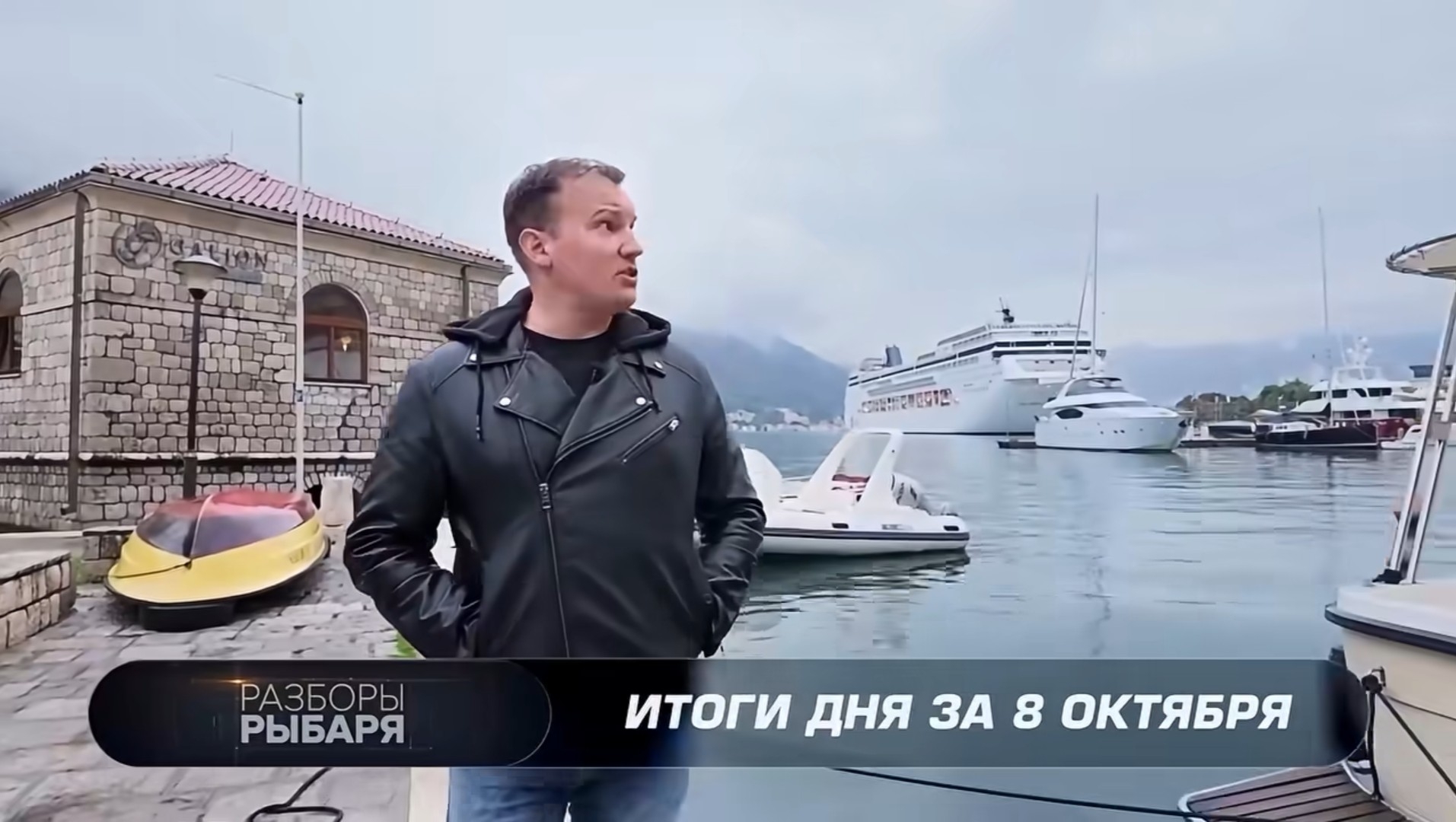
Indeed, in the 8 October edition of “Rybar’s Analysis — Daily Roundup”, which Zvinchuk recorded while standing on the shore of the Bay of Kotor, he touched on the visa issue: “We are continuing our series of documentaries from the Balkans. And right now we are enjoying a weeping Montenegro. They have not seen rain like this here for a long time, especially at this time of year. Usually, this kind of weather comes in winter. They say Montenegro is crying because it is introducing visas for Russians.” He stressed that “this will primarily hit the tourism sector, while official Podgorica will miss out on a huge amount of revenue” — in other words, he was voicing precisely the narrative that the Montenegrin authorities consider aimed at undermining the country’s European integration efforts.
Propagandist or Recruiter?
Another reason for the Montenegrin security services’ concerns regarding Zvinchuk was his support for Russian aggression against Ukraine.
The European Union’s individual sanctions against the founder of the Rybar project were imposed for actions that undermine or threaten the territorial integrity, sovereignty and independence of Ukraine. According to the European Union’s statement, this concerns not only informational support for the “special military operation”, but also Zvinchuk’s direct involvement in the war through his participation in the working group coordinating Russia’s mobilisation efforts, which was established by decree of Vladimir Putin in December 2022.
The founder of the Rybar project said that during his detention, Montenegrin police officers asked whether he and his group had actually come to Montenegro in order to recruit foreigners to participate in the “SMO”. Thus, concern that the Russians would set up a Russian army “recruitment centre” in a NATO country was, if not the main reason, then a significant one for the expulsion of Zvinchuk and his team.
Rybar Left, but Promised to Return
Rybar’s activities in Montenegro did not begin with the current trip and will probably not end with it.
“Measures against individual persons do not mean that the network’s ability to operate has ceased. Local contacts, affiliated portals, distribution channels and organisational support may remain active even after the departure or detention of its representatives,” the Digital Forensic Center (Podgorica) states.
Marko Banović, a DFC analyst, stresses in an interview with DW: “In addition to spreading Russian propaganda and disinformation, Rybar’s activities in the region have so far included training, links with local actors and the provision of knowledge and technical support for conducting information campaigns. Therefore, expulsion may be a justified preventive measure, but it is also necessary to examine the possible network of cooperation that remains in the country after their departure.”
In addition to its established links with Montenegrin supporters of the “SMO”, Rybar can work with Montenegro through neighbouring Serbia and Bosnia and Herzegovina, which have not joined and do not intend to join the European sanctions.
Zvinchuk himself says the following about his future plans: “For us, this business trip to the Balkans will be far from the last, because my team has worked there and continues to work there. We have established close cooperation with local structures.”
CWBS Analytical Group