Bosnia and Herzegovina General Election Results Raise Concerns Among Experts
On 4 October, general elections were held in Bosnia and Herzegovina, in which citizens elected officials and deputies to state-level government bodies and to the bodies of the two entities — the Federation of Bosnia and Herzegovina and Republika Srpska. The Brčko District also participates fully in the electoral process.
According to the country’s Central Election Commission, voter turnout was around 42 per cent, indicating a decline in participation of approximately 10 percentage points compared with the previous general elections.
More than 3.4 million voters were entered in the Central Voters Register, while voting was organised at more than 5,500 polling stations in the country and at 20 diplomatic and consular missions abroad.
These elections were the first in which biometric voter identification, ballot scanners and electronic transmission of results were used nationwide. The innovations were aimed at preventing electoral fraud.
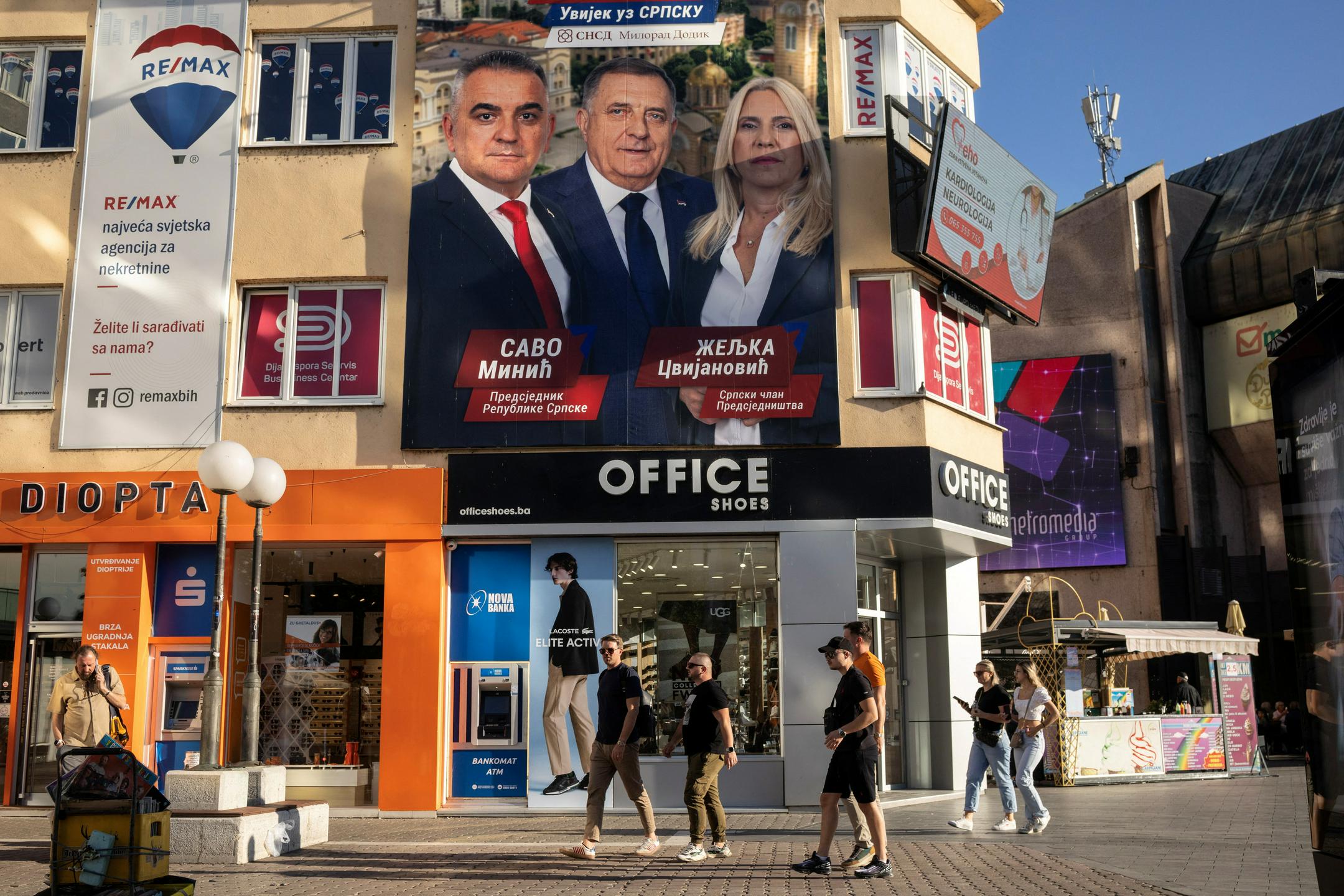
At the state level, elections were held for the three members of the Presidency of Bosnia and Herzegovina. According to preliminary vote counts, Denis Bećirović of the Social Democratic Party of Bosnia and Herzegovina retained the position of Bosniak member of the Presidency. Darijana Filipović of the Croatian Democratic Union of Bosnia and Herzegovina (HDZ BiH) won the position of Croat member of the Presidency. Željka Cvijanović of the Alliance of Independent Social Democrats (SNSD) remained the Serb representative in the Presidency.
At the state level, voting was also held for 42 members of the House of Representatives of the Parliamentary Assembly of Bosnia and Herzegovina.
In the Federation of Bosnia and Herzegovina, 98 members of the House of Representatives of the Parliament of the Federation of Bosnia and Herzegovina were elected, as well as deputies to the assemblies of the 10 cantons that make up this entity. According to the voting results for the House of Representatives of the Federation of Bosnia and Herzegovina, the Party of Democratic Action (SDA), led by Bakir Izetbegović, received the largest number of votes.
In Republika Srpska, voters cast their ballots for the president of Republika Srpska and two vice-presidents of Republika Srpska, as well as for members of the National Assembly of Republika Srpska (NSRS). In the NSRS, the ruling party, the Alliance of Independent Social Democrats (SNSD), led by Milorad Dodik, retained its leading position. Savo Minić, the SNSD candidate, the incumbent prime minister of Republika Srpska and Dodik’s closest associate, is leading the race for the presidency of Republika Srpska.
Preliminary parliamentary election results indicate that the leading parties representing the three constituent peoples of BiH — Bosniaks, Serbs and Croats — namely the SDA, SNSD and HDZ BiH, retained or even strengthened their positions. On the other hand, multinational, civic parties such as the Democratic Front (DF) and Our Party suffered a noticeable decline.
The election results in BiH have caused concern among political experts. In their view, the current balance of power could lead to increased political turbulence. In addition, doubts are being expressed as to whether the new BiH authorities at the state level will be able to implement the reforms necessary to unblock the country’s path towards the EU.
- Kosovo Parliament Adopts Amendments to the Law on the Specialist Chambers and Elects a New President
The decisions adopted late in the evening of 6 October and during the night of 7 October made it possible to avoid the dissolution of parliament and the calling of early elections because a president had not been elected within the time limits established by the Constitution.
Amending the law on the Specialist Chambers was a key demand of the opposition parties, which refused to support any candidate for president until the law was revised.
Political tensions rose sharply after the Kosovo Specialist Chambers in September delivered first-instance judgments against four former leaders of the Kosovo Liberation Army (KLA), including former Kosovo President Hashim Thaçi, former speakers of the Kosovo Parliament Kadri Veseli and Jakup Krasniqi, and former MP Rexhep Selimi, finding them guilty of war crimes. The total sentence imposed on the four defendants amounted to 81 years.
The judgments triggered a wave of protests. Veterans’ organisations demanded that parliament defend the honour of the liberation struggle and restrict the powers of the court, which, in their view, is criminalising Kosovo’s history. On the eve of the vote, clashes occurred between protesters and police in Pristina, further increasing pressure on MPs.
The amendments adopted by parliament will substantially narrow the jurisdiction of the Kosovo Specialist Chambers in The Hague, limiting it to alleged organ trafficking and crimes directly related to the allegations set out in Dick Marty’s 2011 report for the Parliamentary Assembly of the Council of Europe. Their jurisdiction will also be limited to crimes committed only during the period from 1 July 1999 to 31 December 2000. The amendments to the law provide for the transfer to Kosovo institutions of cases that no longer fall within the jurisdiction of the Specialist Chambers.
The MPs also limited the term of imprisonment that may be imposed by the Specialist Chambers to 15 years, provided for sentences to be served in Kosovo, the possibility of a presidential pardon and international oversight of the Chambers’ activities.
Immediately after the final vote on the amendments to the law on the Specialist Chambers, the MPs proceeded to elect the president.
The compromise candidate was 72-year-old Justina Shiroka Pula, whom Prime Minister Albin Kurti proposed as a figure capable of uniting different political camps. Shiroka Pula has had a long career in state institutions, headed the Kosovo Academy of Sciences and Arts and is known for her research on the country’s economic development. Her candidacy was supported by 81 of the 120 MPs — both from the ruling party and from part of the opposition — which made it possible to secure the required number of votes.
The political compromise and the adoption of the two decisions — on amending the law on the Specialist Chambers and on electing the president — made it possible to avoid early elections, but caused a new crisis in Pristina’s relations with its Western partners. In particular, the European External Action Service stated that the amendments and additions to the law on the Specialist Chambers run counter to Kosovo’s international commitments to the EU.
- Serbia to Cooperate with Kazakhstan in Arms Production
The Kurultai (parliament) of Kazakhstan ratified the Agreement on military-technical cooperation with Serbia, which was signed, on 29 November 2023.
The agreement provides for mutual supplies of military products, including weapons and military equipment, as well as the exchange of information in the military-technical sphere.
Defence enterprises of the two countries have already begun cooperating. In February 2026, the first meeting of the Kazakhstan-Serbia Business Council and the first Kazakhstan-Serbia Business Forum were held in Astana, where, among other things, the Kazakhstani company Kaztechnology and Serbia’s Jugoimport SDPR concluded an agreement on the repair and modernisation of Serbian artillery systems. Jugoimport also signed a framework agreement with Great Sky on technology transfer and the organisation of production of high-energy materials.
According to Kazakhstani media, as part of the national ASPAN project, Great Sky is constructing four new plants in Kazakhstan for the production of artillery shells and mines that will comply with NATO standards. The total cost of the project will amount to approximately $1 billion.