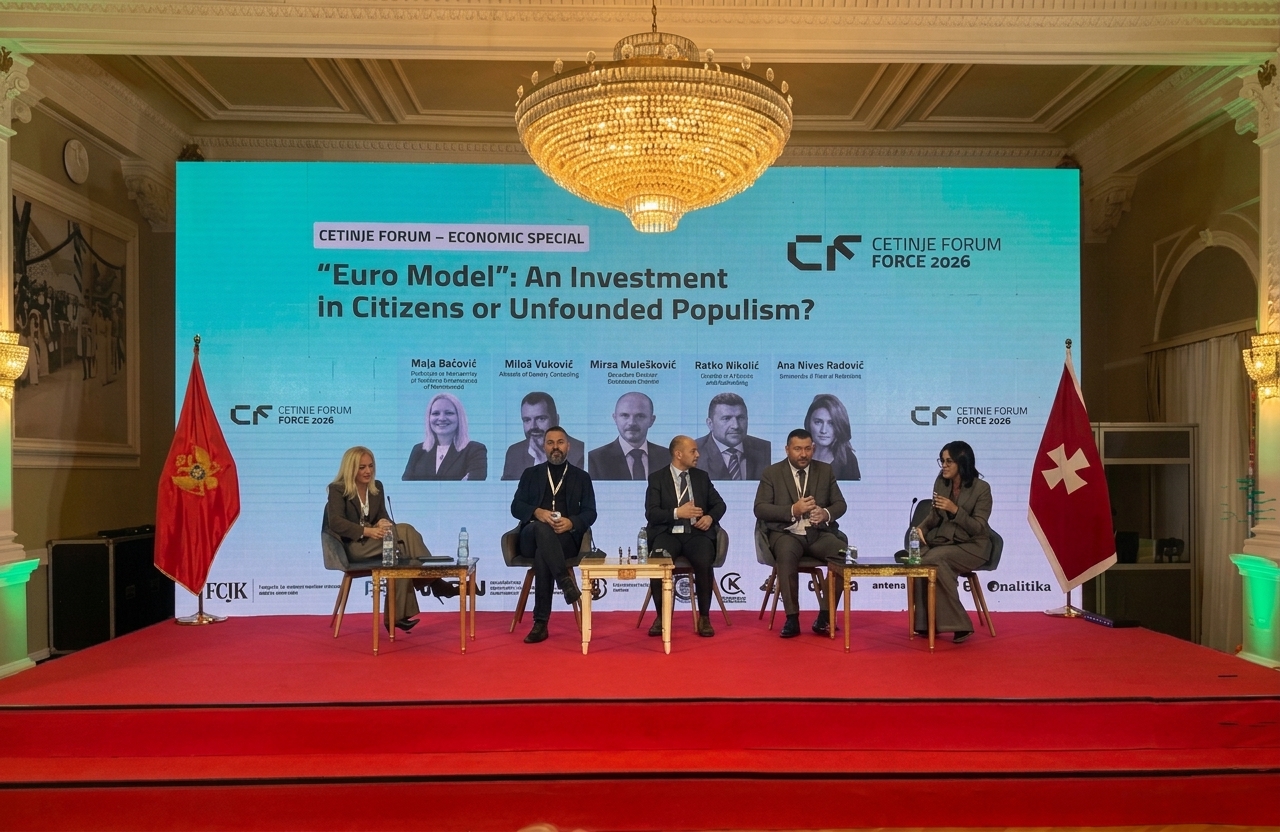
“Greetings from a free Serbia!” Exclamations like these were repeatedly heard from Serbian guests at the two international conferences PLENUM2026 and Cetinje Forum FORCE2026, which took place in Podgorica and Cetinje on 9–12 November (November in Montenegro is traditionally packed with expert events). And there was a sense of genuine optimism in them. After fourteen years of rule by Aleksandar Vučić and the Serbian Progressive Party (SNS), his political camp finally suffered defeat, while the long-running student protest movement won a convincing victory in the parliamentary elections.
The Serbian presence at both events, incidentally, proved particularly strong. Historian Milivoj Bešlin, Director of the Regional Academy for Democratic Development Balša Božović, politician Borko Stefanović, former member of the Serbian National Assembly Nada Kolundžija and other participants readily shared their expectations of the coming changes. After years of sharp disputes over Serbian policy towards its neighbours, the atmosphere was unusually positive. There was talk of democracy, freeing state institutions from party control, reconciliation in the region and the possibility of finally leaving behind the political practices of the 1990s.
But a change of government does not yet mean a change in political culture and foreign policy priorities. The winners’ programme demonstrates this clearly.
On 12 November, representatives of the Student List, Dejan Šoškić and Miodrag Krmar, met with Russian Ambassador Aleksandr Botsan-Kharchenko. According to the embassy, they discussed bilateral relations and Moscow’s support for the Serbian position on Kosovo. On the same day, other representatives of the movement met with U.S. Assistant Secretary of State Brendan Hanrahan.
Ordinary diplomatic contacts by the future authorities, but quite revealing: Serbia is unlikely to abandon its balancing between the West, Russia and China quickly. Democratic changes at home look more promising than a geopolitical pivot.
A Victory the Traditional Opposition Could Not Achieve
In the snap election on 25 October, the Student List (Studentska lista – Studenti pobeđuju) won 140 of the 250 seats in the National Assembly. More than 2.35 million citizens, around 53 per cent, voted for it. Vučić’s bloc won 103 seats, while representatives of national minorities won seven.
Vučić himself had stepped down as president early at the end of September, expecting to return to executive power after the election, this time as prime minister. However, the students’ victory thwarted his plans. The first sitting of the new parliament is scheduled for 17 November, after which the process of forming a government will begin.
The protests were triggered by the tragedy of 1 November 2024, when 16 people were killed in the collapse of the canopy at the Novi Sad railway station. The disaster grew into a nationwide discussion about corruption, opaque public contracts and the lack of accountability of officials.
The students demanded that those responsible be identified and that documentation concerning the reconstruction be made public. They were joined by lecturers, civic activists and representatives of various professions. The protests spread across the country, while attempts to discredit their participants only intensified the discontent.
Ultimately, the students managed to do what Serbia’s divided opposition had been unable to achieve for years. They united citizens with very different views around relatively simple demands: to put an end to corruption, restore the rule of law and compel state institutions to operate in accordance with the law.
Kosovo, Russia, national identity and geopolitical choice remained in the background for a long time. This helped preserve the movement’s unity, but these issues can no longer be postponed.
The Student List does not have a single ideology. Its representatives include pro-European figures, moderate conservatives and supporters of traditional national views. The desire to remove Vučić united them; decisions of government will require more complex compromises.
Moreover, the SNS’s electoral defeat does not yet mean the dismantling of the entire system it built over fourteen years. More than 1.7 million citizens voted for Vučić’s list. His political camp retains significant influence in local government, the state apparatus, economic structures and the media.
The new majority will have to reform the prosecution service, courts, security services, state-owned enterprises and the system of appointments. The depth of the political break depends on this, rather than simply on a change of prime minister or other senior officials. And so does whether 25 October becomes the beginning of a genuinely new political era.
The Student List and Traditional Serbian Interests
The winners’ foreign policy programme raises the greatest number of questions: it is more conservative than some of their liberal supporters had expected.
The Student List supports Serbia’s military neutrality and does not envisage joining NATO.
Its position on Russia is also fairly traditional. The programme explicitly calls for preserving the partnership with Moscow, primarily on issues concerning support for Serbian interests in the UN Security Council and the settlement of the Kosovo issue. At the same time, the winners do not support imposing sanctions on the Russian Federation, citing, among other things, the historical experience of international sanctions against Serbia itself in the 1990s.
At the same time, they recognise Ukraine’s territorial integrity and internationally recognised borders. Thus, support for Ukrainian sovereignty is combined with an intention to preserve special relations with the aggressor state.
After the election, the prime candidate on the Student List, Professor Ilija Srdanović, somewhat softened the categorical nature of earlier statements regarding sanctions. In an interview with Radio Free Europe/Radio Liberty, he stressed that such foreign policy decisions should be made after an open public debate and should reflect the will of the citizens. The possibility of revising the current position therefore remains, although there is as yet no concrete decision to hold a referendum.
Given widespread pro-Russian sentiment and the Kosovo factor, Belgrade cannot be expected to join European sanctions quickly.
A certain ambiguity is also present in the programme section on the European Union. Brussels is described as Serbia’s main economic partner, while further cooperation with the Member States is defined as one of the priorities. Reforms in the areas of justice and fundamental rights, the expansion of economic ties and the attraction of European funding are envisaged. However, the objective of full EU membership itself is not explicitly formulated in the document.
After the election, Srdanović confirmed the intention to continue European integration. However, Serbia opened its last new negotiating chapter back in 2021, and further progress depends not only on reforms but also on relations with Kosovo and alignment of its policies with the EU.
The situation with Kosovo is even more complicated. The Student List continues to regard it as an integral part of Serbia, opposes the territory’s independence and its membership in international organisations. A review of the previous authorities’ agreements with Pristina is envisaged, primarily with regard to their compliance with the Serbian Constitution.
In fact, the winners’ position does not differ greatly from traditional Serbian state policy. Further dialogue under EU auspices will apparently continue, but no rapid breakthroughs should be expected for now.
In the case of Bosnia and Herzegovina, the Student List stresses the preservation of Republika Srpska’s constitutional powers, including its right of veto in state-level institutions and its property claims. It proposes reviewing the practice of applying the so-called Bonn Powers of the High Representative of the international community and continuing to develop the special relationship between Belgrade and Banja Luka.
No abandonment of Serbia’s traditional role in the affairs of the Bosnian Serbs is envisaged. Of course, such programme provisions do not in themselves amount to support for Milorad Dodik’s separatist ambitions. But there are also no grounds at present to expect a fundamental revision of Serbian policy towards Bosnia and Herzegovina.
In Montenegro, the students promise to protect the national and cultural identity of Serbs and seek a settlement of the issue of dual citizenship.
For Podgorica, this is a sensitive issue: some politicians fear the effect of new rules on the electoral balance and increased dependence on Belgrade. The problem lies not in support for compatriots as such, but in the possible methods of political influence.
Thus, Serbia’s traditional foreign policy priorities may outlive Vučić. The question is whether the methods used to pursue them will change.
After Vučić: Optimism and the Burden of the Nineties
At the PLENUM 2026 forum, former Serbian MP Nada Kolundžija gave a fairly harsh assessment of the political legacy of the previous authorities. According to her, the Vučić regime not only restricted freedoms but also deliberately spread hostility, used nationalist rhetoric to preserve its hold on power and conceal large-scale corruption.
At the same time, she urged Serbia’s neighbours not to demand immediate answers from the winners on Kosovo, the wartime past and other painful issues. In her view, excessive pressure could complicate the democratic transition.
Kosovan commentator Veton Surroi drew attention to another problem at PLENUM. In his view, for years the West regarded Vučić as a guarantor of regional stability precisely because of his ability to disrupt that stability. International partners expected the Serbian leader to refrain from dangerous steps in exchange for political support and recognition.
This model, known as “stabilocracy”, made it possible for years to postpone questions of democracy, media freedom and state institutions for the sake of the relative predictability of regional processes. And it ultimately created a political system in which control over society became far more important than its development.
At FORCE26 in Cetinje, prominent Serbian opposition MP Borko Stefanović acknowledged that Belgrade itself must be the first to extend a hand to its neighbours and demonstrate readiness for change after years of confrontational policy. This sounded particularly significant in Cetinje, which in Serbian-Montenegrin relations has traditionally been associated with a distinct Montenegrin national identity. Stefanović even remarked that, for the first time in a long while, he was pleased to be a citizen of Serbia at such an event.
The reflections of historian Milivoj Bešlin were particularly substantive. In his view, the Western Balkans remain to a large extent hostages to the consequences of the Yugoslav wars of the 1990s. The political and territorial order formed at that time continues to determine relations between states, while attempts to revisit long-standing disputes regularly return the region to the same conflicts. Bešlin even suggested that only another major upheaval, up to and including another regional or world war, could radically alter this historical context. In other words, he was referring to the depth of the political inertia left behind by the wars over the Yugoslav succession.
At the same time, the historian does not deny the possibility of positive change at all. On the contrary, he believes that even under the current circumstances the countries of the region are capable of making significant progress in reconciliation, rebuilding trust and developing normal cooperation. This does not require new borders or another historical catastrophe.
He expects the new Serbian authorities to focus more on the courts, security services, education and the media than on disputes with neighbours. Bešlin assesses the potential for these reforms as even greater than after Milošević’s fall in 2000.
Balša Božović spoke much more harshly about the future. He is convinced that Serbia must not repeat the mistakes of the democratic transition of the early 2000s, when a significant part of the former political and security structures retained their positions. In his view, reform of the security services, the opening of archives, accountability for corruption and proper investigation of crimes committed in previous decades are necessary.
Božović also spoke about the former Serbian leadership’s links with political circles in Montenegro, Bosnia and Herzegovina and Kosovo. He believes that these informal mechanisms may outlive Vučić.
There is a rational basis for this assessment. During Vučić’s years in power, Serbia did indeed build an extensive system of political, media, economic and personal contacts with representatives of Serbian communities in neighbouring states. Some of these ties existed long before he came to power and have their own social foundations.
Their future will therefore depend not only on a change in the political leadership in Belgrade. More important is whether the practice of using regional disputes for domestic mobilisation and the strengthening of political influence will continue.
What Will Change for the Region and Ukraine?
Aleksandar Vučić remained one of the key players in the Western Balkans for years: from negotiations with Kosovo to relations with Banja Luka and Podgorica. A change of government may make these relations less personalised and more predictable, but it will not in itself eliminate Serbian national priorities.
For Montenegro, the issues of dual citizenship, the status of the Serbian language, relations with the Serbian Orthodox Church and Belgrade’s influence on local politics will assume particular importance. Podgorica is in the final phase of negotiations on EU accession, and therefore stable relations with its largest neighbour remain an important condition for its political development.
In Bosnia and Herzegovina, attention will focus on whether the new authorities distance themselves from the confrontational actions of the Republika Srpska leadership. Pristina, meanwhile, has no grounds to expect a rapid softening of the position on Kosovo’s independence.
For Ukraine, Serbia’s democratisation opens certain opportunities: more independent institutions and oversight of opaque financial ties could narrow the space for Russian influence. However, the winners’ programme does not envisage abandoning the partnership with Moscow. Energy dependence, Kosovo and public sympathies towards the Russian Federation will continue to influence Belgrade’s course. Much will depend on the concrete decisions of the future government, above all on sanctions, international cooperation and security policy.
Successful domestic reforms could at the same time restore European partners’ trust in Serbia after years of stagnation in the accession negotiations.
After the overthrow of Slobodan Milošević on 5 October 2000, Serbia also went through a period of great expectations. It seemed that the fall of the authoritarian regime would open the way to rapid democratisation and a reassessment of the political legacy of the 1990s. But a significant part of the old structures retained their influence, while many painful questions remained unanswered.
It is no coincidence that Božović in Cetinje once again spoke about the need for a genuine “6 October”, meaning the completion of the reforms that were not carried out after Milošević’s fall.
The coming months will show how quickly the new authorities can move from protest slogans to concrete reforms. What will matter is not only appointments, but also the genuine independence of the courts, the work of the prosecution service, media freedom and the willingness to investigate abuses committed in previous years.
Foreign policy changes are likely to be slower. Criticism of authoritarianism in Serbia is entirely compatible with conservative views on Kosovo, Russia and neighbouring countries.
Nevertheless, the very possibility of speaking more calmly about relations with neighbours, the wartime past and the state’s responsibility for its own policies constitutes a certain degree of progress after many years of aggressive rhetoric.
The students’ victory gave the country an opportunity to change the rules of political life. How deeply they are able to do so will be demonstrated by the work of the new government, not by the election result itself.
While greetings “from a free Serbia” were being heard in Podgorica and Cetinje, preparations were under way in Belgrade for the more mundane task of forming a government. It is there that the justification for November’s optimism will be tested.
CWBS Analytical Group