Anti-government protests have been held every day for four and a half months. Now demonstrators are demanding that Prime Minister Edi Rama resign, something unprecedented in Albania since the fall of the communist dictatorship in 1991.
Over the summer, many people learned about the Flamingo Revolution: the mass peaceful protests against the resort Jared Kushner and Ivanka Trump plan to build in the protected Vjosa-Narta area and on Sazan island, where flamingos live among a wealth of other bird species. Just the place for a resort!
AI-generated concept art suggested that Trump and Kushner think “eco-friendly” means a giant resort with neutral brown walls and a few shrubs. No environmental impact study was deemed necessary, and Rama gave the go-ahead to start fencing and building immediately. On May 31st, locals protested and were met with unprecedented brutality from paid goons masquerading as private security, while police watched with arms crossed and eyes lowered. The next day, the protest moved to Tirana and drew an astounding crowd, and it quickly grew into a protest against the entire political system.
For 137 days the protests stayed completely peaceful. We achieved a few minor victories, but mostly met intimidation, contempt and indifference from Rama. One of the worst slaps in the face was the 4.2 million euros donated to Kanye West’s concert, taken from our emergency fund while wildfires ravaged Albania and our main public hospital ran a GoFundMe over its miserable conditions.
How the Flamingo Protest Escalated
As summer went on, the number of protesters dwindled. Unwilling to let our effort go to waste, we hoped students would reignite the protest when the new school year began. The students, fed up with the sorry state of the Albanian education system, boycotted universities and high schools and took to the streets in violent demonstrations.
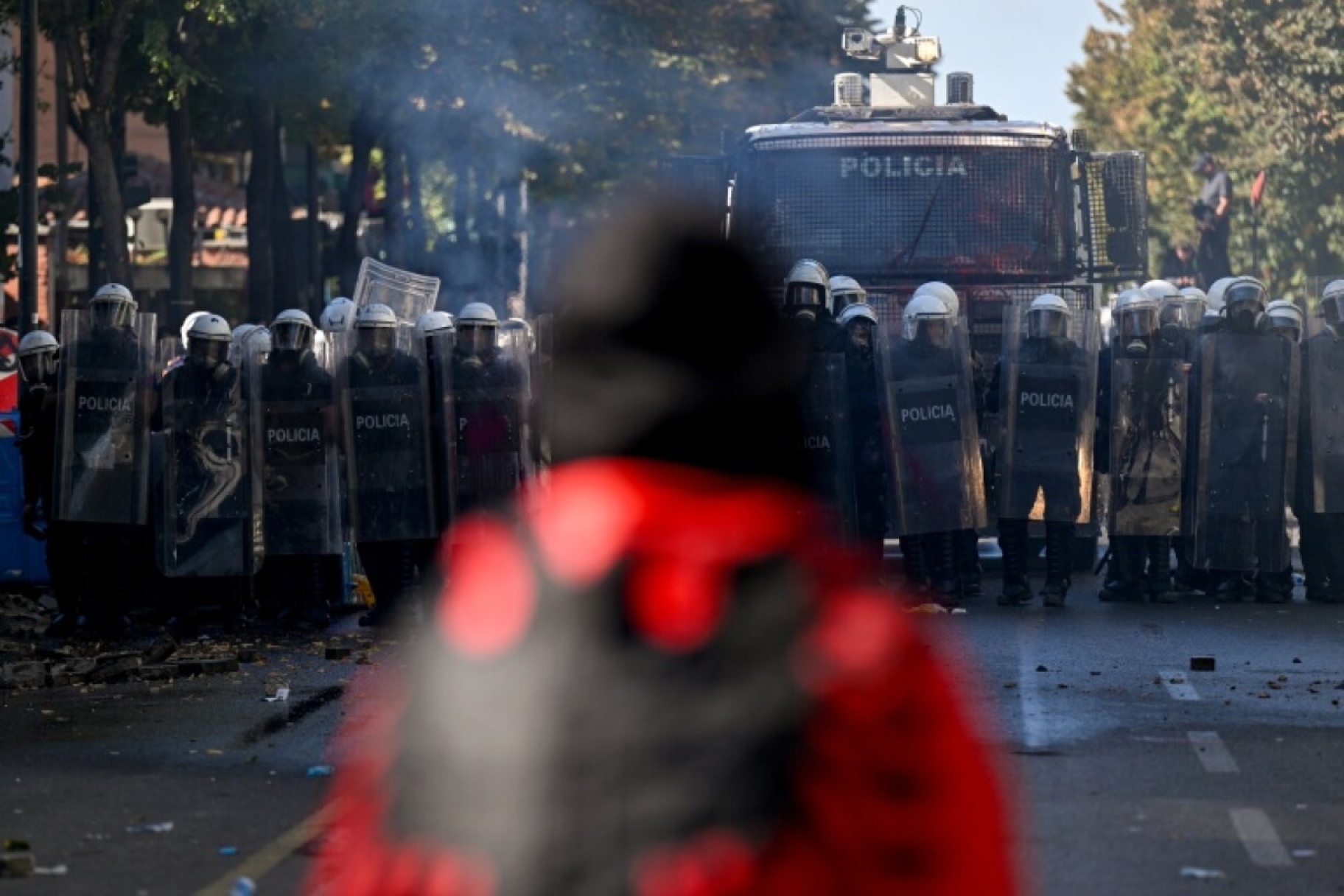
Since 13 October, government buildings have been set on fire, banks and businesses wrecked, street signs torn down, bins set ablaze and cobblestones ripped up to throw at police. Gone are the peaceful evening gatherings with pink flamingo signs and children’s areas. Protests now run from morning until well after midnight. Though long stretches still remain peaceful, everyone acknowledges that violence could erupt at any time.
The State’s Response
The police response has been a growing catalogue of human rights violations: beatings with batons and iron bars; rubber bullets fired at the upper body and head, blinding at least two protesters; near-constant tear gas; water cannons; abductions by plainclothes officers who show no badge, so you can’t tell if you’re being arrested or trafficked; and mass illegal arrests, including of minors, with many stories of extreme abuse in police stations. Injured protesters are turned away from hospitals or arrested at the door, and police follow people home to arrest them in the morning.
Even emergency services have been turned against us. An ambulance regularly drives through the crowd, and protesters always step aside, assuming someone needs help. But it is usually full of police who throw tear gas into the crowd, or it only carries supplies to police. Our makeshift first aid and food point has also been repeatedly hit with water cannons and tear gas.
Journalists have not been spared either: many have been intimidated or outright attacked by police.
Recently, people I assume were police, since they never showed a badge, stopped me in the street and made me empty my bag and show my latest phone photos. This is what the state unleashes on young people who want a better life.
Police at the front of the protest were also awarded a bounty of 2,500 euros each, about what was left of our emergency fund. Rama claims anyone near a violent protester will be treated as violent and arrested. He claims that a special governmental group has been formed to blacklist protesters, claiming that they will be forced to pay for damages, won’t be allowed on public transportation like trains (Albania has no trains), stay at hotels, travel to EU countries and more.
Dialogue or Resignation
Our prime minister, a former artist, has been staging a strange art exhibit: every day, different chairs on the steps to his office with pieces of paper reading “dialogue” on them. Protesters see this for the trap it is and refuse. This is the exact same way Rama defused the massive student protests of 2018, negotiating their demands down to the bare minimum – which remains unfulfilled. The only thing they ask of him is to resign.
Rama says he won’t resign. He accuses the opposition of orchestrating the unrest, even though opposition politicians have been booed at the rallies, and has named Iran, Russia, Greece, Antifa and more as masterminds. Very recently he named several protesters and claimed they were criminals and drug dealers, not students. Those protesters came forward, unmasked and showing their IDs, to refute him. One was a straight-A medical student and the rest were regular citizens with a clean record; all they had in common was having been arrested at least once while protesting peacefully.
137 Days of Peace, 13 Days of Fire
The violent turn has only vindicated the protesters who were there for the 137 peaceful days. They are still on the front line, aiding the injured and kicking tear gas away from the crowd.
People want to live in a democratic country. This is 35 years of pent-up frustration since the fall of the communist dictatorship. Such protests are rare in Albania, and they usually signal a major regime change. This is a revolution, and a revolution is not peaceful.
At the Tirana march, students chanted “Revolution!”, “Rama, resign!” and “Criminal police!” Protesters largely stood behind this form of protest but condemned the less frequent damage to private property.
The support of ordinary people was unmistakable. Tirana is home to nearly half of Albania’s population, and as protesters ran through the city to escape police, water cannons and tear gas, drivers honked and fists went up in solidarity. Many more back us but don’t dare protest for fear of losing their state jobs. Even without them, the movement draws people from across the political spectrum.
No EU with Rama!
Albania is in a major crisis, yet Edi Rama carries on with his tourism propaganda, hurrying to sell Albanians’ land and labour to the highest bidder and declaring in livestreams that only he can bring Albania into the EU.
Turning one of the most pro-Western and pro-EU countries in the world into a Eurosceptic one is no small feat. Albanians once held the EU in extremely high regard, but now even the promise of accession can’t soothe the wounds of living in a country where nothing works. What does it matter if we join the EU when nothing at home is in order? All it will mean is a faster exodus, as emigration becomes easier.
All of this is happening while tourists dine in cheap restaurants served by children as young as 12, expecting the waiters to understand Italian too, and relax in luxury hotels at 50 euros a night. Meanwhile, people have lost their homes and land, and 450,000 Albanians have left in the past decade alone; the country now has about 2.5 million inhabitants, though many estimate fewer. If Albania had clean streets, reliable healthcare and opportunities, many would choose to come home to their Mediterranean paradise. In fact, with only the faint hope of potential change ignited by this protest, many have already returned to take part.
Tirana is something of a diamond in the rough for Westerners: life is good and everything is cheap, as long as a company abroad pays you. Rent doesn’t differ much from other European cities, while outside lay broken roads, barefoot children selling sunflower seeds and pensioners living on 100 euros/month in mouldy homes.
Is this how we will enter the EU? With our heads down? On her 30 September visit to Tirana, European Commission President Ursula von der Leyen said Albania is making great progress towards integration and that she and Rama “see the world with the same eyes.” The EU’s response has been exceedingly lukewarm, and if it deems our dictatorial government’s excessive protest-control tactics ignorable at best and commendable at worst, it spells trouble for not only Albanians, but for EU citizens as well.
The articles published in the “Opinions” column reflect the personal opinion of the author and may not coincide with the position of the Center