- Montenegro Resolves Two of Eight Disputed Issues with Croatia
The Government of Montenegro renamed the municipal swimming pool in Kotor after Petar II Petrović-Njegoš; since 2021, the pool had borne the name of former water polo player Zoran “Džimi” Gopčević. Zagreb had objected to the previous name, claiming that Gopčević had served as a guard at the Morinj camp, where Croatian civilians and prisoners of war were held during the war in the early 1990s.
The government also formally approved the memorial plaque near the entrance to the former military facility in Morinj, which was ceremonially unveiled with the participation of Montenegrin and Croatian officials in October 2022. The decision allows the plaque to remain at its current location, with its existing design and inscription.
The renaming of the swimming pool and the formal approval of the plaque constituted two of Zagreb’s eight demands to Podgorica in the process of Montenegro’s accession to the EU.
Croatia’s six other demands concern compensation for former prisoners at Morinj, the search for 14 missing Croatian citizens, the punishment of war criminals, the return of property to Croatian families in Montenegro, resolution of the issue of the Croatian-Montenegrin border, and the return to Croatia from Montenegro of the training sailing ship Jadran.
***
Provided that the necessary reforms are completed and the unresolved disputes with Croatia are settled in the spirit of good-neighbourly relations, Montenegro could sign an accession treaty with the EU by summer 2027, European Commissioner Marta Kos said during a two-day visit to Montenegro. In an interview with Radio and Television of Montenegro (RTCG), she stressed that Montenegro had completed almost all the necessary technical work, but needed the green light from every EU member state to make further progress. According to her, Croatia’s demands are not formally part of Montenegro’s EU accession negotiations, but the unresolved issues with Zagreb must be settled because further progress requires the consent of all 27 states. Kos noted that the latest steps indicate that the two countries are moving towards resolving their disputes.
- Youth Protests Continue in Albania
Large-scale youth protests are continuing in Albania; they began with demands concerning the state of education but developed into a broader anti-government movement.
The protests began in Tirana on 13 October. The students’ initial demands included improved study conditions, lower education costs, increased financial support and better employment opportunities after graduation. On the very first day, the demonstration outside the Ministry of Education developed into clashes: some protesters threw stones and other objects, while police used tear gas and water cannons.
The student protest subsequently took on a more pronounced anti-government character and became more widespread. Participants began demanding Edi Rama’s resignation, while school pupils and young people from other cities joined the demonstrations.
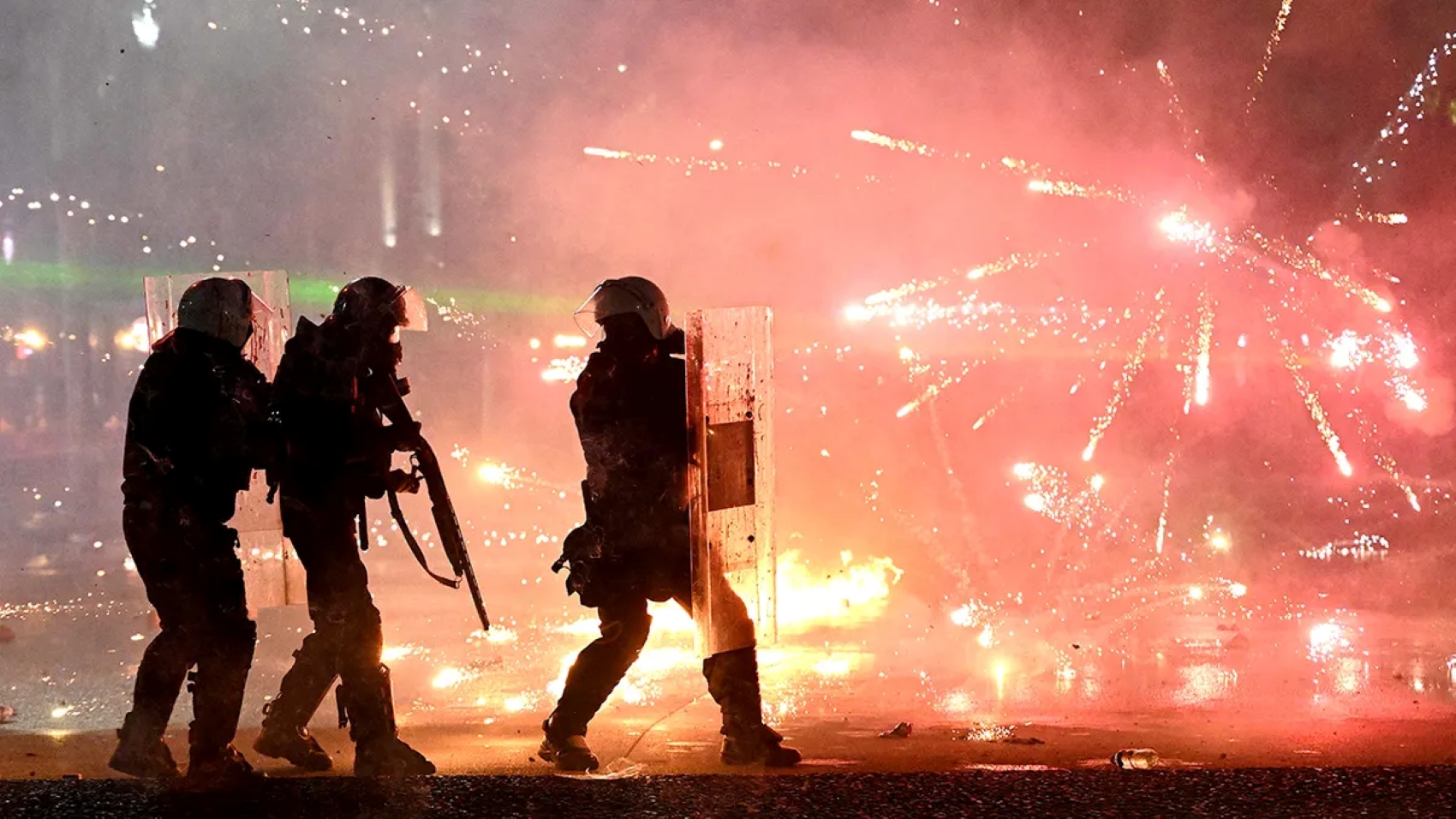
Several days of protests were accompanied by serious clashes. During the protests in Tirana, demonstrators damaged the buildings of several ministries and a police station and set police vehicles on fire. Protesters threw stones and Molotov cocktails and used pyrotechnics, while police dispersed demonstrators with tear gas and water cannons.
On 22 October, opposition MPs attempted to block the work of parliament after its leadership rejected their demand to discuss the student protests. Opposition MPs displayed photographs of students who, they claimed, had been injured by police and blocked the parliamentary rostrum. A fight broke out between government and opposition MPs.
Meanwhile, Prime Minister Edi Rama rejects calls for his resignation and describes the protests as a “hybrid war”. In his statements over recent days, Rama has spoken of possible Russian influence following the publication on X of a post by Kremlin ideologue Alexander Dugin in support of the protests. However, the head of government’s latest version is that the far-left Antifa movement is involved in the student protests in Albania.
International media view the protests in Albania as part of mass youth demonstrations in other European countries, primarily France and Italy, noting that the protest movement is driven by a demand for social justice.
- Kosovo President Does Not Sign Amendments to the Law on the Specialist Chambers in The Hague
Kosovo President Justina Shiroka-Pula returned to parliament for reconsideration the previously adopted amendments to the Law on the Specialist Chambers in The Hague. The decision was made at the official request of the Democratic Party of Kosovo (PDK), which had itself proposed the amendments.
According to PDK representatives, they asked the president to return the law in order to remove legal elements that could complicate or block its practical implementation. According to the party, their initiative does not constitute a retreat “from the original objective”, but provides for the involvement of “experts and the Ombudsperson to address the disputed legal issues”.
The President’s Office stated that the review primarily concerns issues of the jurisdiction and mandate of the Specialist Chambers, as well as ensuring the constitutional rights of the accused. At the same time, Shiroka-Pula stressed her position on defending the “liberation character of the war” of the Kosovo Liberation Army (KLA) and emphasised that she was continuing consultations aimed at providing diplomatic and inter-institutional support for former KLA leaders.
The controversy surrounding the Kosovo Specialist Chambers (the court and the prosecutor’s office) in The Hague intensified after 16 September 2026, when the Specialist Chambers delivered guilty verdicts against four former KLA leaders — Hashim Thaçi, Kadri Veseli, Jakup Krasniqi and Rexhep Selimi. On charges of war crimes, they were sentenced to a combined total of 81 years in prison..
In response to the verdict, amid protests in Pristina in support of the KLA leaders, the Democratic Party of Kosovo initiated legislative changes that were adopted by the Kosovo Assembly on 6 October. The amendments were intended to narrow the jurisdiction of the Specialist Chambers, reduce the maximum possible sentence and introduce a mechanism for presidential pardons for those convicted.
The adoption of the law amending the operation of the Specialist Chambers in The Hague drew sharp criticism from Pristina’s Western partners.
The European Union officially stated that the amendments adopted by the Kosovo Assembly were contrary to the country’s international commitments to the European Union. Brussels stressed the need to ensure the independence of the judiciary, preserve the mandate of the Specialist Chambers and protect witnesses, warning that such steps could seriously harm Kosovo’s path towards European integration.
The United States issued similar warnings, calling on the Kosovo authorities to comply with their international legal obligations and not undermine the legitimacy of judicial institutions established with Western support.
International pressure, legal uncertainty and disagreements within the party itself caused domestic political turmoil.
A day before the withdrawal of the law, on 21 October, Democratic Party of Kosovo chairman Bedri Hamza announced his resignation as party leader. Although Hamza had led the PDK for less than a year, he noted that he was taking responsibility for the situation surrounding the controversial legislative initiative and opening the way for internal party elections.
Honorary chairman of the opposition Alliance for the Future of Kosovo, former KLA commander and member of parliament Ramush Haradinaj described the return of the law as a political game and a serious reputational blow to the country. “The return of the Law on the Specialist Chambers to the Assembly is a great shame and a severe blow to Kosovo,” Haradinaj said.
- Construction Begins in Serbia on Pipeline to Transport Gas from the United States
Construction has begun in Serbia on an interconnector that will link the gas transmission systems of Serbia and North Macedonia. The first pipes have already been delivered to Vranjska Banja and welding has begun, the Serbian government reported on 21 October.
Acting Serbian Minister of Mining and Energy Dubravka Đedović Handanović said that pipes for the first 20 kilometres of the gas pipeline had now been delivered. The total length of the pipeline on Serbian territory will be 147 kilometres.
According to the Serbian government, total investment in the construction of the gas pipeline and associated infrastructure will amount to €153 million. The interconnector’s planned capacity will be 1.5 billion cubic metres of gas per year. Construction in both Serbia and North Macedonia is planned to be completed in 2028.
Belgrade stresses that the significance of the project lies not only in creating additional capacity but also in reducing Serbia’s dependence on a single gas supply route — the TurkStream/Balkan Stream pipeline, through which Russian gas is supplied to the Balkans.
For Serbia, diversification remains particularly important because of its significant dependence on Russian gas. In 2025, the country imported around 2.76 billion cubic metres of pipeline natural gas, of which approximately 2.45 billion cubic metres came from Russia.
After connecting to North Macedonia’s gas network, Serbia will potentially gain access to liquefied natural gas (LNG) imported through the terminal in Alexandroupolis, Greece. North Macedonian Prime Minister Hristijan Mickoski previously stated that this route could be used to transport U.S. LNG from Alexandroupolis through North Macedonia and Serbia onwards to Hungary and Austria. At the same time, the infrastructure will not be limited to American gas: gas from other sources will also be able to flow through it.
The project fits into the broader concept of the Vertical Gas Corridor, which is intended to connect the gas infrastructure of Greece, Bulgaria and other countries in South-Eastern and Central Europe.