
Putin no longer needs to send tanks towards Warsaw to wage war against Europe. A drone carrying explosives in Leipzig, sabotage in Poland, torched infrastructure, saboteurs and an army of useful idiots who, after every Russian strike, will explain that the war has not yet begun are enough. While Europe carefully chooses the word with which to describe what Russia is doing to it, the Kremlin chose that word long ago.
A few months ago, the question was whether Vladimir Putin, cornered in Ukraine, would try to expand the war towards Europe. Today, that question sounds almost outdated. The attempted attack with an explosives-laden drone on a Ukrainian Antonov at Leipzig/Halle Airport, acts of sabotage, fires, attacks on infrastructure, intelligence operations and increasingly aggressive probing of Europe’s borders show that Putin no longer needs to send tanks towards Warsaw in order to wage war against Europe. He has already carried the war across Ukraine’s border; he is simply conducting it carefully enough for European governments still to be able to debate what to call it.
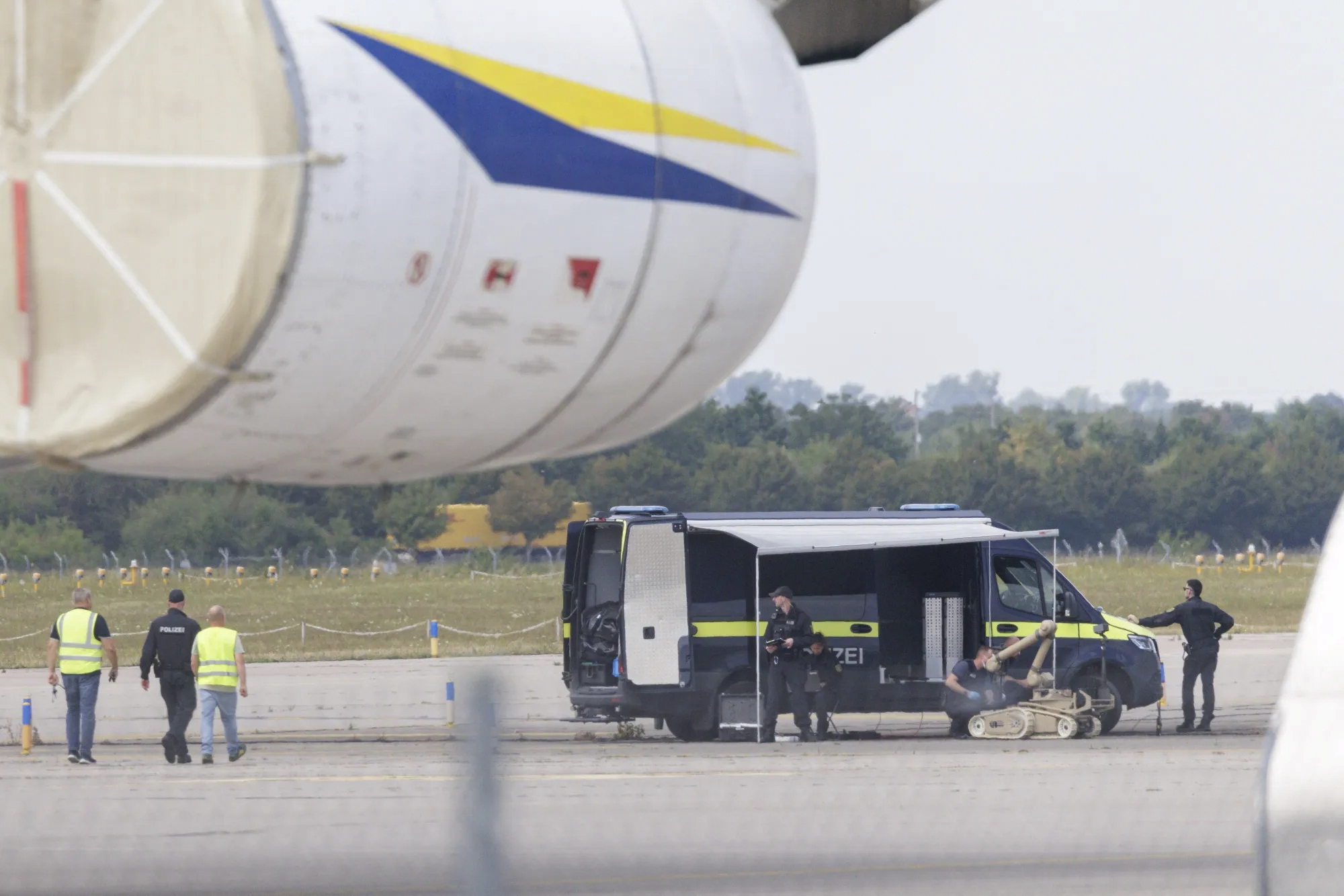
The German government now openly claims that Russian state structures were behind the attempted attack in Leipzig. The target was a Ukrainian Antonov transport aircraft, the drone was carrying explosives, and the airport is one of the important logistical hubs through which aid to Ukraine passes. Moscow rejects the accusations, Berlin responds by closing the Russian consulate and the cultural centre, while Europe’s top officials speak of a serious escalation on the territory of the European Union. At the same time, acts of sabotage, attempted sabotage and Russian intelligence operations are being investigated in Germany, Poland and Denmark.
Welcome to European peace of 2026, where an explosives-laden drone at a German airport can still be something other than war simply because it does not have a Russian flag on its tail.
This is precisely the space in which Putin wants to wage war. Militarily, Russia today does not need a march on Warsaw, Berlin or Vilnius, because such an undertaking could provoke exactly what the Kremlin has been trying for years to avoid: a united, militarily mobilised NATO and a direct conflict that Moscow would find difficult to control. It is far more useful to produce dozens of Leipzigs, acts of sabotage, fires, explosions, drones, hacks and political crises, and after each of them to observe how much Europe can endure before it stops choosing terminology and starts defending its own territory.
This is the perfect zone of Russian warfare: enough violence to produce fear, enough ambiguity to produce debate, and just enough restraint for Article 5 to remain behind the “break in case of emergency” glass. Putin thus gets a war without a formal declaration of war, a frontline without trenches, and an enemy that spends more time convincing itself that it has not yet been attacked than the aggressor spends planning the next attack.
Here the story returns once again to Ukraine and to what the Kremlin has been trying for years to conceal behind ever more grandiose propaganda. Four and a half years after the start of the full-scale invasion, Kyiv remains Ukrainian, the Ukrainian state exists, the Ukrainian army exists, NATO has expanded, European countries are increasing their military budgets, and Germany, which for decades almost ritualistically avoided serious militarisation, is building an army of a kind Europe has not seen in decades. Through his war, Putin has produced precisely the armed Europe with which he now frightens his own population.
That is why Lavrov and the rest of the Kremlin propaganda machinery increasingly invoke Hitler, Nazism and the “Fourth Reich.” German rearmament becomes the restoration of Nazism, European aid to Ukraine becomes proof of a conspiracy against Russia, and NATO becomes some kind of pan-European Nazi coalition. This grotesque recycling of history has a very concrete political purpose, because the Russian population must be given an explanation for how the state with the world’s largest nuclear arsenal has remained bogged down for years in a war against a country that its government presents as a historical mistake and a Western puppet.
The answer is already being manufactured: according to this version of reality, Russia has never really fought against Ukraine, but against the entire West, NATO, Berlin, London, Paris and Washington. Thus military failure acquires an epic backdrop, hundreds of thousands of dead and wounded become victims of some final civilisational showdown, and Putin is transformed from the man who launched a catastrophic war of conquest into the leader of an empire that supposedly stood alone against the entire world.
In this respect, Europe is invaluable to Putin. He needs it as an enemy, but even more as an alibi.
Defeat or endless stalemate against Ukraine is difficult to sell to a society that has been told for years that Ukraine does not actually have the right to its own existence. A conflict with the whole of NATO is another matter; there, even defeat can become an epic, a sacred Russian sacrifice before the hordes of the decadent West and a new imperial myth on which generations after Putin will feed. If you cannot defeat Ukraine, then explain that you have been fighting NATO from the first day; if you cannot admit defeat, then manufacture a mythical battle against Europe; if you spend years conquering Donbas over mountains of your own corpses, then explain to the people that you were actually defending humanity from Berlin, London and Paris.
This is the perverse logic of the Kremlin, in which failure is treated not with peace, but by spreading the fire of war.
At the same time, Putin understands perfectly Europe’s fear of the final step. Nuclear weapons may have greater political value than military value for him, because it is enough to mention nuclear escalation from time to time for an entire industry of “realists,” peacemakers without other people’s blood on their hands, and politicians prepared to pay for peace with the territory of a country in which they themselves do not live to appear on European television. Somehow, that price always ends up in Ukraine’s backyard, on Ukrainian land, among the Ukrainian dead and beneath the ruins of Ukrainian cities.
That is why the Kremlin tests the limits far more carefully than it would with tanks. In this sense, Leipzig is far more useful than a column of armoured vehicles heading towards Poland, because an open attack unites the opponent, while a series of acts of sabotage produces ten national investigations, ten political debates and ten different thresholds of tolerance. NATO can quite reasonably assess today that there is no immediate threat of a conventional Russian attack, but the problem arises the moment we imagine war exclusively as a tank smashing through a border barrier. Putin can attack Europe piecemeal for years precisely so that Europe never gets one great moment in which everyone can say at the same time: “it has begun”.
And then comes perhaps the most important part of that war, the part being waged within European societies. Russia benefits from fear that produces political polarisation, the growth of parties that sell capitulation as peacemaking, fatigue with Ukraine, and a citizen who, after enough acts of sabotage, economic costs and propaganda, will be told that life would be simpler if Kyiv accepted Russian terms. The higher the bill for European defence, the easier it is for Putin, through his European political and media intermediaries, to explain that the bill is actually being presented by Ukraine, rather than by Russia, which attacked it.
Russia is thus trying to defeat Europe with European hands.
For us in the Balkans, this model should not seem at all exotic. We have already seen its laboratory version here: Russian propaganda, local political intermediaries, Wagner iconography, myths about “little Russians,” destabilisation structures, and a society in which part of the population perceives someone else’s empire as its own metaphysical homeland. The training camps mentioned in European investigations, links with structures that were preparing the destabilisation of Moldova, and the years-long Russification of the political space of Serbia and Republika Srpska show how short the distance is between a flag, a Telegram channel, propaganda and actual infrastructure for destabilisation.
That is why Europe’s problem with Putin is no longer confined to the question of whether the Russian military will one day attack a NATO member state. A far more disturbing possibility is unfolding before our eyes: Europe can be attacked piecemeal for years, just enough for each individual attack to remain below the threshold of a major response, while their cumulative effect gradually changes Europe’s political, security and social reality.
Putin’s ideal war against Europe therefore has no starting date, no formal declaration, no single front and no image of a Russian tank smashing through a Polish border barrier. It has Leipzig, explosives, saboteurs, drones, torched infrastructure, political extremists who present Moscow as an alternative to Brussels, and societies arguing over whether an enemy even exists while that enemy is already probing their airports, factories, railways and power lines.
A few months ago, I asked whether Putin, cornered, would move against Europe. Today, I would put that question differently.
How many more Leipzigs does Europe need to see before it realises that Putin has already made his move?
Dragan Bursać. Professor of philosophy, columnist and journalist (BiH).

The articles published in the “Opinions” column reflect the personal opinion of the author and may not coincide with the position of the Center