- Ratko Mladić Buried in Belgrade with Military Honours
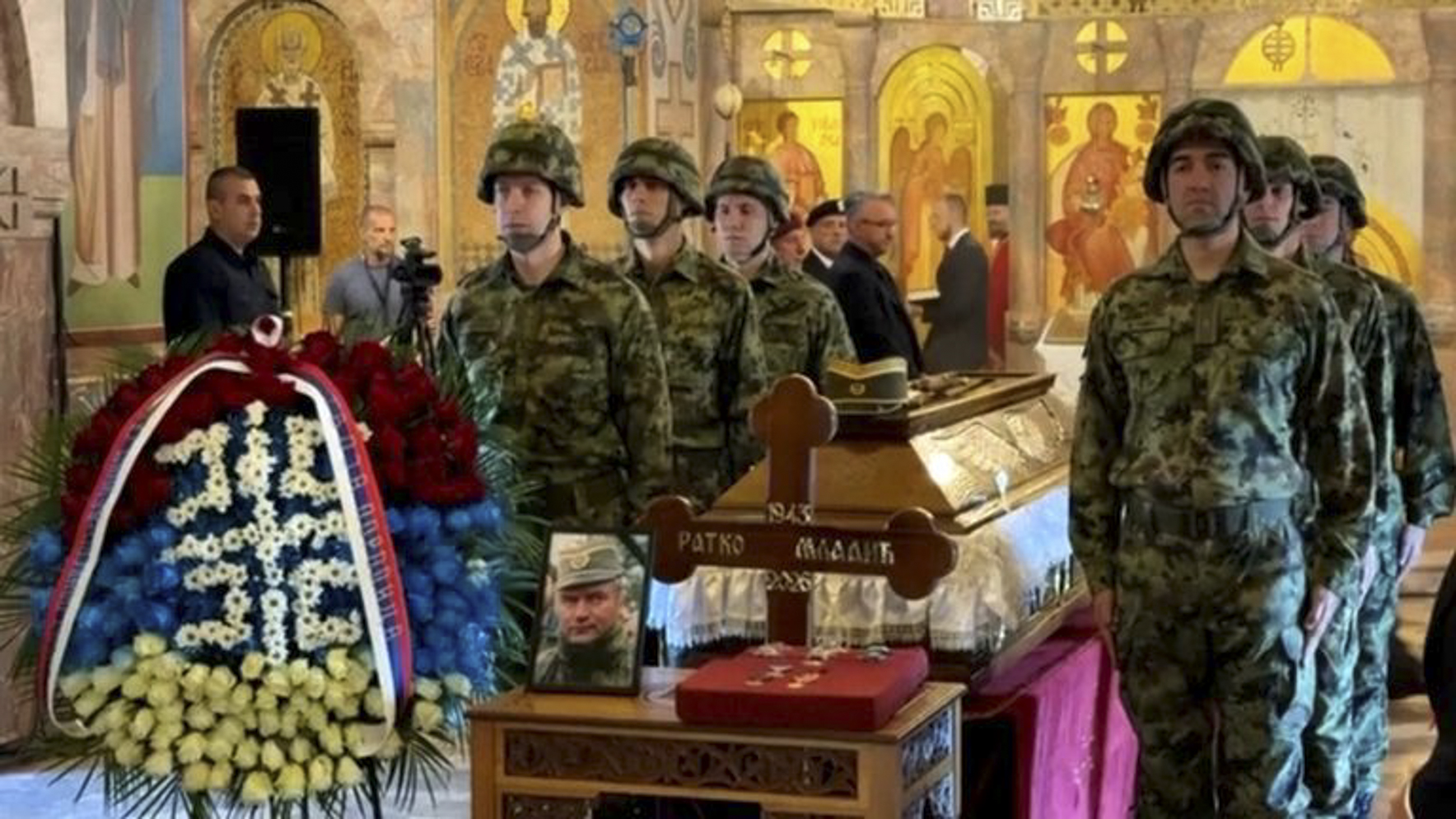
Ratko Mladić, the former commander of the Army of Republika Srpska, who was sentenced by the Hague Tribunal to life imprisonment for the Srebrenica genocide, the siege of Sarajevo, and other war crimes and crimes against humanity, was buried on 7 September at a cemetery in Belgrade with full military honours. The coffin was draped with the flags of Serbia and Republika Srpska, and military personnel accompanied it to the burial site.
A memorial service for Mladić was held at St Luke’s Church in the presence of officials from Serbia and Republika Srpska. The service was led by Patriarch Porfirije of the Serbian Orthodox Church.
Serbian Minister of Culture Nikola Selaković, Minister of Justice Nenad Vujić, Minister for Public Investment Darko Glišić, Minister of Defence Bratislav Gašić and Minister without Portfolio Nenad Popović expressed their condolences to members of Mladić’s family at the church. The funeral ceremony was also attended by Serb Member of the Presidency of Bosnia and Herzegovina Željka Cvijanović, President of Republika Srpska Siniša Karan, Prime Minister of Republika Srpska Savo Minić, President of the National Assembly of Republika Srpska Nenad Stevandić, Mayor of Banja Luka Draško Stanivuković, as well as leader of the Alliance of Independent Social Democrats and former President of Republika Srpska Milorad Dodik.
Among those present at the farewell ceremony were Russian Ambassador to Serbia Alexander Botsan-Kharchenko, as well as Bosnia and Herzegovina’s Ambassador to Serbia Aleksandar Vranješ.
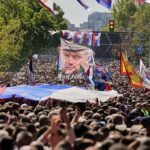
The Archive of Public Gatherings, an organisation that has been estimating attendance at public gatherings since 1991, stated that up to 16,000 people attended Mladić’s funeral.
Serbian President Aleksandar Vučić did not attend the funeral, citing a previously scheduled visit by his counterpart from Uzbekistan. Vučić’s son, Danilo, attended the funeral ceremony.
Observers interpreted the Serbian President’s absence from Ratko Mladić’s farewell ceremony as an attempt to send Western partners a signal that the country was maintaining a balanced and pro-European course. But the overall atmosphere in Serbia surrounding the honouring of the war criminal drew sharp criticism from the EU.
European Commissioner for Enlargement Marta Kos cancelled a visit to Serbia in protest, arguing that the glorification of Ratko Mladić in Serbia was “incompatible with the values on which the path to the EU is built”.
European Commission President Ursula von der Leyen stated in a post on X that footage from the funeral of Mladić, who was convicted of genocide and war crimes, was shocking, and that elements of official support and the presence of some senior Serbian officials at the funeral in Belgrade “demonstrate a failure to confront a dark chapter in Europe’s recent history and contradict the values underpinning Serbia’s path towards the European Union.”
European Council President António Costa later made the same statement.
- Diplomatic Crisis Between Sarajevo and Belgrade
The Ministry of Foreign Affairs of Bosnia and Herzegovina recalled from Belgrade all staff members of the BiH Embassy whose recall does not require the approval of the Presidency of Bosnia and Herzegovina. On 7 September, Bosnia and Herzegovina’s Foreign Minister Elmedin Konaković explained the decision by events in Serbia following Ratko Mladić’s death, including the funeral, commemorations and messages that appeared in public places.
According to the head of the BiH Foreign Ministry, only the ambassador and consul may remain in Belgrade, because decisions on their appointment and subsequent recall are made by the Presidency of Bosnia and Herzegovina, while the rest of the staff will be recalled. Consular affairs are to be transferred to the embassies of Bosnia and Herzegovina in Zagreb and Podgorica, as well as to the Consulate General in Novi Pazar. “If I could, I would sever diplomatic relations with Serbia right now. But what I can do is reduce relations to the lowest possible level,” Konaković stated.
As experts note, this is an unprecedented step in relations between Bosnia and Herzegovina and Serbia since diplomatic relations were established in 2000. Although the two countries have gone through numerous political and diplomatic crises, including disputes following the judgment of the International Court of Justice, commemorations of the Srebrenica genocide and political tensions surrounding Republika Srpska, there has been no recorded case in which Bosnia and Herzegovina recalled almost all of the staff of its embassy in Belgrade.
In addition to reducing its diplomatic representation in Serbia, the BiH Ministry of Foreign Affairs decided to expel two employees of the Serbian Embassy in Bosnia and Herzegovina — the military attaché and an adviser who serves as the representative of the BIA (Security Information Agency). “We are cancelling their diplomatic ID cards in Bosnia and Herzegovina; we are calling on the diplomatic corps to cease cooperating with them,” Konaković said on 8 September.
- Initiative to Dismiss President of the Parliament of Montenegro Andrija Mandić Submitted
Thirty-five MPs from opposition and ruling parties supported the initiative to dismiss President of the Parliament of Montenegro Andrija Mandić. (The Parliament of Montenegro has 81 MPs in total.)
The initiative to dismiss Mandić was submitted by the opposition Democratic Party of Socialists (DPS). The immediate trigger for submitting the proposal was Mandić’s decision to publicly express condolences over the death of former commander of the Army of Republika Srpska Ratko Mladić, who was sentenced by the Hague Tribunal to life imprisonment for crimes against humanity and war crimes, including the Srebrenica genocide.
The justification for the proposal to dismiss Mandić states that the office of President of the Parliament entails special political and institutional responsibility, as well as a duty to safeguard the authority and integrity of the representative body of all citizens. It emphasises that honouring a convicted war criminal, convicted of genocide in Srebrenica, is incompatible with the responsibility of the president of parliament of a state that is obliged to respect the decisions of international courts, foster a culture of remembrance and promote reconciliation and good-neighbourly relations. The proposal stresses that the fact that Mandić expressed condolences in his own name and on behalf of the party does not absolve him of institutional responsibility, since he simultaneously holds the office of President of the Parliament.
It is also noted that the European Commission described the glorification of war criminals as inconsistent with European values, while Croatia’s Ministry of Foreign and European Affairs regarded Mandić’s expression of condolences as unacceptable and contrary to the values of the European Union. “When an act by the president of parliament of a candidate country prompts such a reaction from EU institutions and a neighbouring member state, it can no longer be presented as a matter of personal or party convictions,” the authors of the Initiative emphasise.
It is emphasised that Montenegro is entering a decisive phase of European integration, and that EU membership, in addition to meeting technical requirements, entails a clear commitment to European values. “The latest act by the President of the Parliament crossed a line beyond which the issue of his responsibility can no longer be relativised by the need to preserve the parliamentary majority or political stability,” the document states. According to the authors of the Initiative, Andrija Mandić does not have the political and institutional authority necessary to hold the office of President of the Parliament.
The request to convene an extraordinary session to consider the initiative to dismiss Mandić was signed by 29 MPs. It is proposed that the session to discuss the issue be held on 24 September.