- Serbia Took Part in the Inaugural Summit of the “Carpathian Eight”
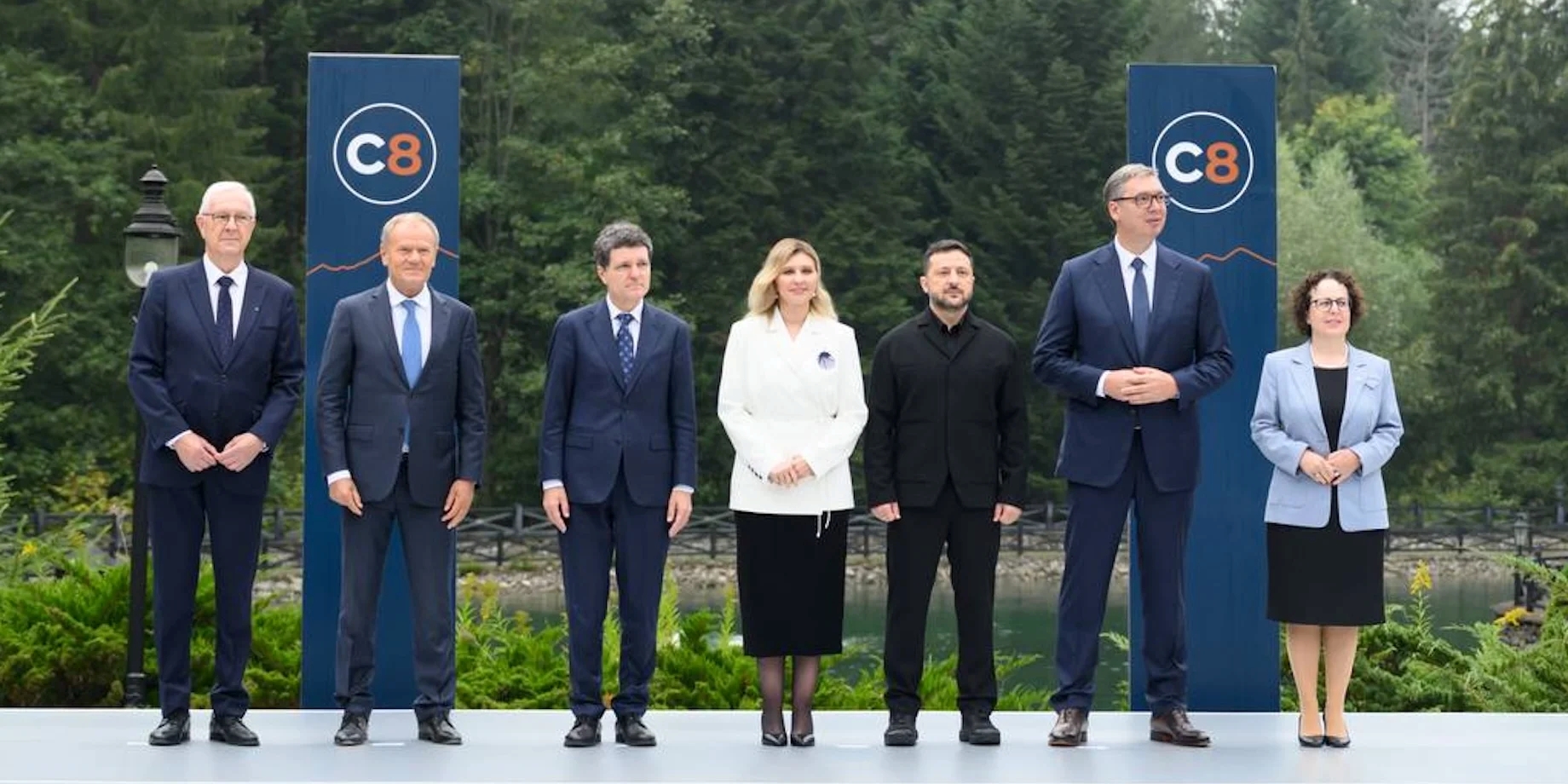
From 18 to 20 September, the Carpathian 8 Summit – the inaugural summit of the “Carpathian Eight” (C8) – was held in Ivano-Frankivsk Region, in the Prykarpattia area of western Ukraine. The regional format brings together Ukraine, Serbia, Romania, Poland, Slovakia, the Czech Republic and Austria; Hungary, as reported, may join at a later stage. The aim of the initiative is to strengthen regional cooperation and establish ties between the countries through joint projects in infrastructure, energy, trade, logistics and investment.
The opening of the forum was attended by President of Ukraine Volodymyr Zelenskyy and Prime Minister of Ukraine Serhii Koretskyi, Presidents of Romania and Serbia Nicușor Dan and Aleksandar Vučić, Prime Minister of Poland Donald Tusk, and President of the Austrian Federal Council Christine Schwarz-Fuchs.
As part of the summit, the Carpathian Economic Forum was held, at which Serbia was represented by a joint exhibition of the Development Agency of Serbia (RAS), the Chamber of Commerce and Industry of Serbia (CCIS), and the Organising Committee of “EXPO 2027 Belgrade”.
One of the key outcomes of the summit was the establishment of the Carpathian Investment Coalition – a new voluntary platform for practical investment cooperation within the Carpathian macro-region and the broader economic space of Central and Eastern Europe. Its establishment was announced by investment promotion institutions from Ukraine, Austria, the Czech Republic, Poland, Romania, Serbia and Slovakia, including the Development Agency of Serbia (RAS) and the Chamber of Commerce and Industry of Serbia (CCIS).
President Vučić, who took part in the summit, placed particular emphasis on the opportunities opening up for Serbia within the new format through joint infrastructure projects, primarily transport and energy projects, as well as opportunities to attract investment and funding from European funds for regional initiatives.
Vučić also held a bilateral meeting with Zelenskyy, during which, among other things, issues of European integration were discussed.
- Director of Albania’s Intelligence Service Arrested
Director of Albania’s State Intelligence Service (Shërbimi Informativ i Shtetit, SHISH) Vlora Hyseni was arrested on 22 September after returning from an official trip abroad. The previous day, the Special Prosecution Office against Corruption and Organised Crime (SPAK) issued a warrant for her arrest. On the same day, President of Albania Bajram Begaj, acting on a proposal from Prime Minister Edi Rama, decided to dismiss Hyseni from the post of SHISH director. “Everyone is innocent until a final court ruling is issued, but no one is above the law,” Rama wrote on X.
Hyseni is suspected of disclosing classified information to third parties as part of a corruption case concerning the National Agency for Information Society (AKSHI).
The suspicions concerning Vlora Hyseni are linked to her relationship with Ergys Agasi – an influential businessman who had previously been arrested in the AKSHI case. He is suspected, among other things, of having been a key figure in a network involved in violations during the conduct of the agency’s public tenders. According to investigators, Hyseni provided Agasi with confidential official information.
This situation became another blow to the Rama government. Earlier, in February 2026, the prime minister had already been forced to part ways with his deputy, Belinda Balluku, who was under investigation by SPAK on suspicion of abuses in the awarding of public contracts.
- North Macedonia Declared Its Readiness to Unblock European Integration
North Macedonia will continue on its path towards the European Union while seeking a way out of the existing deadlock. Prime Minister of North Macedonia Hristijan Mickoski said this during the Concordia Summit in New York, held on the sidelines of the UN General Assembly.
“We are ready to move forward and find a way out of this situation,” he stressed.
According to Mickoski, frustration among the citizens of North Macedonia is considerable, as the country has made too many concessions in the past. For his generation, he noted, negotiations with the EU were viewed as a way of changing institutions, not identity, but “unfortunately, there are some member states that are trying to resolve bilateral issues and change the Macedonian identity.” “We changed our flag, amended the Constitution several times and even changed our constitutional name, and all of this seems like an endless story. Nevertheless, we believe in European values and will continue along this path in order finally to find a way out of the deadlock in which we currently find ourselves,” the prime minister stressed.
As is known, unblocking the accession negotiations currently depends on constitutional amendments to include Bulgarians in the preamble to the Constitution of North Macedonia. Skopje opposes making further concessions to individual EU members without additional guarantees from the European Union.
- The Future of Republika Srpska Discussed in Moscow
Representatives of Republika Srpska (Bosnia and Herzegovina) took part in the round table “The Future of Republika Srpska: Prospects for Cooperation,” devoted to opportunities for improving cooperation between Republika Srpska and the Russian Federation, which was held in Moscow on 22 September and organised by the Centre for International Cooperation “Russian-Balkan Dialogue” and the Russian-Balkan Centre of Cultural and Business Cooperation.
The round table brought together more than 30 representatives of the education sector, diplomatic corps, chamber of commerce and industry, business community, public organisations and the media, while the organisers identified the strengthening of business, social and humanitarian cooperation between Republika Srpska and the Russian Federation as one of the main objectives of the meeting.
Pavel Bushuev, Head of the Department of Balkan Studies at the Institute of CIS Countries, who took part in the discussion, stated that, in the current geopolitical realities, it is precisely cooperation with Republika Srpska that opens a window of opportunity for Russia to expand its economic, cultural and humanitarian presence in the Balkans.
Republika Srpska was represented at the event by RS Minister of Scientific and Technological Development and Higher Education Draga Mastilović, Milovan Peulić, Head of the European Integration Department of the RS Ministry of Energy, and President of the Association of Journalists of Republika Srpska Danijel Simić.
In his speech, Minister Mastilović stressed that there is potential for further improving cooperation between universities and scientific institutions, particularly through joint research projects, exchanges of teaching and research staff, cooperation in higher education, as well as establishing contacts between students and young researchers from the RS and the Russian Federation, including student exchanges.
Milovan Peulić, a representative of the RS Ministry of Energy, presented a report on the unique position of Republika Srpska, which allows the RS to develop cooperation in the energy sector with European countries while maintaining a high level of interaction with Russia. At the same time, he noted that, in addition to stable gas supplies and the operation of oil-refining capacities, in the new geopolitical context it is necessary to seek new, modern and pragmatic forms of cooperation with Russia.