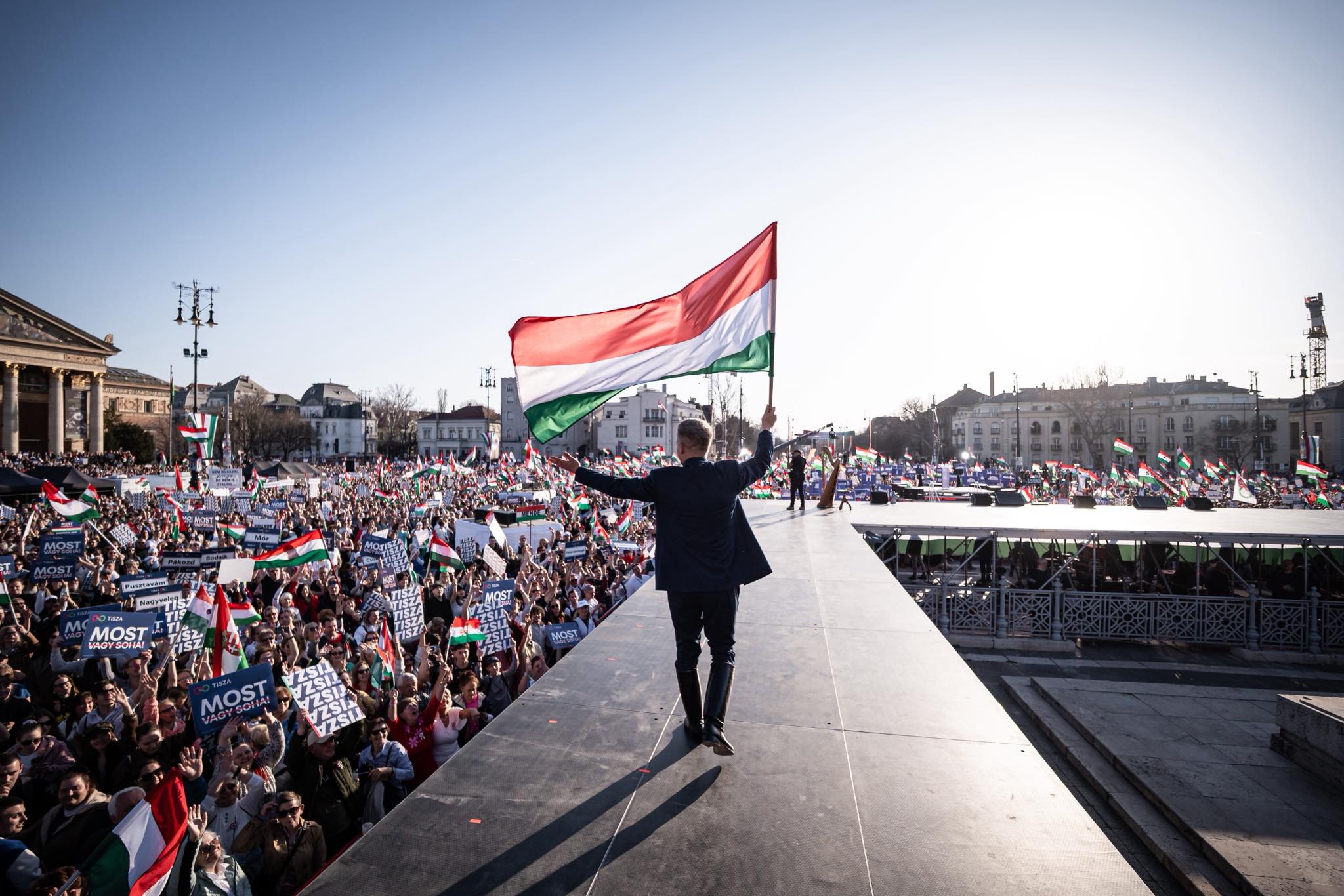
The victory of the “Tisza” party led by Péter Magyar and the defeat of Viktor Orbán’s Fidesz have the potential to become one of the most notable political shifts in Central and Southeastern Europe. This also concerns the Western Balkans — a region where Hungary under Orbán has been one of the most active and controversial players.
Viktor Orbán has for many years been building his own network of influence in the Western Balkans. His government actively supported regional political leaders who shared his political views and his geopolitical orientation. Moreover, this was not only about support at the level of political or diplomatic efforts, but also at the level of intelligence services.
The most striking examples of such support were the 2018 special operation to transport to Hungary and grant political asylum to former Prime Minister and ex-leader of the Macedonian party VMRO-DPMNE Nikola Gruevski, and the planned, although not implemented due to the change in circumstances, intervention of special forces from the Hungarian government’s Counter Terrorism Centre (TEK) to protect Bosnian Serb leader Milorad Dodik from imprisonment in 2025.
The presence of Hungarian intelligence services in Republika Srpska was later recorded officially, after the opening of a TEK office at the beginning of 2026.
With Serbia, Hungary was developing cooperation even in the military sphere. In 2023, Belgrade and Budapest signed an agreement on strategic partnership, and two years later approved a concrete action plan to implement the signed document, which was assessed as a step toward the creation of a Hungarian-Serbian military alliance.
Another form of support by the Hungarian authorities for their allies in the Western Balkans was the financing of economic cooperation programs and the implementation of infrastructure projects.
The main areas of effort and the largest regional recipients were Serbia (infrastructure projects), Republika Srpska in Bosnia and Herzegovina (grants, loans, support for business and farmers), and North Macedonia (provision of a loan after VMRO-DPMNE returned to power).
Other countries in the region did not avoid Hungary’s attention either. Thus, Montenegro signed an Agreement on cooperation in infrastructure development in 2025, which envisaged the construction of highways and the modernization of railways, although, admittedly, the implementation of all planned projects did not materialize.
Sometimes infrastructure projects supported by Hungary involved not only Hungarian funds, but also Chinese ones, as was the case with the construction of the high-speed railway from Budapest to Belgrade, although the Hungarian government still acted as the main operator of these funds.
There was much discussion that Chinese money was also used for Budapest’s loan to Skopje, but the Hungarian authorities denied this.
Another mechanism for strengthening Orbán’s positions in the region was active and demonstrative lobbying in Brussels for decisions favorable to his Balkan allies and the blocking of unfavorable ones.
Viktor Orbán, his Minister of Foreign Affairs Péter Szijjártó, and also previously the European Commissioner for Enlargement (2014–2024) Olivér Várhelyi positioned themselves as advocates of the Western Balkans in the EU, constantly emphasizing that they were the main driving force of the region’s European integration.
In practice, these statements were not always supported by corresponding decisions at the EU level. Indeed, sanctions against Milorad Dodik or restrictive measures against Serbia were never introduced by the European Union, among other reasons due to Hungary’s opposition. However, Belgrade, despite all promises from Budapest, was unable to continue opening negotiation chapters, and North Macedonia did not begin accession negotiations with the EU. Nevertheless, despite everything, the activities of Orbán’s team in promoting the European integration ambitions of the Western Balkans found understanding and even admiration in the countries of the region.
The most important political project of Orbán was support for the Hungarian diaspora in all neighboring states, including in the Western Balkans (primarily in Vojvodina, but not only). The Fidesz government invested funds in the development of sports (primarily football) infrastructure, educational institutions, cultural centers, support for business and media. This activity was aimed primarily at strengthening the electoral base of Fidesz. Simultaneously, however, it was assumed that in elections to the governing bodies of the countries of residence, Hungarians, who usually have two passports, would vote for Orbán’s political allies (in Serbia, this is Aleksandar Vučić).
In general, the policy of Orbán and his team in the Western Balkan direction was aimed at strengthening their own influence, political weight and geopolitical authority to maintain power at home, at increasing influence over the situation in the region, at supporting regional political allies and ensuring the loyalty of the diaspora. However, other important tasks included the promotion of Chinese and Russian interests.
If for China Orbán’s Hungary was important as an economic partner and an “entry point” into the European economic space, as an implementer of infrastructure projects within the “Belt and Road” framework, then for Russia Budapest under Orbán’s rule effectively became a multi-purpose partner, a kind of “ambassador-at-large”.
Support at any cost for politicians loyal to the Kremlin (Milorad Dodik), lobbying for Russia’s energy interests, even at the cost of conflict with it’s traditional partner — Croatia (it should be recalled that Budapest accused the Croats of “war profiteering” due to allegedly excessively high transit prices via the JANAF oil pipeline and demanded in an ultimatum form that Zagreb transport Russian oil through this route), fueling hysteria around the threat to the “Balkan (Turkish) Stream” in such a way that even Aleksandar Vučić decided to distance himself from it as much as possible… It is no coincidence that it was to the Hungarian MOL that Moscow (was) ready to sell a controlling stake in the Oil Industry of Serbia (NIS), since in this way the company would effectively remain under Russian control.
Political analysts argue about the moment that the turning point occurred, when Fidesz began implementing not its own, Hungarian policy, but specifically Russian policy in the Western Balkans? Did Orbán and his team’s dependence on Moscow become the main factor in his defeat? How will the foreign policy of the Hungarian government in the Western Balkans direction change after the formation of the “Tisza” government? And finally, who will now acquire NIS?
Sharp, revolutionary moves are not expected from Péter Magyar. The politician himself said: “If the government of Viktor Orbán maintained close relations with the countries of the Balkans or other states, this does not mean that the new government will have fewer ties with these countries.” Experts emphasize that the economic dependencies that arose during Orbán’s rule, in particular on Russia and China, will require a cautious approach so that their rapid dismantling does not lead to economic collapse.
However, judging by Magyar’s first statements after the victory, the Balkan policy of his government will differ from that of Fidesz. In particular, he emphasized that he would not interfere in the affairs of Balkan countries (likely referring to the saga around Milorad Dodik or the granting of asylum to Nikola Gruevski). The leader of “Tisza” also criticized the pro-Russian alliance of “Orbán, Robert Fico and Aleksandar Vučić,” called for an independent investigation into the attempted sabotage of a gas pipeline in Serbia, and hinted at the extradition of the Macedonian former prime minister…
It cannot be ruled out that Budapest’s focus of attention may shift from Belgrade, Banja Luka and Skopje to Zagreb. “I believe that it is a historical crime of Viktor Orbán that relations between Croatia and Hungary, which were once excellent, have cooled so much,” the leader of “Tisza” told journalists and announced that he would invite the Prime Minister of Croatia Andrej Plenković for a visit as soon as possible.
The only area where no changes are expected is the participation of Hungarian military personnel in EU and NATO missions in Bosnia and Herzegovina and Kosovo. After the victory, Péter Magyar emphasized that Hungary would again become a strong ally in the European Union and NATO, therefore the presence of the Hungarian contingent in EUFOR Althea and KFOR should be maintained.
* Tavaszi szél, Spring Wind — the title of a Hungarian folk song that became the anthem of the “Tisza” campaign
CWBS Analytical Group