- Bosnia and Herzegovina will implement an American project for diversification of gas supply
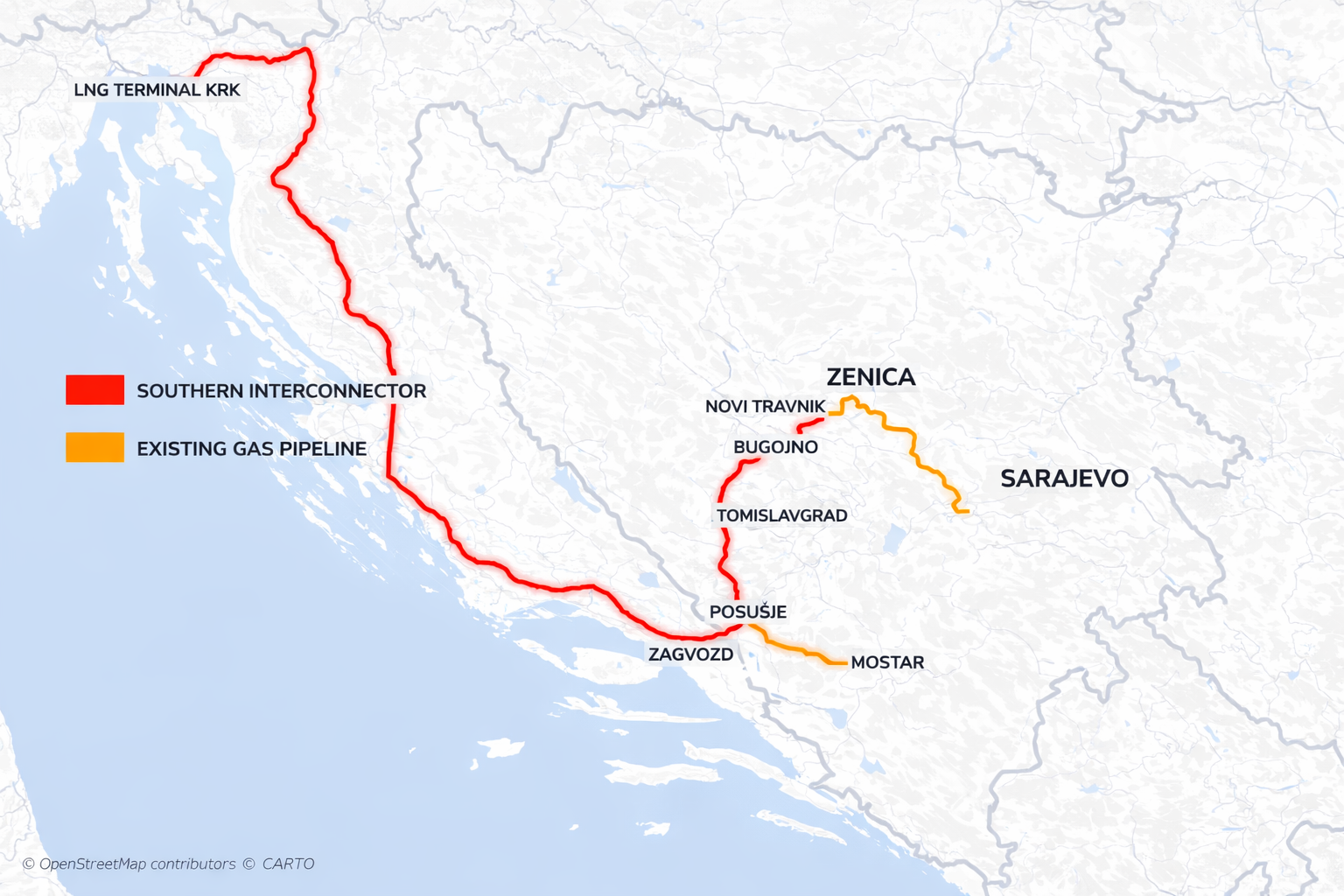
On 15 April, the House of Peoples of the Parliament of the Federation of Bosnia and Herzegovina, at an extraordinary session, adopted key amendments to the law on the Southern Interconnection (gas interconnection) of Bosnia and Herzegovina and the Republic of Croatia. It concerns a gas pipeline that will connect Bosnia and Herzegovina with the Croatian gas network and the liquefied natural gas (LNG) terminal on the island of Krk in Croatia, which will make it possible to diversify sources of gas supply, eliminating dependence on supplies from Russia.
At present, Bosnia and Herzegovina receives exclusively Russian gas, which arrives via the “Turk/Balkan Stream” through Serbia.
The House of Representatives of the Parliament of the Federation of Bosnia and Herzegovina adopted the same law on 8 April, thus the vote in the House of Peoples marks the completion of the legislative process. The next step is the signing of an intergovernmental agreement between Bosnia and Herzegovina and Croatia, which is scheduled for the end of the month in Dubrovnik, as well as the conclusion of an Agreement between the Government of the Federation of Bosnia and Herzegovina and the investor.
The adopted amendments to the law removed the previous provision according to which the project was to be implemented by the Bosnian company BH Gas. According to the new version of the law, the investor and project manager is defined as AAFS Infrastructure and Energy d.o.o. in Sarajevo, which is wholly owned by the American company AAFS Infrastructure and Energy LLC.
Earlier this year, individuals associated with Trump’s entourage visited Bosnia and Herzegovina to discuss the project on behalf of AAFS, viewing it as a step toward strengthening energy security and reducing regional dependence on Russian gas.
American partners have already expressed readiness to begin financing and implementation of the project immediately. The estimated cost of construction of the project ranges from 405 million to 810 million euros, depending on terrain configuration, materials, and technical solutions.
The Government of the Federation of Bosnia and Herzegovina stated that the Southern Interconnection is one of the most important infrastructure and energy projects for the Federation of Bosnia and Herzegovina and the state of Bosnia and Herzegovina, as it directly affects the security of gas supply, the stability of the energy system, and economic development.
- Vučić initiates the robotization and digitalization of the army
The President of Serbia and Supreme Commander-in-Chief Aleksandar Vučić met on 15 April at a military base in Belgrade with the leadership of the Ministry of Defence and the Armed Forces of Serbia, with whom he discussed the current security situation and future plans to improve the operational and functional capabilities of the Armed Forces of Serbia. The meeting was attended by Minister of Defence Bratislav Gašić and Chief of the General Staff of the Armed Forces of Serbia General Milan Mojsilović, as well as representatives of Republika Srpska — member of the Presidency of Bosnia and Herzegovina Željka Cvijanović, the leadership of RS, and the leader of SNSD Milorad Dodik.
In his remarks at the meeting, Vučić announced that in the coming days “large and very important contracts for the further procurement of weapons and military equipment” would be signed. According to him, the Serbian Armed Forces “will have an extremely powerful multi-layered air defence system.”
The President of Serbia also stated that he expects a significant increase in drone production in the country this year. In addition, according to him, significant robotization and digitalization of the army is planned, and that he, as Supreme Commander-in-Chief of the Armed Forces of Serbia, “proposed developing and adopting a Strategy of Robotization.”
In Vučić’s view, the security situation is somewhat more complex than at the beginning of the year, primarily due to the activities of the military alliance of Pristina, Tirana, and Zagreb.
- Croatia and Albania agree on further development of defence cooperation
Deputy Prime Minister and Minister of Defence of Croatia Ivan Anušić met on 15 April in Zagreb with his Albanian counterpart Ermal Nufi. The focus of their talks was on strengthening trilateral cooperation between Croatia, Albania, and Kosovo, possibilities for further development of defence cooperation, as well as the current security situation in South-Eastern Europe, Ukraine, and the Middle East.
The Ministry of Defence of Albania emphasized on its official website that the meeting in Zagreb “once again confirmed the rapprochement between the two countries as allies within NATO framework.”
“As for the specific projects we discussed, they primarily concern unmanned aerial vehicles, drones, and other systems used in modern warfare,” Minister Anušić told journalists after the meeting.
The Croatian minister also commented on statements by the President of Serbia Aleksandar Vučić that Serbia would continue to arm itself in response to what Vučić calls a threat and an alliance against Serbia. “I am not concerned by the statements or actions of Aleksandar Vučić. This is his country, he is the president of that country, and he has the legitimacy to do what he considers appropriate in Serbia. I do not see a problem here, and there are no reasons for our concern. We have our strategy, vision, and projects, and we are implementing them. Ultimately, as we have repeatedly stated, we strive for stability in this part of Europe,” Anušić said.
- Discussion at the UN Security Council on the UN Mission in Kosovo
The UN Security Council meeting on Kosovo on 9 April once again recorded differences of views regarding the future of the United Nations Interim Administration Mission in Kosovo (UNMIK).
Peter Due, the new Special Representative and head of UNMIK, stated that, guided by resolution 1244 (1999), he is focusing the Mission’s efforts on supporting dialogue and building trust between communities, as well as between communities and institutions. Due insisted that, despite a reduction of UNMIK staff positions by almost 30 percent due to the financial crisis in the UN, the Mission’s activities in promoting a culture of peace remain vital.
The Minister of Foreign Affairs of Serbia Marko Đurić stressed that UNMIK continues to serve as a “key guarantee of peace, stability, and protection of the fundamental human rights of Serbs in Kosovo and Metohija.” In his view, the presence should be strengthened, and “any discussion of its future must be strictly guided by the situation on the ground.”
This view was supported by representatives of Russia and China.
The representative of the Russian Federation stated that the UN Mission continues to perform its “core task — to contribute to maintaining stability,” therefore it is “unacceptable” to reduce the budget or staff of UNMIK. He stressed that Moscow “will accept only the decision that will be acceptable to the Serbs themselves.”
The representative of China agreed, recalling the “important role” of the UN Mission in maintaining stability in Kosovo and promoting national reconciliation, and called on the Council to provide the Mission with appropriate political and budgetary support.
At the same time, the Minister of Foreign Affairs of Kosovo Glauk Konjufca stated that the UNMIK mandate has been “fulfilled.” He called on Serbia to “accept reality,” recognize Kosovo as a sovereign, independent state, and “stop holding its society — and the entire region — hostage to aspirations to restore regional hegemony.” Emphasizing that the UNMIK mandate is “completed,” he said: “The focus should not be on the presence of the United Nations in Kosovo through UNMIK, but on the admission of Kosovo to the UN.”
The representative of the United States also spoke in favor of ending the UN Mission in Kosovo. She stated that “there is no reason to treat Kosovo in 2026 as if it were still Kosovo in 1999.” According to her, UNMIK no longer plays a meaningful administrative, military, or mediating role, and is an “overstaffed, overfunded peacekeeping mission without peacekeepers.” Welcoming the Secretary-General’s proposed reduction of the budget of the UN Mission in Kosovo as a step in the right direction, she concluded: “UNMIK has reached the end of the road.”
- A development program for the controversial “Serbian-Russian Humanitarian Center” has been approved
The “Serbian-Russian Humanitarian Center” in Niš will receive modern firefighting equipment and a new training simulator at the training ground, according to the Center’s development program for the period 2025–2027. This was agreed on 16 April in Belgrade by officials of the Ministry of Internal Affairs of Serbia and the Ministry of Civil Defence and Emergency Situations of Russia.
The Center was established 14 years ago under an intergovernmental agreement to ensure a “range of humanitarian tasks on the territory of Serbia and other countries of the Balkan region.” Recently, journalists discovered that over the past ten years Serbia has allocated about 2.3 million euros of state funds to finance the Center. Annual amounts vary. According to media reports, they increased sharply in 2024, when about 55 million dinars (470 thousand euros) were paid to the Center from the Serbian budget. In the following year, 2025, the Center received 48 million dinars (410,000 euros). The purposes of the payments are listed as “trade in goods and services,” “other capital grants to international organizations,” or “other operations.” However, there is no data on what exactly the state funds were spent on.
Western intelligence services have repeatedly expressed the view that the facility in Niš is in fact a Russian “spy nest” and a hybrid Russian base.
Opposition members of the Serbian parliament at the end of last year put forward an initiative to terminate the activities of the “Serbian-Russian Humanitarian Center.”
- Gruevski may be extradited to North Macedonia
The winner of the parliamentary elections in Hungary, Péter Magyar, does not rule out the extradition to North Macedonia of the former prime minister of that country, Nikola Gruevski, who was granted political asylum in Hungary in 2018.
At a press conference the day after his election victory, Magyar stated that Hungary would not become a refuge for criminals who are internationally wanted. “This applies not only to former Polish ministers, but also to Nikola Gruevski. After all, he is a former prime minister of North Macedonia and a wanted criminal who is on the run,” Magyar said.
Gruevski, who served as Prime Minister of Macedonia from 2006 to 2016, was sentenced to imprisonment for corruption and money laundering. In November 2018, Gruevski fled North Macedonia and, having passed through several Balkan countries, arrived in Hungary, where the government of Viktor Orbán granted him asylum. North Macedonia unsuccessfully requested his extradition from Hungary in the same year, as well as in 2019.
The leader of the opposition and president of the SDSM party Venko Filipče has already appealed to the government to immediately send an extradition request to Hungary for former prime minister Nikola Gruevski.
On 14 April, the Ministry of Justice of North Macedonia announced that it would request the necessary documents from all cases related to Nikola Gruevski from judicial authorities and prosecution bodies. “After receiving the necessary documents from the competent authorities, the Ministry of Justice will act in accordance with the applicable legislation,” the ministry stated.
The current Prime Minister of North Macedonia Hristijan Mickoski, who now heads Gruevski’s party VMRO-DPMNE and was an adviser in his government, stated that “if Nikola Gruevski appears in Macedonia, there is a final verdict for him, and immediately upon his appearance in Macedonia law enforcement authorities, as a rule, detain him and send him to serve the sentence in prison in accordance with the final decision.”
- Trump Jr. visited Republika Srpska
Donald Trump Jr., the eldest son of the President of the United States, visited Republika Srpska (Bosnia and Herzegovina) on 7 April. The visit had the private status and took place at the invitation of Igor Dodik, a functionary of the ruling SNSD party and the son of SNSD leader Milorad Dodik.
The program of Trump Jr.’s stay in Banja Luka included a business panel with the participation of leading representatives of the political and business circles of RS, at which the possibility of attracting American investment to Republika Srpska and economic cooperation between the United States and RS was discussed.
The US Department of State and the US Embassy in Bosnia and Herzegovina distanced themselves from the event, emphasizing that Donald Trump Jr. is traveling as a private individual and does not represent the official government of the country. However, for the local leadership this visit became confirmation of the correctness of their course toward strengthening ties with the ruling circles in Washington and the entourage of President Trump.