In late May of this year, the inhabitants of Zvërnec village woke up to the sounds of bulldozers rolling through the protected Pishë Poro – Nartë area. A tall iron fence reinforced with barbed wire is erected and the protected area and sea is fenced off, sealing off the coastline from the people who had lived beside it for generations. When villagers approached to ask what was going on, they’re only met with warnings to keep out.
What they eventually discovered was this: a $4 billion luxury resort, backed primarily by Jared Kushner, was being built on their land. Directly across the water, Sazan island — a place of extraordinary ecological and historical significance — had been earmarked for a $1.6 billion development by Ivanka Trump.
How It All Started
The couple “found” the island on a boat trip on Nat Rothchild’s yacht. Ivanka says they went for a swim and a hike on Sazan island, and were awestruck by the beauty of the untouched nature. So naturally, they had to “develop” it. Because these are protected areas, this process was facilitated by sneakily changing the law to enable construction to take place.
Using Sazan and Karaburun, Enver Hoxha used to control the strait of Otrantos – similarly to how Iran controls the strait of Hormuz – and all maritime trade routes supplying Yugoslavia, Italy, and part of Central Europe. The island is equipped with a vast network of bunkers and interconnected tunnels, due to its role as a military base. This has raised concerns that it may be used for more nefarious purposes than luxury tourism.
Local residents opposed this decision, although the first protests had a modest turnout. Brunela Mërtiri, a young writer, engineer, and Zvërnec local, was among those who refused to accept this in silence. She was filmed speaking directly to camera, her voice unwavering: “They don’t deserve to take our land, sea, forest. It’s ours, not theirs. It’s not Kastrati’s, not Kushner’s, not
Trump’s, none of them have claim to it. This is my land and I will speak out with all my strength. Even when my voice trembles, my body shakes. This is our land.”
The video went semi-viral, but what really earned the citizens’ ire was the violence that took place on May 30. A local got into an argument with the private security forces that had been deployed on site — aggressive, intimidating, operating well beyond any legitimate remit. Without warning, the man was grabbed, beaten until he lost consciousness, and dragged away from his feet.
State police, seemingly deaf and mute, did not intervene. They looked at the ground. The resident was later released, but the image of uniformed officers standing idle while a citizen was beaten by private security captured everything people needed to know about whose interests the Albanian state was actually serving.
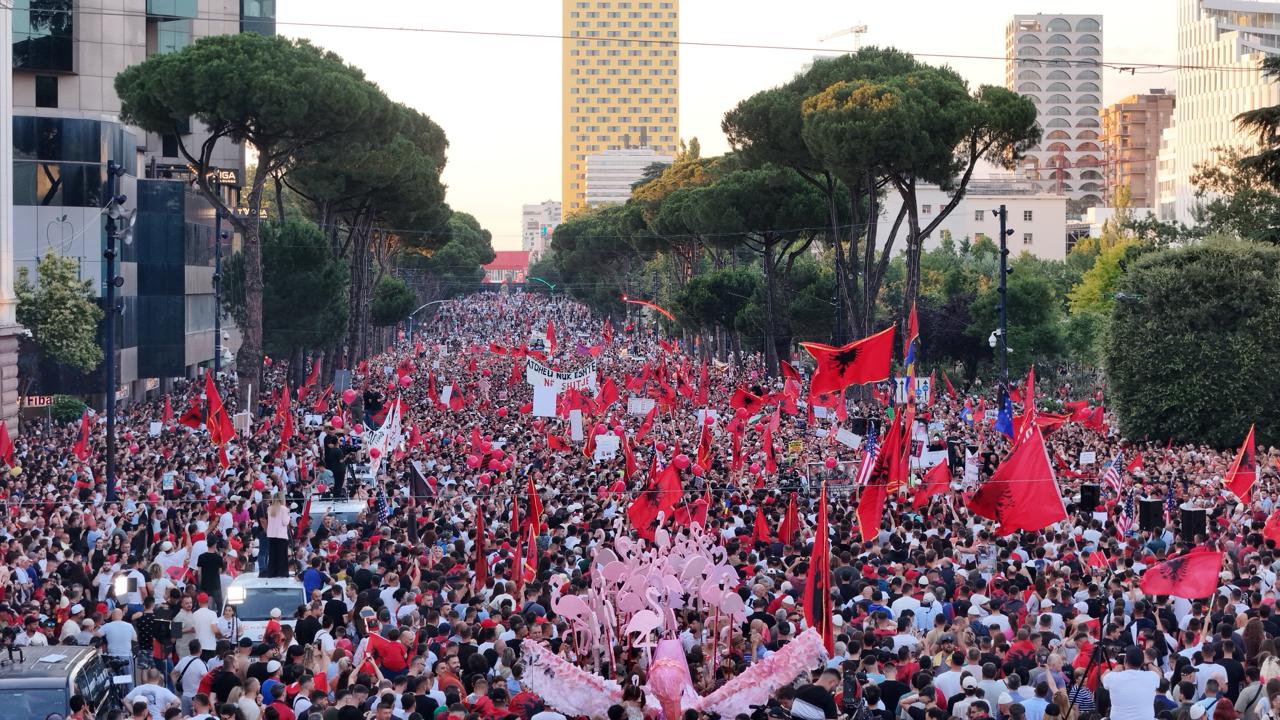
On May 31, the first protest in Tirana was announced. Emboldened by the impressive turnout, more and more Albanians took to the streets to protest not only the project, but every aspect of the corrupt government that made it possible. Today, there are hundreds of thousands of protesters taking to the streets every day in Tirana, as well as worldwide.
Why This? Why Now?
To understand why Zvërnec broke something open in Albania, you need to understand what Albanians have been living through — and living with — for the past 35 years. The project in Zvërnec summarizes a lot of issues in a neat bow.
Enver Hoxha’s communist dictatorship left the country economically shattered and politically traumatized. What followed was not a clean break. The figures who came next — Sali Berisha, then Edi Rama — represented the dictatorship’s continuation under new branding. They simply adapted, reframed their stories, and kept governing. The same club of oligarchs and their heirs has been redistributing power and wealth among itself ever since.
Rama’s Socialist Party has now been in government for thirteen years. In that time, Albania has become an increasingly attractive destination for foreign tourists — and an increasingly difficult place for ordinary Albanians to live. Wages have stagnated. Rent, food, and fuel prices have risen sharply. The public healthcare system is in a state of managed decay: underfunded, understaffed, and in some facilities, genuinely hazardous. Universities lack basic laboratory infrastructure. Most Albanian households do not have a reliable around-the-clock water supply. And yet the government’s flagship ambition is to advance luxury tourism and privatize public land for profit.
This is the backdrop against which Zvërnec must be understood. Zvërnec showed people that our land, which is sacred to us, is nothing to the ruling oligarchy except a piggy bank waiting to be broken. Laws can be changed at their whim, for their benefit, whenever they want. The rules of the game are fake.
This is not the first time laws were sneakily changed to remove protected area status from a site, just for Kushner. In December of 2025, Kushner’s company Affinity Partners scrapped its plans for a $500 million hotel and luxury complex in Belgrade, Serbia, also after massive protests.
The Revolution Takes Shape
As the movement grew, several species were considered when deciding the symbol for the protests. After all, Narta is a protected area, home to 530+ species. But most people naturally gravitated towards the flamingo, due to its uniqueness and flashy appearance.
Although Zvërnec was the straw that broke the camel’s back, the protest is not laser-focused on this single objective, but rather everything that made this investment possible in the first place. The student protests of 2018 were extinguished when Rama “defeated” the representatives, snuffing out the spark that lit the fire of the protests. To this day, the education system remains a nightmare to navigate for Albanian students, rife with corruption and unwarranted struggles.
This is why the Flamingo Revolution refuses to be represented by any one individual or group.
Some of the main demands are correspondingly broad:
- Cancellation of the Zvërnec project
- Resignation of the entire government
- Cancellation of Law 21/2024, which altered the protected status of natural areas
- Regulation of the “strategic investor” status established under Law 55/2015
- Cancellation of Law 20/2025, known as the Mountain Package
- Cancellation of the sale of 100 000 hectares of agricultural land to foreigners
A Thousand Reasons
If you walk among the protestors and ask 1000 of them what they’re protesting for, you’ll hear 1000 different, equally valid reasons to overthrow the Albanian government.
The sick and dying who have navigated the wreckage of Albania’s public hospitals. Students revolting against the unacceptable absence of laboratories, functioning equipment, and basic dignified conditions in institutions that are supposed to prepare them for the future. Workers whose wages have not kept pace with rent, food, or fuel — people who work long hours and weekends, and still cannot make the numbers add up. Farmers whose produce rots in storage as the government imports from the cheapest overseas sources rather than buying locally. Elderly people who can remember when the promises were different, and who have watched every government make and break them in turn.
This and more has caused the mass immigration of Albanians, who must leave their family and birthplace behind in search of a better life. There are currently more Albanians outside than inside Albania.
The Lie of “Development”
Prime Minister Rama has argued that Albanians should be grateful. The investments in Zvërnec and Sazan will, he says, create jobs. They represent a vote of confidence in Albania’s future. To question them is to be against progress.
This is economic illiteracy 101.
The economic pattern in Albanian investments is predictable. The oligarchs who own these projects will outsource every possible good and service. Overseas workers will be brought in for roles that locals might otherwise have filled, as they already have. Produce will be sourced from wherever it costs least, with local produce fated to rot. The ports through which those goods arrive are, in many cases, already owned by the same interconnected network of interests that owns the resorts.The money flows in a circle that Albanians are largely excluded from, evidenced by other such large projects like the so-called Green Coast. Can we really only hope for the crumbs left behind by people who own the table?
Any country with a sole focus on tourism becomes a nightmare for locals. Rama has been unusually candid about his intentions. He has stated, in public, that Albania should develop “tourism for the elites, not tourism for the masses who bring their food with them.” He means ordinary Albanians. He is describing his own constituents as an inconvenience to be managed.
Development isn’t measured by how much money the oligarchy has, but by how an everyday citizen spends their days.
A Government Against Its Citizens
When I participate in a Flamingo Revolution protest, I keep my phone turned off and my head down. This is because I expect the same tired intimidation tactics that the Albanian government has used for decades – with a technological twist!
Signal Jammers are placed in the area, so that you can’t reliably use the internet to
communicate or find your friends in the crowd. If you connect to free Wi-Fi networks, have your Bluetooth or Airdrop turned on, you forfeit your personally identifiable information to the government.
If you’re paying attention to your surroundings, you will notice the surveillance cameras on top of the Prime Minister’s Office building moving in different directions, tracking faces in the crowd. People clad in all black are seen taking pictures from the top of adjacent buildings or from the windows of the upper floors. Cops in civilian clothes and loyal government defenders will be in the crowd, trying to identify people up-close.
If they have leverage over you, they will use it. They will fire you or one of your relatives that are employed by the government. Calls come from unknown numbers, dropping personal details into the conversation to make clear that you have been seen. The Albanian government punishes democracy in a myriad creative ways.
The traditional media, meanwhile, is silent or actively hostile. Every major outlet in Albania is aligned with either the ruling party or the establishment opposition — a distinction that barely exists in practice, since the two have been in close partnership for years. Both are pro-investment. Both have covered the protests with skepticism or not at all. It has fallen to ordinary protesters, documenting what they see and posting it themselves, to keep the story alive.
After the first week or so, social media algorithms shadow-banned almost all content pertaining to the Flamingo Revolution. If you open the comments section on any post, there’s a good chance you’ll find at least one profile snubbing the protesters. Almost all of them have 0 posts, 0 followers, 0 following. All created very recently. Many speculate that these are either bots or throwaway accounts created by government employees. Rama himself accused protesters of flooding social media with bots, but as the saying goes, “every admission is a confession”.
When Prime Minister Rama first spoke about the situation publicly, he declared: “For as long as I am Prime Minister, the investment in Zvërnec will not stop.” Within days, he was insisting there was no project yet. He has since accused the protest of being orchestrated by foreign agents — Iranians, jealous Greeks, Serbians, Montenegrins, even Kosovars — and by paid operatives of the opposition. His appearances have been disorganized, though he’s always insulting his own people.
What does the EU think about this?
On June 9th, European Commission spokesperson Guillaume Mercier issued a pointed warning: Albanian authorities needed to act “without delay” to avoid jeopardising the country’s EU accession bid. The development, he said, needed to comply with Chapter 27 of the accession negotiations — the chapter on environmental policy.
Marta Kos, the EU’s Commissioner for Enlargement, had previously described Albania as “the best example of the transformative power of enlargement”. On June 15th, her office issued a statement saying the Commission had received assurances from the Albanian government that an environmental impact assessment would be carried out. We were not aware that environmental assessments are done with bulldozers. The fact that construction had already taken place without permits shows us that Kos’s true allegiance is not with the people.
On June 17th, MEPs of the European Parliament voted to adopt a resolution on the 2025
Commission Report on Albania, expressing serious concern about the situation in the
Vjosa–Narta Protected Area and stating plainly that rule of law and EU environmental standards are non-negotiable conditions of accession.
The resolution called specifically for the repeal of Albania’s 2024 amendments to the Law on Protected Areas — the legislation that made the Zvërnec development legally possible in the first place — and called for a moratorium on all new construction inside protected areas until that repeal was achieved. MEPs also raised deep concern about Albania’s Law on Strategic Investments, whose fast-tracked permitting procedures risk bypassing environmental scrutiny across the board.
Our Temporary Conclusion
The movement has no single leader and is making no deals. It has stayed in the streets. It has grown.
Development is not measured by how many resorts are built, or how much money flows to the people who already have it. It is measured by how an ordinary citizen spends their days — whether they have water when they turn on the tap, whether their children learn in buildings that are fit for learning, whether they can afford to stay in the city they were born in. By that measure, Albania has not been developed. It has been sold.
The Flamingo Revolution is the demand for a different answer.
CWBS Analytical Group