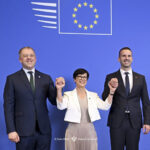
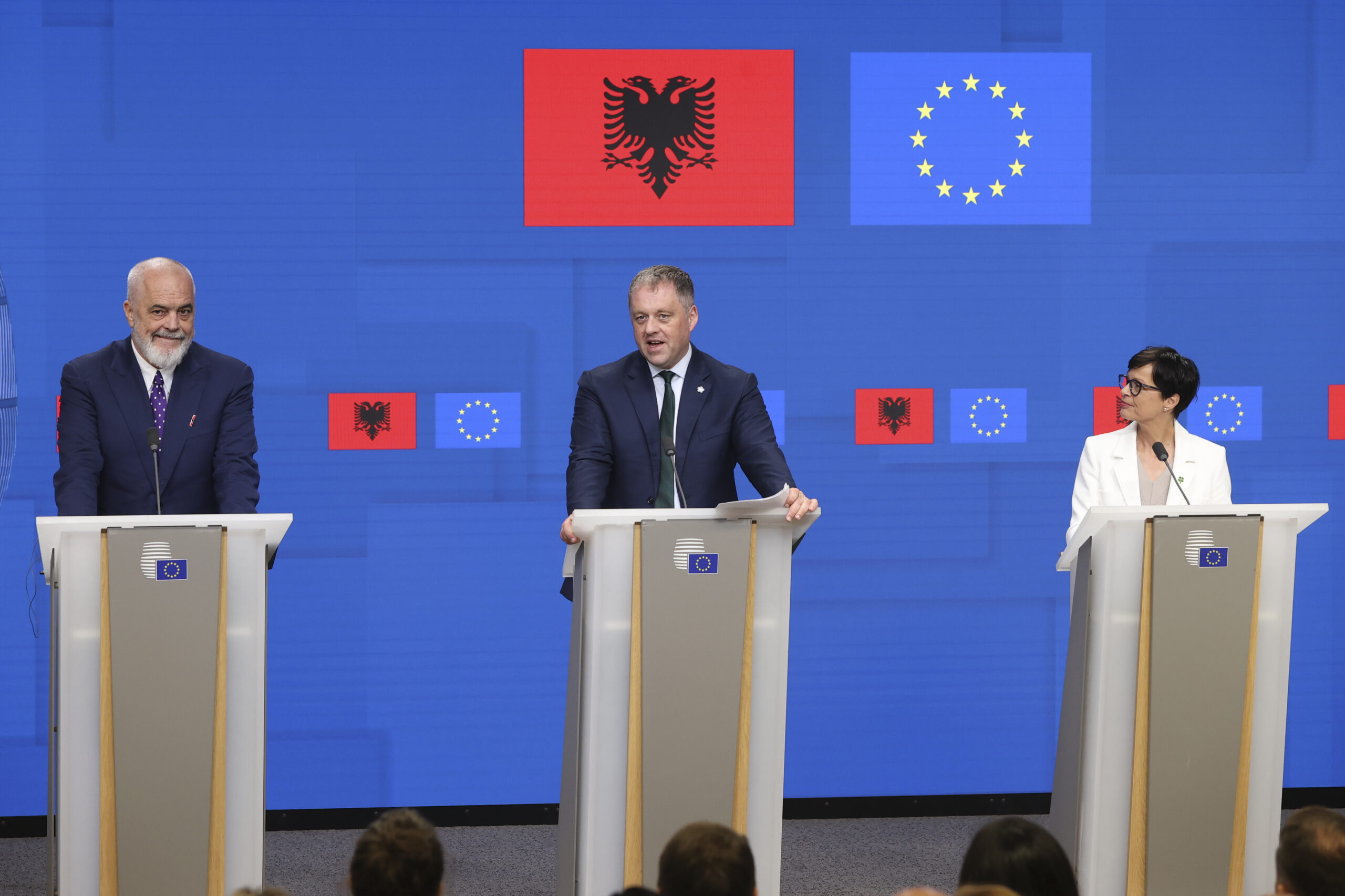
14 July 2026 became a landmark day for the European integration of the countries of South-Eastern Europe, and particularly for the Western Balkans. Four Intergovernmental Conferences were held in Brussels at once—with Montenegro, Albania, Ukraine, and Moldova. European Commissioner for Enlargement Marta Kos literally called the day “Super Tuesday.” For the Western Balkans, its main significance lay not only in the closure of five negotiating chapters—two by Montenegro and three by Albania. The EU effectively formalized a new differentiation within the region: Montenegro definitively entered the final phase of negotiations, Albania began closing chapters for the first time, while Serbia and North Macedonia remain at a standstill—albeit for fundamentally different reasons.
At the 28th Intergovernmental Conference, Montenegro provisionally closed Chapter 8, “Competition Policy,” and Chapter 29, “Customs Union.” Podgorica now has 18 of 33 chapters closed, six of them since the beginning of this year. Thomas Byrne, Ireland’s Minister of State for European Affairs and Defence (Ireland currently holds the Presidency of the Council of the EU), called the country the frontrunner in the enlargement process and recalled that it had already completed more than half of the negotiating path. At the same time, the word “provisionally” is crucial here. The EU continues its monitoring and may return to any chapter before the entire negotiating package is finally agreed. Therefore, formal closure does not yet guarantee that no further questions will arise in the relevant area.
The chapters closed on 14 July have entirely practical significance for Podgorica. Chapter 8 concerns state aid, concentration of capital, and the independence of the competition regulator—sensitive issues for a small economy such as Montenegro’s, where politics and major commercial interests are often rather closely intertwined. Chapter 29 concerns customs procedures, the fight against smuggling, controls on dual-use goods, and the practical implementation of restrictive measures. For a state with the Port of Bar, this has both an economic and a security dimension.
The pace of Montenegro’s negotiating process with the EU is indeed impressive. In January, Montenegro closed Chapter 32, “Financial Control”; in March, Chapter 21, “Trans-European Networks”; and in June, Chapter 2, “Freedom of Movement for Workers,” and Chapter 28, “Consumer and Health Protection.” For negotiations that have been under way since June 2012, this is the most dynamic period. Since April of this year, the EU has already moved on to preparatory work on Montenegro’s future Treaty of Accession. The main question now is whether the country can withstand the final and most difficult stage.
The remaining 15 chapters are unlikely to be closed just as quickly. Particularly demanding and sensitive areas lie ahead: the rule of law, final judgments in cases of high-level corruption and organized crime, the environmental cluster, the independence of regulators, and financial and budgetary obligations.
Relations with Croatia remain a separate risk. Zagreb has repeatedly shown that it can link progress on individual negotiating chapters to a broader package of bilateral issues—the sensitive wartime legacy of the 1990s, the border, property, the status of the Croatian minority, and the controversial resolution on the Jasenovac concentration camp (an issue dating back to the Second World War). The most visible manifestation of this was the postponement in December 2024 of the closure of the technically ready Chapter 31 on foreign, security, and defence policy because of Croatia’s position. Also, during the “Super Tuesday” on July 14, Montenegro failed to close Chapter 14 (Transport Policy) due to a blockade by Croatia. Zagreb has reservations regarding cabotage — the right of foreign carriers to provide domestic transport services in another country — and is concerned about the existing aviation charts, as their current design allegedly could weaken the Croatian negotiating position in the future definition of the border with Montenegro in the area of the Prevlaka peninsula.
The goal of Milojko Spajić’s government to close all chapters by the end of 2026 remains achievable, but the timetable leaves no space for error. Conflict in the Skupština between the majority and the opposition (the previous dispute over amendments to the laws on the Ministry of the Interior and the National Security Agency was resolved only in July 2026), a delay in Chapters 23 and 24 (concerning the judiciary, fundamental rights, and the rule of law), or new Croatian reservations could easily push the finish line into 2027. Membership in 2028 no longer looks unrealistic, but after the negotiations are completed, a unanimous decision by the Member States, the signing of the Treaty of Accession, and its ratification by all EU Member States will still be required. It should also be taken into account that the Russian Federation is interested in obstructing Podgorica’s successful progress on the European path. As Montenegro’s next parliamentary elections (to be held in the summer of 2027) draw closer, further engagement of radical pro-Russian forces can be expected, aimed at destabilizing the situation in the country and discrediting its European course as such. Relevant signs are already being demonstrated by local pro-Russian forces such as Milan Knežević’s Democratic People’s Party and Vladislav Dajković’s Free Montenegro. This distinguishes them from the more moderate New Serb Democracy, which in recent years has moved away from anti-Western rhetoric, at least formally.
On 14 July, Albania took a step that was different in scale but significant politically. At its ninth Intergovernmental Conference, it provisionally closed Chapters 25, “Science and Research,” 26, “Education and Culture,” and 30, “External Relations,” for the first time. The first two traditionally belong to the relatively easier chapters. The third, by contrast, confirms Tirana’s foreign-policy reliability: Albania fully aligns itself with the EU’s common foreign policy and sanctions, including those against Russia.
The precondition was the EU’s May decision that Albania had fulfilled the interim benchmarks in the fundamentals cluster. Thomas Byrne welcomed the progress but immediately called on Tirana to “stay the course” on core reforms. The first three closed chapters are a political milestone, although Albania still noticeably lags behind Montenegro in its overall level of readiness in negotiations.
A more difficult test begins where sustainable results of judicial reform, the independence of institutions, final judgments in corruption cases, and the effectiveness of the Special Structure against Corruption and Organized Crime (SPAK), including its Special Prosecution Office, are required.
Despite this, Albania’s speed is one of the main surprises of the current cycle. It held its first Intergovernmental Conference only in July 2022 and opened all six clusters during 2024–2025. Edi Rama’s government wants to complete the negotiations by the end of 2027. After the first chapters were closed, this objective no longer appears purely propagandistic. However, risks and complications may arise on Albania’s path to European integration because of domestic political tensions in the country, where large-scale anti-government protests have recently taken place quite regularly and Edi Rama’s governance style is toxic to a considerable part of Albanian society. On the other hand, because of the almost complete absence of pro-Russian political forces in Albania, the Kremlin’s ability to exert a negative influence on the country’s European integration is currently extremely limited.
Albania’s European leap is felt most painfully in Skopje. Why is that? The reason is that Albania and North Macedonia formally began negotiations on the same day—19 July 2022. After their tracks were separated in the autumn of 2024, Tirana opened all clusters and began closing chapters, while North Macedonia, which has held candidate status since 2005, has still not moved on to opening the first cluster.
The main obstacle remains the requirement to include Bulgarians in the Constitution as one of the officially recognized national communities—a condition of the 2022 Negotiating Framework. Prime Minister Hristijan Mickoski is demanding guarantees that Sofia will not subsequently put forward new requirements concerning language, history, and identity.
During her July visit to Skopje, Marta Kos made it clear that Brussels was not prepared to guarantee the absence of new bilateral issues before the ratification of the future treaty was completed. In the European Commission’s view, trust must be built by fulfilling commitments already undertaken and developing good relations with the Member States.
Macedonian stagnation is not linked to geopolitical ambiguity. Skopje supports sanctions against Russia and generally aligns its course quite diligently with the EU’s current foreign policy. The country has become stuck where Bulgarian pressure overlapped with domestic fatigue following previous concessions, above all the change of the state’s name under the 2018 Prespa Agreement, which resolved the dispute with Greece by renaming the Republic of Macedonia the Republic of North Macedonia. The current Macedonian authorities fear that another compromise will merely open the next round of demands. The EU does not intend to rewrite the agreed framework, and without a constitutional majority, no rapid breakthrough is in sight.
Serbia’s stagnation is much more domestic in nature. Belgrade’s negotiations have been under way since January 2014: 22 of 35 chapters have been opened, two provisionally closed, and the last cluster was opened in December 2021.
The European Commission continues to regard its 2021 assessment as valid, according to which Serbia technically fulfilled the criteria for opening Cluster 3, “Competitiveness and Inclusive Growth.” However, the necessary political unanimity among the Member States is absent.
According to European Western Balkans, on 8 July, eight Member States—the Netherlands, Belgium, Bulgaria, Croatia, Sweden, Estonia, Lithuania, and Latvia—did not support the opening of the cluster. Their concerns span over the rule of law, pressure on the media, and Serbia’s insufficient alignment with EU foreign policy.
In the European Commission’s 2025 report, the level of such alignment was assessed at 63%, but Belgrade still has not joined the sanctions against Russia. One of the main reasons for Serbia’s stagnation remains precisely Belgrade’s principled refusal to impose EU sanctions against Russia. Since the start of the full-scale war against Ukraine, this issue has changed for Brussels from one of many foreign-policy criteria into a test of a candidate country’s strategic reliability. The Serbian authorities continue to declare their commitment to EU membership and regularly make gestures friendly towards Ukraine (support for territorial integrity, humanitarian assistance, and votes in favour of relevant UN resolutions) but at the same time maintain close political and economic ties with Moscow, which is increasingly undermining the confidence of some Member States in Belgrade’s genuine European orientation.
Added to this are mass protests following the tragedy in Novi Sad, problems with the electoral process, and the absence of visible results in the normalization of relations with Kosovo.
On the same 14 July, the Financial Times published an interview with Aleksandar Vučić in which he proposed admitting the Western Balkan states to the EU as a single package, in a “Big Bang” format. The Serbian President explained this by the desire to avoid creating new borders within the region.
At the same time, it is difficult to separate this proposal from the new reality: the individualised approach shows that Serbia is already falling behind not only Montenegro but Albania as well. Accession as a package would blur the distinction between countries that fulfil the conditions and those that retain a declarative commitment to membership without changing key elements of their domestic and foreign policy.
The events of 14 July showed that the Western Balkans are no longer moving towards the EU at the same pace. Geopolitical realities and circumstances following Russia’s invasion of Ukraine have returned enlargement to Brussels’ agenda, but responsibility for the results remains individual.
Montenegro may complete the negotiations at the end of 2026, although 2027 remains a realistic fallback scenario. Albania will probably continue closing technically ready chapters, but its real test will begin in the fundamentals cluster. The opening of Serbia’s Cluster 3 is still possible as a political compromise, but by itself it will not return Belgrade to the group of frontrunners. In North Macedonia, everything depends on securing a constitutional majority and on the authorities’ ability to convince society that yet another concession will finally open the way forward.
The Brussels decisions taken in July do not promise rapid membership. However, they restore to the process what it had lacked for years: a tangible link between meeting the conditions and achieving a political result. From now on, it will become increasingly difficult to explain delays by a shared “Balkan destiny”—each capital will be responsible for its own place in the queue. Ultimately, any stagnation case in European integration in the Balkans will benefit Moscow and its plans to expand its hybrid influence in this highly security-sensitive region.
CWBS Analytical Group