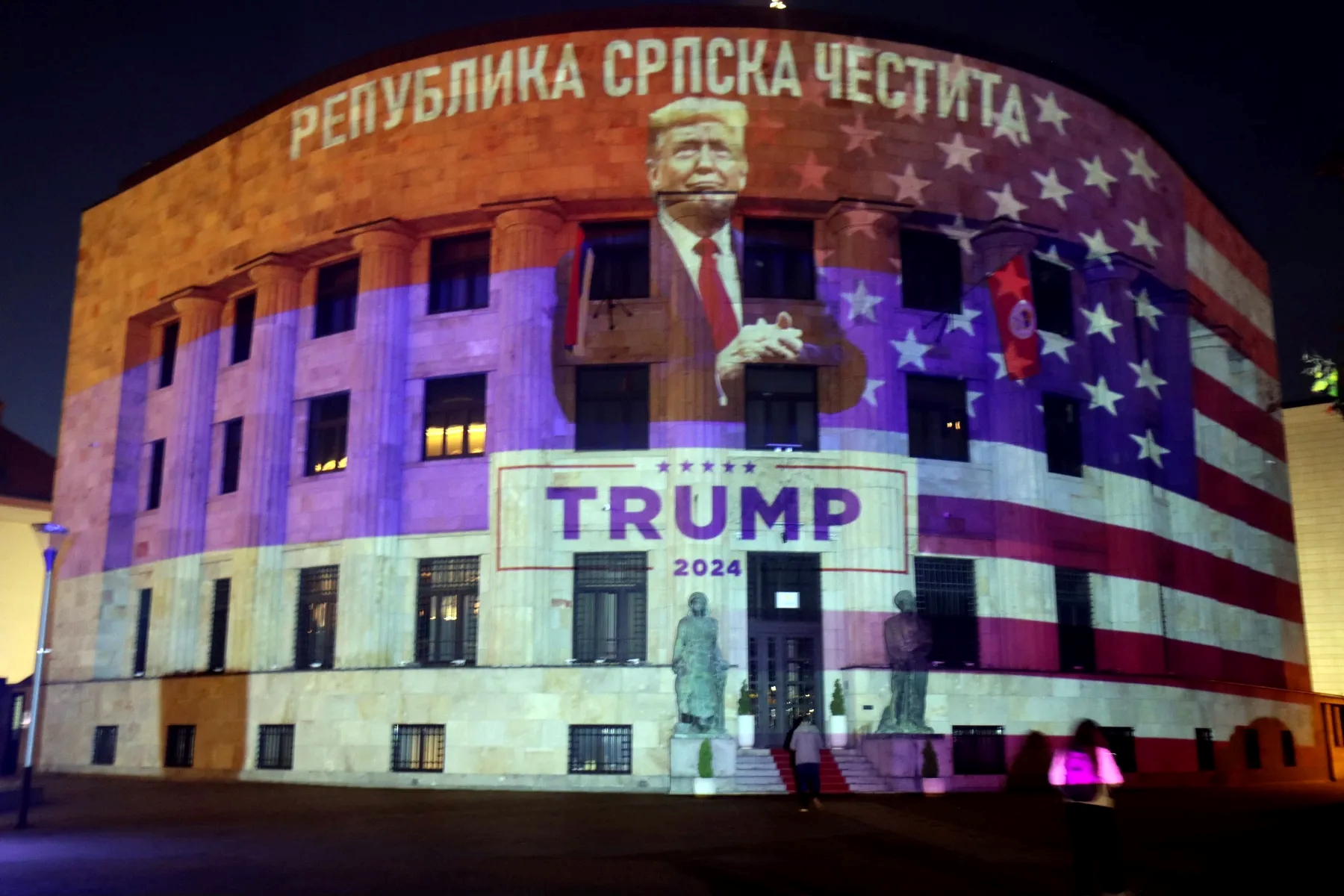
Recent disclosures concerning Republika Srpska’s engagement with influential American political consultants raise broader questions about foreign lobbying, transnational nationalist networks, and the potential intersection of Serbian and Russian strategic interests in Washington.
The controversy surrounding Republika Srpska’s use of politically connected American consultants highlights a broader policy challenge: regional nationalist actors can gain access to Washington while advancing objectives that conflict with U.S. commitments to stability in the Western Balkans. Their engagement deserves scrutiny for its policy aims, financing, and potential conflicts of interest.
According to Reuters and The New York Times, Republican strategists Chris LaCivita and James Blair, both associated with President Donald Trump, traveled to Republika Srpska ahead of the October 4 elections and were reportedly retained by its government. On October 7, Trump said he would terminate their services if their involvement posed a conflict of interest, before subsequently stating that no conflict had been established.
A separate arrangement involves Continental Strategy. Documents filed under the Foreign Agents Registration Act (FARA) show that the firm agreed in February 2026 to provide federal lobbying services to Republika Srpska for $35,000 per month. The Financial Times and CBS News identified Katie Wiles, daughter of White House Chief of Staff Susie Wiles, as a partner. The firm stated that she had not contacted U.S. officials about Republika Srpska and had visited Bosnia and Herzegovina for a separate American commercial client; partner Alejandro Garcia handled its government contacts concerning the entity.
Foreign governments and political entities may lawfully retain American lobbyists, subject to applicable requirements. The significance of these arrangements lies in the access they provide and the agendas they promote. Western Balkan leaders have cultivated relationships across Republican and Democratic administrations because Washington remains influential in regional security, sanctions policy, and diplomacy. Even limited shifts in its position can change local political calculations and perceptions of American commitments.
The “Serbian World” (Srpski svet) provides an ideological context for some of this advocacy. Drawing inspiration from Russia’s “Russian World” (Russkiy Mir), it promotes national, cultural, religious, and political unity across existing borders. Aleksandar Vulin, a former director of Serbia’s Security Information Agency (BIA) and former Minister of Defense and Minister of the Interior, has been a prominent advocate. A longstanding ally of Moscow, he has called for the political integration of Serbs across the region. In July 2023, the U.S. Treasury sanctioned him, citing corruption and activities facilitating Russia’s malign influence in the Western Balkans.
Proponents present the concept as a means of preserving identity and connections between Serbia and Serbs in neighboring countries. Its political implications become contentious when it challenges those countries’ sovereignty or independent foreign-policy choices. The June 2024 All-Serb Assembly in Belgrade illustrated its institutional dimension. The European Parliament subsequently expressed concern that the assembly’s declaration could undermine the sovereignty and territorial integrity of Bosnia and Herzegovina and other states in the region.
The Serbian World is not a single organization with a demonstrable unified command structure. It encompasses overlapping political, religious, media, and institutional networks. The Serbian government, Republika Srpska’s leadership, Serbian nationalist parties in Montenegro, and Serbian-American organizations are distinct actors whose activities require individual examination. Diplomatic engagement, trade, academic exchanges, cultural cooperation, and diaspora participation in American public life remain legitimate and beneficial; the concern is advocacy that weakens the arrangements supporting regional peace.
Several nationalist objectives converge with Russian strategic interests. Moscow’s close relationship with Milorad Dodik and its opposition to Western oversight in Bosnia and Herzegovina reinforce challenges advanced by Republika Srpska’s leadership. The European Commission’s 2025 assessment documented continued high-level contacts between the entity’s authorities and Russia. In Montenegro, the European Parliament has identified foreign information manipulation and interference as threats to democratic institutions and European integration.
Strategic convergence does not require direct organizational control. Campaigns opposing NATO enlargement, delegitimizing Western involvement in Bosnia, or questioning neighboring states’ sovereignty can serve local nationalist ambitions while helping Moscow weaken Euro-Atlantic cohesion. This overlap warrants attention, but does not establish Russian direction or financing of particular Washington lobbying campaigns. Those claims require evidence of transfers, communications, or operational coordination.
Lobbying can shape how disputes are described and which political leaders Washington treats as credible partners. Dodik’s sanctions history illustrates the stakes. The United States sanctioned him in 2017 and again in 2022 for actions threatening implementation of the Dayton Peace Agreement and concerns involving corruption. In October 2025, the Treasury removed him and several associated individuals and entities from its sanctions list. The policy change merits examination alongside efforts to cultivate American intermediaries, although public evidence does not establish that a particular contract caused it.
Dodik’s own account shows how such concessions can be used politically. In an October 11 interview with RTS, reported by Index.hr, he said he learned of the sanctions removal upon arriving in Moscow from Minsk and celebrated in a Moscow restaurant. American accommodation thus becomes a personal victory for a politician who retains close ties to Russia. The policy concern is whether sanctions relief encourages a change in conduct or instead strengthens his standing while leaving those relationships intact.
Financial transparency is essential to assessing these relationships. FARA disclosures should accurately identify foreign principals, activities, payments, and relevant intermediaries. Registration is a disclosure mechanism, not evidence of misconduct. Separately, federal law prohibits foreign nationals, including foreign governments, from making contributions or expenditures in connection with U.S. elections, directly or indirectly. Registered lobbying and unlawful electoral involvement therefore require separate analysis.
An investigation should establish the ultimate sources of lobbying funds, trace payments to consultants and subcontractors, and determine whether campaigns are coordinated across organizations or jurisdictions. Possible connections to Russian financial networks are a legitimate research question given the political relationships involved, but cannot be inferred from shared rhetoric. FARA filings, corporate records, financial documents, and communications offer a firmer basis for attribution.
For U.S. policymakers, the immediate priority is scrutiny of conflicts of interest involving consultants who represent foreign clients while maintaining influential American political relationships. The State Department, working with relevant U.S. and European institutions, should assess the objectives and effects of these campaigns in the context of regional security and Russian influence. Independent researchers and investigative journalists can contribute by connecting financial records with political networks and the messages delivered to decision-makers.
Washington should also sustain engagement with Serbian civil society, independent media, universities, and organizations promoting constructive bilateral relations. A credible response must protect legitimate participation while holding foreign representation to consistent standards of transparency and accountability. The essential policy question is whether access purchased in Washington advances cooperation or helps shield political leaders whose agendas threaten the sovereignty and stability of the Western Balkans.
Ljubomir Filipović. Montenegrin political scientist

The articles published in the “Opinions” column reflect the personal opinion of the author and may not coincide with the position of the Center