- The EU has suspended payments to Serbia under the Growth Plan due to controversial justice laws
The European Union has suspended financial tranches for Serbia within the Growth Plan for the Western Balkans. This was stated by the European Commissioner for Enlargement Marta Kos. The reason for this step was regression in Serbia’s judicial system due to the adoption at the beginning of the year of a package of normative acts known as the “Mrdić laws”.
In January, Serbia adopted a judicial reform that caused sharp criticism both inside the country and at the international level. These changes grant court presidents significantly greater powers over ordinary judges and effectively abolish guarantees of independence for prosecutors. Critics note that the “Mrdić laws” were adopted precisely at a time when high-profile corruption investigations against senior government officials and the ruling party were underway, which may indicate an attempt at political control over investigations.
The advisory body of the Council of Europe — the Venice Commission — published an opinion in which it clearly pointed out the shortcomings of the reform. The main concerns of experts: the reform was implemented hastily, without proper democratic discussion; the adopted laws create risks for the independence of the judiciary. The Commission provided a package of recommendations to eliminate these shortcomings, the implementation of which is now a mandatory condition for receiving money from the EU.
“We have currently suspended all payments under the Growth Plan because the judicial system has regressed. Until this is resolved, they will not be able to receive European financial support,” Marta Kos emphasized.
From the funds of the Growth Plan, Serbia is entitled to a total amount of 1.588 billion euros for the period between 2024 and 2027.
Although Serbian officials emphasize that no official decision has been made to freeze funds from the European Union’s Growth Plan, they simultaneously confirm that the European Commission is waiting for the implementation of the Venice Commission’s recommendations regarding the controversial judicial laws. According to Commissioner Marta Kos, until the situation in the judicial system is “restored”, there will be no further payments to Serbia.
As stated on May 2 by the Minister of European Integration Nemanja Starović, Serbia submitted a request in July 2025 for the payment of the second tranche from the Growth Plan, but the decision on this request is still awaiting consideration by the European Commission. According to the minister, the reason is precisely the judicial laws. Starović emphasized that the Venice Commission’s recommendations regarding the package of judicial laws will be “fully implemented”, and that this issue will be considered by the parliament by the end of May. “We are working intensively on this, a working group has been formed, and during May all recommendations of the Venice Commission will be fully implemented.”
- Early parliamentary elections in Kosovo scheduled for June 7
The acting president of Kosovo Albulena Haxhiu appointed early parliamentary elections for June 7. These will already be the third parliamentary elections in Kosovo in the past year and a half.
The decision to announce the elections was made after the dissolution of the parliament because the deputies were unable to elect a president within the deadline set by the Constitution (by April 29).
On April 28, sessions were convened four times, until midnight, but not once were there 80 deputies in the hall, which are necessary to ensure a quorum. The opposition parties — the Democratic Party of Kosovo (PDK — Partia Demokratike e Kosovës), the Democratic League of Kosovo (LDK — Lidhja Demokratike e Kosovës) and the Alliance for the Future of Kosovo (AAK — Aleanca për Ardhmërinë e Kosovës), as well as the “Serb List”, refused to participate in the voting.
Prime Minister Albin Kurti accused the opposition parties of boycotting the sessions on the election of the president with the aim of deliberately blocking the work of the institutions, calling such actions “unethical and anti-institutional”.
On the other hand, representatives of the opposition parties throughout the process claimed that the process of electing the president of Kosovo was conducted “unilaterally and with a blatant violation of the Constitution of Kosovo”.
According to estimates by the Ministry of Finance, early elections will lead to significant financial losses. In addition to the 10 million euros that the organization of the elections will cost, there will be much greater losses due to the parliament’s inability to approve reforms envisaged by the EU Growth Plan. Thus, Kosovo will not be able to receive 882 million euros from the EU provided under the Plan.
- Energy issues were in focus at the Three Seas Initiative summit
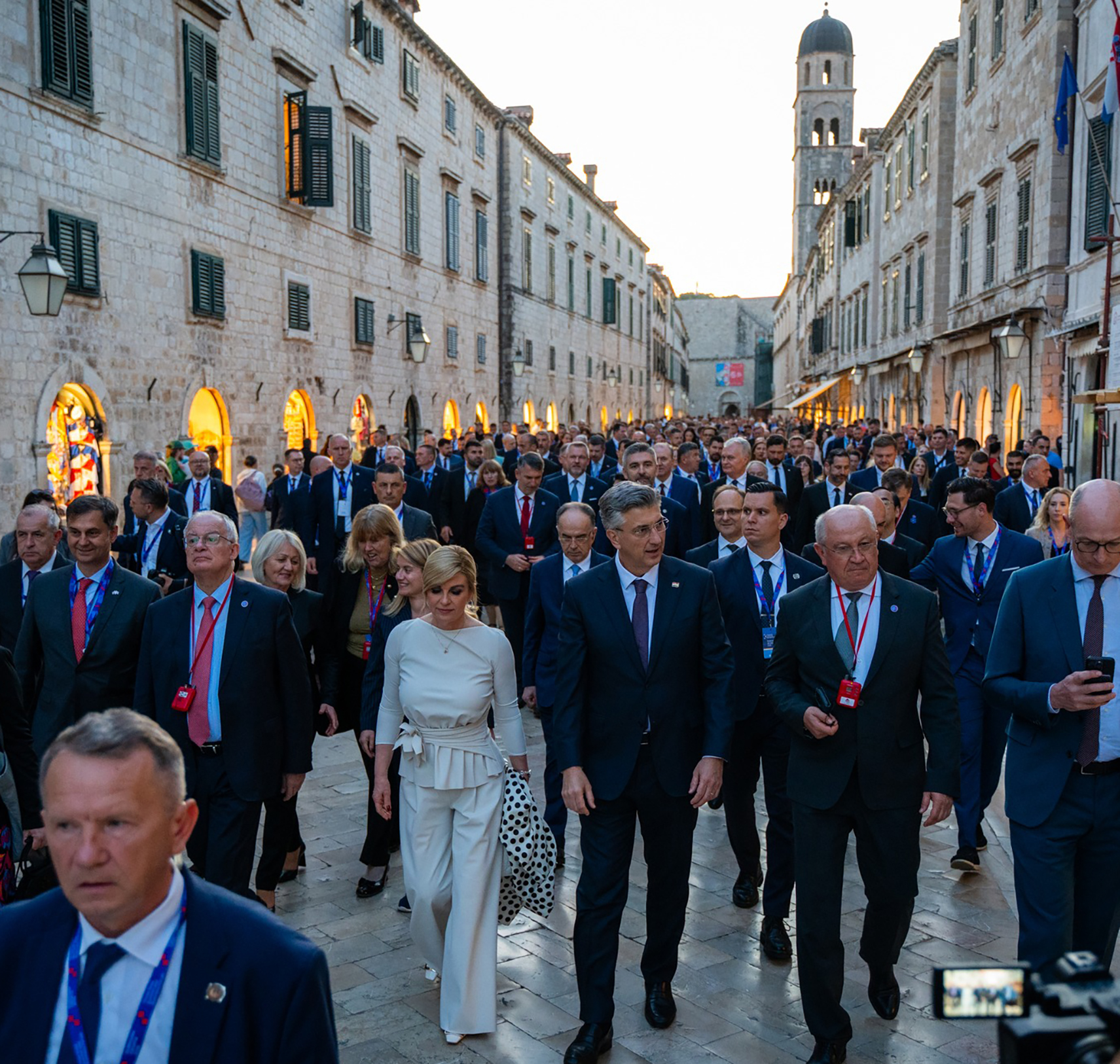
The annual summit of the Three Seas Initiative (3SI) took place on April 28–29 in Dubrovnik. The forum was attended by 1,500 participants from more than 40 countries.
The 3SI Initiative, launched ten years ago by Croatia and Poland, unites 13 EU member states located between the Baltic, Black and Adriatic Seas. The Initiative receives support from international partners, including the United States, Japan and Italy.
The President of Poland Karol Nawrocki stated at the conference that the Three Seas region is one of the fastest-growing in the world. “This is a market that generates a total of 2 trillion euros annually, which is almost 20% of the GDP of the European Union. Together — all 13 countries — we form the seventh-largest economy in the world,” he said during a joint press conference with the Prime Minister of Croatia Andrej Plenković and the President of Slovakia Peter Pellegrini.
Prime Minister Plenković assessed the results of the summit as successful, noting that nine agreements were signed on the sidelines of the event. The most important, he said, was the agreement between Croatia and Bosnia and Herzegovina on the construction of the “Southern Interconnector” gas pipeline, which will connect the gas infrastructure of the two countries.
The document was signed by Prime Minister Plenković and the Chairwoman of the Council of Ministers of BiH Borjana Krišto. The project provides BiH with access to the LNG terminal on the Croatian island of Krk and is expected to become a key element of gas supply diversification for the country, which has been fully dependent on Russian imports since 1979.
At the signing ceremony in Dubrovnik, the U.S. Secretary of Energy Chris Wright was present. The American company AAFS Infrastructure and Energy, which is believed to be connected with Donald Trump’s team, is to provide financing for the project and become the operator of the part of the gas pipeline that will pass through the territory of BiH.
During the summit, the U.S. government and American companies announced billions of dollars in new U.S. investments in Croatia and the region. As noted, this will strengthen energy security, expand digital infrastructure and open new opportunities for American companies.
The largest of the planned projects is American investment in a next-generation data processing center (the Pantheon project) worth more than 50 billion dollars, which is expected to bring Croatia to leading positions in digital infrastructure in the Three Seas region.
“President Trump is launching a new era of cooperation for Central and Eastern Europe. These partnerships are based on our mutual support for the agenda of increasing energy supplies, creating more jobs, broader opportunities and greater investments — all of this is confirmed by the multi-billion-dollar agreements that were signed today,” Minister Wright emphasized.
- Albania signed a $6 billion LNG supply agreement with the U.S. and Greece
On April 28, Albania signed a long-term energy agreement worth 6 billion dollars with the United States and Greece, which provides for the supply of American liquefied natural gas (LNG) and the creation of a large regional energy hub in Vlora. The signing took place on April 28 in the presence of Prime Minister Edi Rama and the U.S. Ambassador to Greece Kimberly Guilfoyle, who arrived in Tirana specifically for the event.
The agreement was concluded by the state company Albgaz, the American Venture Global LNG and the Greek Aktor LNG USA.
The signed agreement provides for the creation in Vlora of a full infrastructure complex for receiving and regasifying LNG, the modernization of the existing thermal power plant and the construction of additional generating capacities. A Fier–Vlora gas pipeline will also be built, connecting the new terminal with the national and regional gas transmission network.
According to the Albanian government, the contract is designed for 20 years and may turn Vlora into a strategic energy center of the Western Balkans, providing access to American LNG for the markets of Southeastern and Central Europe.
Prime Minister Edi Rama stated that the partnership with the United States “is particularly strong due to its comprehensive nature, which combines long-term supply security, the development of critical infrastructure, private sector expertise and a shared geopolitical commitment to energy resilience”.
Ambassador Guilfoyle emphasized that the agreement “advances President Donald Trump’s energy agenda” and “strengthens the region’s energy and national security”.