
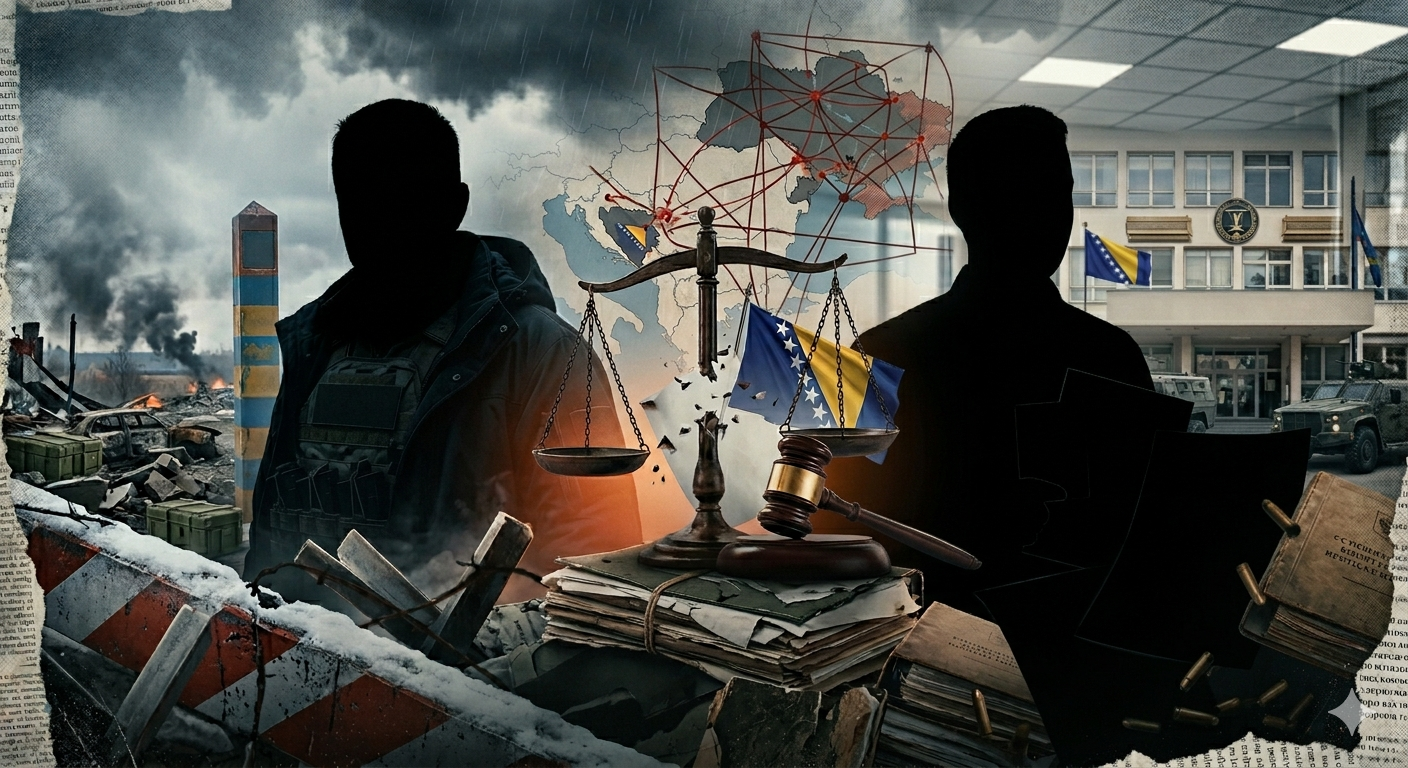
Detektor’s analysis of the cases of Davor Savičić and Dario Ristić shows that Bosnia and Herzegovina faces not only the problem of its citizens joining Russia’s side in the war in Ukraine, but also the challenge of how to respond if they return or face prosecution. So far, there are no clear answers.
While tracing the paths of Bosnian citizens on the Ukrainian battlefield, two cases stood out as more than individual biographies. Davor Savičić from Doboj, known by the codename “Volk”, is suspected in Ukraine of war crimes. Dario Ristić from Modriča, after joining Russia’s side in the war, avoided prosecution in Bosnia and Herzegovina because, according to the court’s reasoning, he had served in the regular army of a state whose citizenship he had previously obtained.
One case raises questions of war crimes and international legal cooperation. The other shows how domestic legislation can become a loophole through which criminal responsibility for joining a foreign battlefield effectively disappears. Together, they test the seriousness of Bosnia and Herzegovina’s institutions.
In Savičić’s case, Ukrainian authorities and organizations have made serious allegations: unlawful detention, abuse of civilians, coercion into making propaganda statements, and violence against captured persons. Detektor clearly stated the limits of its professional responsibility in the article: “Detektor was unable to independently verify these allegations.” That sentence matters because it reminds us that journalism must not pass judgment. But it is equally important that institutions must not remain silent. If a foreign prosecutor summons a citizen of Bosnia and Herzegovina for questioning on suspicion of war crimes, that is not an issue to be ignored. It demands an institutional response.
Savičić’s case is particularly sensitive because it does not concern only an alleged fighter. Previous investigations have linked him to the recruitment of volunteers from the Balkans for the Russian army, while Detektor uncovered his role in communications within recruitment channels. If a person holding Bosnian citizenship is linked both to alleged war crimes and to facilitating the departure of others to a battlefield, the issue is no longer merely legal. It becomes a security, political, and European matter.
The case of Dario Ristić reveals another side of the same problem. He was indicted in Bosnia and Herzegovina for the unlawful formation of and joining foreign paramilitary or parapolice formations. The Court of Bosnia and Herzegovina first returned the indictment for revision, and it was later dismissed because, according to the court’s reasoning, Ristić held Russian citizenship and served in the regular army of the Russian Federation. In other words, what appeared in public to be a classic example of departure to a foreign battlefield became, in the courtroom, a question of citizenship and an exception under Bosnia and Herzegovina’s Criminal Code.
That exception was created at a time when Bosnia and Herzegovina was trying to respond to the departure of its citizens to Syria. But the war in Ukraine has shown that the security context has changed. If a state waging a war of aggression first grants citizenship and only then signs a contract with a volunteer, Bosnian law may exempt that person from prosecution for merely joining a foreign army. This does not necessarily mean the court was wrong. Former judge Azra Miletić summarized the essence of the legal problem as follows: “The court acted as it should have, in accordance with the law.” The problem, therefore, is not necessarily the judge applying the law, but the legislator who failed to foresee how that law could be circumvented.
That is why it is wrong to view these cases solely through the question of individual criminal responsibility. They reveal an institutional pattern: Bosnia and Herzegovina reacts only once a case becomes public, and even then often without a clear response. In Savičić’s case, by the time Detektor published its article, it had not received responses from the ministries of justice, foreign affairs and security, SIPA, or the Prosecutor’s Office of Bosnia and Herzegovina. In Ristić’s case, the justice minister’s office did not respond to questions about possible amendments to the law. Institutional silence here is not neutral. It sends a message that joining someone else’s war can be transformed into an administrative void.
The most dangerous consequence of such a void is not only that someone may avoid prosecution. More dangerous is the model of behavior it creates. If people see that joining the Russian army can be legally covered by a foreign passport, the preventive function of the law collapses. If they see returnees from the battlefield publicly presented as heroes, posting videos of weapons, explosives, drones, and war scenes on social media, then war becomes normalized as an identity-based and political choice. This is no longer only a question of Ukraine. It is a question of Bosnia and Herzegovina.
In an interview with Detektor, Mirza Buljubašić warned of the broader security dimension: “Our security apparatus is also at risk, not only our society.” That sentence explains why returnees from the Ukrainian battlefield cannot be discussed only through court files. People who have undergone military training, established contacts with military and intelligence structures, and gained experience in violence are returning to a society that already has enough political tensions. If the state has no records, no risk assessments, no monitoring programs, and no clear legal framework, the problem does not disappear. It is merely pushed into the future.
That is precisely why comparison with earlier departures to Syria is unavoidable. Bosnia and Herzegovina has developed court practice, databases, and a security narrative around departures to Middle Eastern battlefields. According to data cited in the article, 51 verdicts have so far been handed down for terrorism or departures to foreign battlefields in Syria, while only one verdict has concerned departure to Ukraine — an acquittal in the case of Gavrilo Stević. This imbalance raises the question of political selectivity: does the state treat all foreign fighters equally, or does it react differently depending on ideology, geopolitical direction, and domestic political pressure?
The European context further heightens the issue. Bosnia and Herzegovina is a candidate for membership in the European Union, and cases such as Savičić and Ristić show that alignment with European standards is not an abstract matter from negotiation chapters. It is a question of borders, security, and accountability for war crimes. Estonia and other European countries are already pushing an initiative to ban entry into the Schengen area for people who have served in the Russian army. According to a response from Estonia’s Ministry of Foreign Affairs to Detektor, Estonia has already imposed entry bans on more than 1,300 former Russian fighters.
Data obtained by Detektor from Ukrainian authorities indicate that around 200 volunteers from Western Balkan countries are fighting in the Russian army. That is not a number Bosnia and Herzegovina can afford to ignore, especially if it does not have precise data on its own citizens on foreign battlefields. Without data, there can be no risk assessment. Without risk assessment, there can be no policy. Without policy, there can be no prevention.
Ukrainian interlocutors in the article insist on a message of accountability. Ruslan Deynychenko from StopFake said: “You must know that there are consequences.” That may be the shortest sentence that describes what Bosnia and Herzegovina is currently failing to communicate clearly. Consequences are not only prison sentences. Consequences include investigations, checks, international cooperation, bans on the glorification of violence, security assessments, and a public message that war crimes do not expire in political silence.
For that reason, the solution cannot be limited to a single legal amendment, although such an amendment is necessary. Bosnia and Herzegovina must review the exception that exempts people with dual citizenship from the application of the article on departure to foreign battlefields. It must consider introducing a requirement for prior approval to serve in foreign armed forces. It must clearly distinguish lawful military service from participation in a war that generates allegations of war crimes and violations of international law. It must establish records of returnees, exchange data with partner states, and create mechanisms for responding when serious suspicions of crimes emerge.
But first, it must acknowledge that the problem exists.
The cases of Savičić and Ristić are not closed stories. They are warnings. One shows what happens when a citizen of Bosnia and Herzegovina becomes the focus of Ukrainian suspicions of war crimes. The other shows how domestic law can allow departure to the Russian army to go unprosecuted as a criminal offense. Between them stands a state that wants to join the European Union, but has yet to show that it knows what to do with its own citizens who take part in other people’s wars.
If Bosnia and Herzegovina does not close this legal and security gap, the next case will not be a surprise. It will be a consequence.
Nino Bilajac. Journalist, Detektor.ba

The articles published in the “Opinions” column reflect the personal opinion of the author and may not coincide with the position of the Center