- Vučić Plans to Resign as President of Serbia
In response to a question from the host of Radio Belgrade 1 as to whether he plans to resign within the next three to four months, Serbian President Aleksandar Vučić replied that he might do so “perhaps even sooner.” The president emphasized that it would be a resignation rather than a shortening of his mandate. “I am not going to tell people that I shortened my mandate, I am going to say that I resigned,” Vučić said. To confirm his intentions, he stated that he had already “started packing books” in his office.
In the event of Vučić’s resignation, according to the legislation, the duties of president will be performed by the Speaker of the National Assembly (Parliament) of Serbia, which means that Vučić will be replaced by Speaker Ana Brnabić. Such a period of “acting presidency” cannot last longer than three months. In addition, the law requires that new presidential elections be called within 90 days of the resignation.
Analysts predict that after Vučić resigns from the presidency, he will accept the invitation of his allies from the Serbian Progressive Party and run for the position of prime minister.
Recently, Miloš Vučević, president of the Serbian Progressive Party (SNS) and an adviser to the president, stated that he expects to see President Aleksandar Vučić as the future prime minister because he “still has the energy and knowledge” and “it would be a great shame to lose such capital as he possesses.” Ana Brnabić shares the same view — she announced that the SNS leadership would speak with Aleksandar Vučić about becoming their candidate for prime minister.
According to analysts’ forecasts, the parliamentary elections that will lead to a change of government will be held in Serbia in the autumn, while presidential elections will take place closer to the end of the year.
Speaking in his radio interview about the timing of the parliamentary elections, Vučić said that the elections would be held in several months. “The elections will be held in several months. There will be no elections in July or August, that is certain,” he said.
- EU–Western Balkans Summit Held in Montenegro
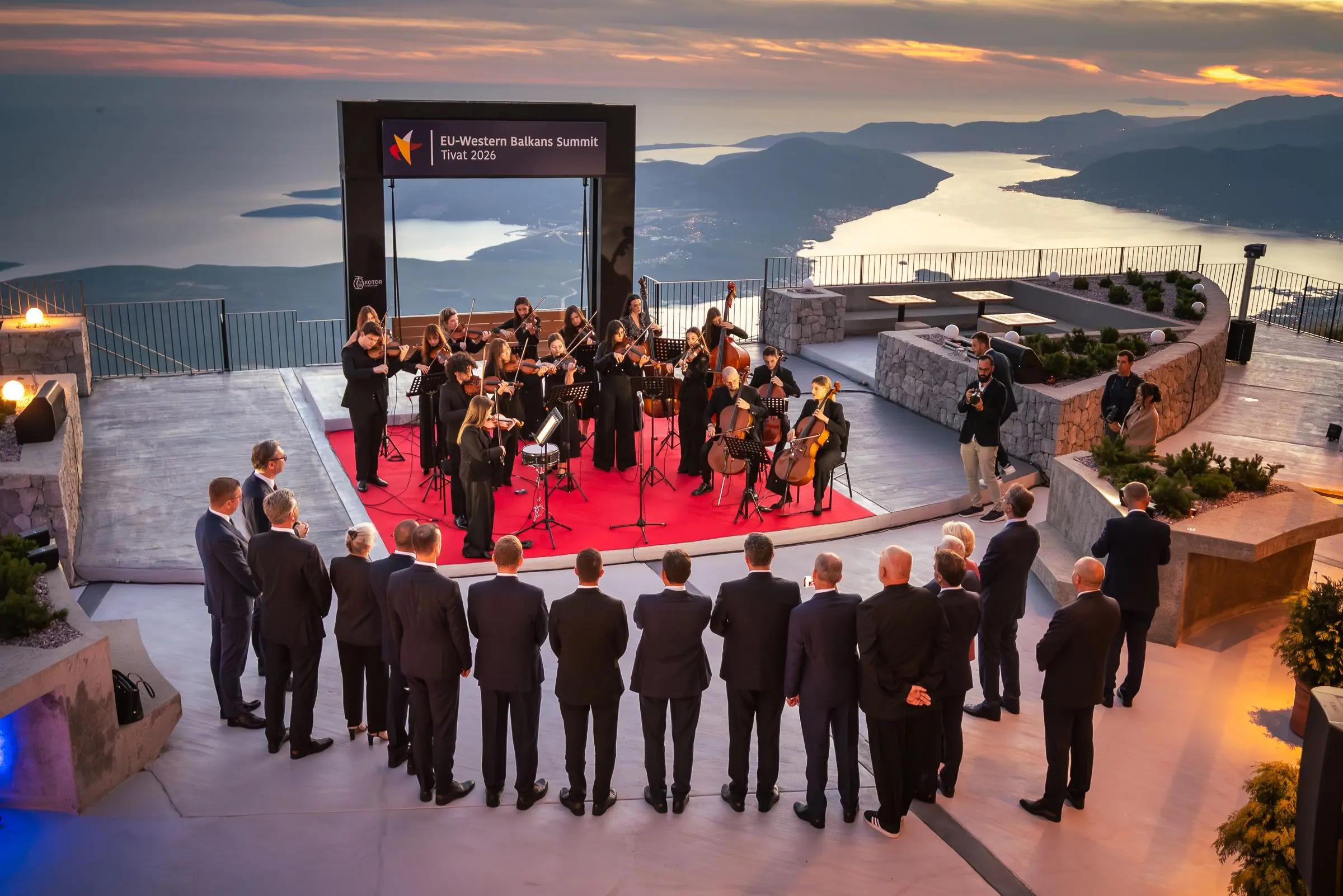
On 5 June, the European Union–Western Balkans Summit was held in the Montenegrin city of Tivat under the slogan “Shared Prosperity and Stability of the EU and the Western Balkans.” The meeting brought together more than thirty foreign delegations, including leaders of EU states and governments, heads of European institutions, as well as representatives of Albania, Bosnia and Herzegovina, Kosovo, Montenegro, North Macedonia, and Serbia. The event took place amid heightened security measures and significant traffic restrictions and was somewhat overshadowed by a scandal related to the unsuccessful attempt of 90 activists of Serbia’s ruling Serbian Progressive Party (SNS) to arrive in Tivat on a charter flight in order to demonstrate support for Aleksandar Vučić.
The forum itself focused on the implementation of reforms necessary for the European integration of the region and the deepening of cooperation with the EU Single Market.
“We are opening sectors of the Single Market to companies from the Western Balkans, and therefore the countries of the region must implement reforms and create a level playing field for businesses, because our investments follow reforms,” emphasized European Commission President Ursula von der Leyen.
“My message to the Western Balkans is clear: now is the time to seize the momentum and deliver reforms,” stressed President of the European Council António Costa.
A distinctive feature of the summit was that the participants agreed not to prepare joint concluding documents or declarations, indicating the difficulty of reaching compromise wording acceptable to all parties.
One of the difficult issues was the foreign policy orientation of the candidate countries, more specifically Serbia’s refusal to join sanctions against Russia.
Following the summit, European Commission President von der Leyen stressed that Serbia has very clear conditions for opening the next, third package of negotiation chapters. According to her, these are reforms in the areas of the rule of law, media freedom, and electoral legislation, as well as alignment with the EU’s Common Foreign and Security Policy.
The EU statement issued after the summit quoted remarks by the President of the European Council, who stated that “the full alignment of our Western Balkan partners with the EU’s Common Foreign and Security Policy remains an essential expression of our unity.”
After the meeting, Serbian President Aleksandar Vučić confirmed that several countries had insisted on the introduction of sanctions against Russia because of the war in Ukraine, which Serbia has not introduced. “That is exactly what they asked of us,” he said.
German Chancellor Friedrich Merz told journalists in Tivat that Serbia must clearly determine where it sees its future. “It is impossible to pursue a policy of wavering between Russia, China, and Europe. Serbia’s path to the EU is open, but it must decide whose side it is on,” he said.
Regular EU–Western Balkans summits have been held since 2020, when Croatia, which at the time held the presidency of the Council of the European Union, proposed annual meetings of regional leaders as recognition of the European perspective of the Western Balkans.
This was the first major meeting of the highest representatives of the European Union and its Western Balkan partners held in Montenegro. Montenegro is expected to become the 28th member of the EU by 2028.
- Early Elections in Kosovo May Not Resolve the Political Crisis
In the early parliamentary elections in Kosovo held on 7 June, the Self-Determination Movement (LVV), the party of current Prime Minister Albin Kurti is leading by a wide margin, although it lost several percentage points compared to the previous early elections held in December last year (43% compared to 51% in December 2025). This means that the ruling party failed to secure an absolute majority in parliament and remains far from the two-thirds majority necessary to form a government on its own and elect a new President of Kosovo.
The opposition Democratic Party of Kosovo (PDK) won 21% of the vote, the Democratic League of Kosovo (LDK) was supported by 17% of voters, and the Alliance for the Future of Kosovo (AAK) received more than 7%.
In municipalities with a Serbian majority, the Serb List won the election, receiving almost 7%.
Another Serbian party, For Freedom, Justice and Survival, led by Nenad Rašić, also participated in the elections and received about 0.8%, mostly in predominantly Albanian areas.
Thus, Serb List will receive nine of the ten seats guaranteed to Serbs, while one seat will go to Rašić’s party.
Voter turnout was significantly lower than in the parliamentary elections held on 28 December last year — only about 36.8% compared to 45%. The decline in voter interest was predictable, as these were already the third parliamentary elections in Kosovo within a year and a half.
It should be recalled that the early elections were called after the Kosovo parliament failed to elect a new president within the deadline set by the Constitutional Court following the expiration of Vjosa Osmani’s term of office in April.
The results of the June elections show that Albin Kurti and his party will be forced to form a coalition with one of the main Albanian opposition parties in order to form a government, ensure the election of a president, and avoid new early elections.
- NATO Mission in Kosovo to Be Reduced Due to “Improved Security Situation”
“As the security in Kosovo remains generally steady, NATO will optimise KFOR’s posture in Kosovo and gradually adjust its current strength over the next year,” a statement by SHAPE (Supreme Headquarters Allied Powers Europe) said.
“With the security situation now stable,” KFOR’s presence “can be adjusted accordingly while effectively maintaining a safe and secure environment for all people and communities living in Kosovo as well as freedom of movement, at all times and impartially, in line with its long-standing UN mandate,” “in close coordination with the Kosovo Police and the EU Rule of Law Mission in Kosovo (EULEX),” the statement emphasized.
“NATO and KFOR are fully committed to safety and security in Kosovo,” and “it is this commitment that has led to increased stability as the security organisations in Kosovo have become more capable,” stated U.S. Air Force General Alexus G. Grynkewich, Supreme Allied Commander Europe (SACEUR). “The current conditions provide an opportunity to optimise KFOR’s size and posture further,” he stressed, reaffirming “NATO’s firm commitment to the Western Balkans, a region of strategic importance to the Alliance whose security is directly linked to security in the Euro-Atlantic area.” According to him, “NATO will not allow a security vacuum to emerge.”
The optimization announced on the occasion of the 27th anniversary of NATO’s mission in Kosovo will be carried out “following a careful review and assessment of the security situation based on intelligence.” The process “will proceed gradually and in accordance with conditions on the ground,” and may be halted “if required by relevant security developments.”
The reduction is expected to take place following “national rotational deployment and redeployment cycles between now and next year.”
There are currently more than 4,600 KFOR troops from 31 countries in Kosovo, significantly fewer than in 1999, when there were approximately 50,000.
As Serbian media noted, the news about the reduction of the NATO mission sends a clear signal that the mission is slowly but steadily moving toward its eventual termination.