- A New Format of Cooperation Among EU Candidate Countries Launched in Belgrade – Conference of Speakers of Parliament
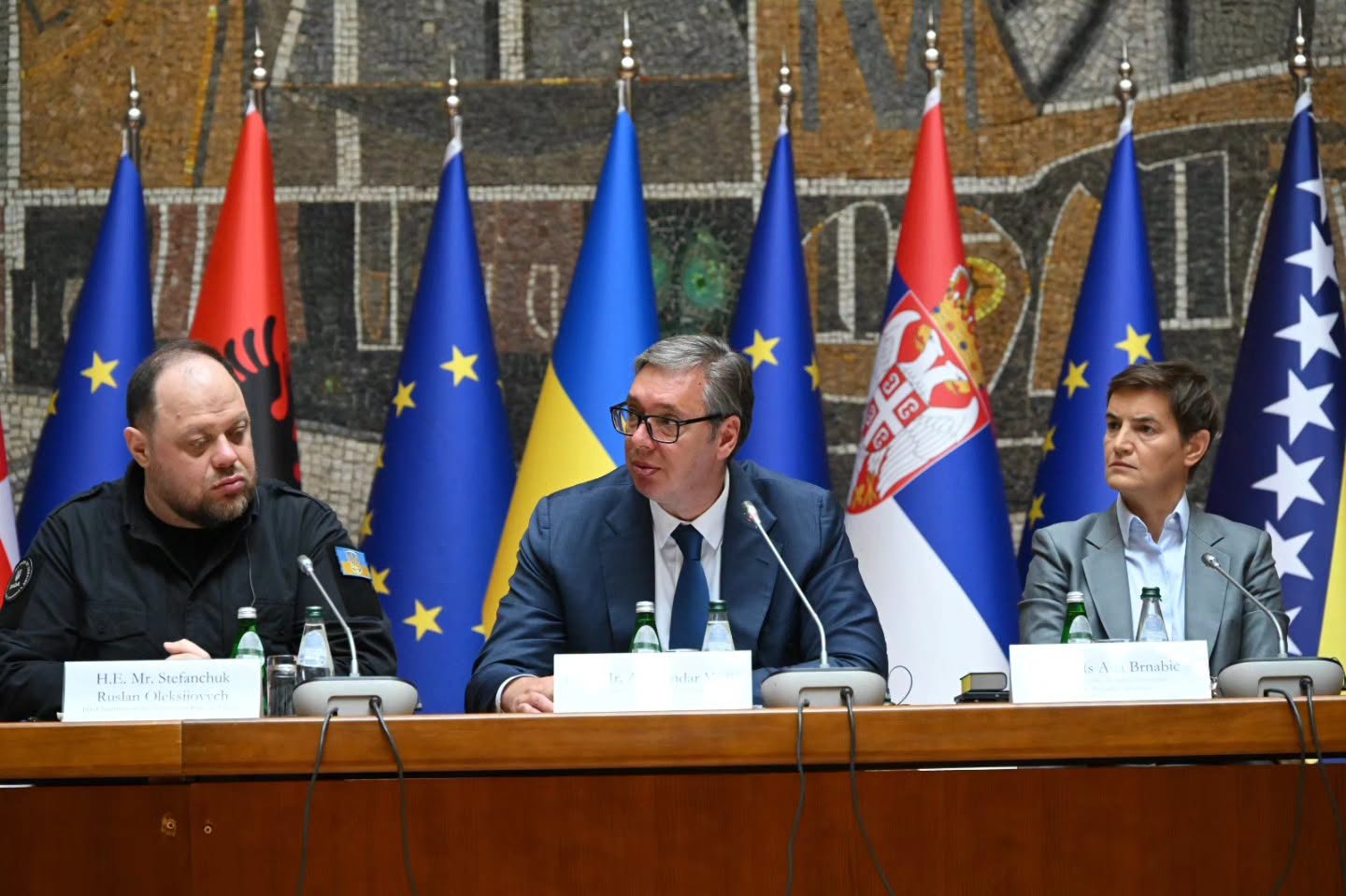
On 7 July, the two-day Conference of Speakers of Parliament of the European Union candidate countries began in Belgrade. The conference is a joint initiative of the National Assembly of the Republic of Serbia and the Verkhovna Rada of Ukraine.
Addressing the participants, Speaker of the National Assembly Ana Brnabić emphasized that “this is the first time that the speakers of parliament of European Union candidate countries have launched a joint initiative to establish regular cooperation.” According to Brnabić, parliaments should play a more active role in strengthening cooperation among candidate countries.
The main objective of the conference is to establish a permanent framework for cooperation among the speakers of parliament of European Union candidate countries, based on regular dialogue, the exchange of experience, and joint initiatives. As Brnabić stressed, the participating countries are at different stages of European integration and face different challenges, making the exchange of experience particularly important.
The conference brought together the highest-ranking parliamentary officials from the European Union candidate countries.
For the Speaker of the Verkhovna Rada of Ukraine, this was the first official visit to Serbia in the past 15 years. In his address to the conference, Speaker of the Ukrainian Parliament Ruslan Stefanchuk informed those present about the devastating consequences of the latest Russian missile attacks on Kyiv and expressed his gratitude to the Serbian side for its support of Ukraine.
On the eve of the conference, in an interview with Euronews, Ana Brnabić stated that since the beginning of Russia’s full-scale war against Ukraine, Serbia has provided Ukraine with more than €60 million in direct financial and humanitarian assistance, although not military support.
As part of the visit of the Speaker of the Ukrainian Parliament to Belgrade, Ruslan Stefanchuk held a bilateral meeting with Serbian President Aleksandar Vučić, during which the two sides discussed the current state of bilateral relations and the European prospects of both countries.
- Parliament of Montenegro Votes to Launch the Procedure for Amending the Constitution
The constitutional amendments concern the Judicial and Prosecutorial Council and the Central Bank of Montenegro, which are essential for closing one of the key negotiating chapters in the European integration process—Chapter 23: Judiciary and Fundamental Rights.
At the parliamentary session on 7 July, 74 out of 77 members of parliament voted in favour, while three voted against.
Following the decision to initiate the constitutional amendment procedure—which required the support of at least 54 MPs—the parliamentary Constitutional Committee will prepare draft amendments, which will again be submitted for a vote. This will be followed by a public consultation lasting at least one month, after which the final text of the amendments will be prepared and submitted to parliament for a final decision.
Earlier, representatives of the parliamentary majority and part of the opposition reached an agreement on supporting the constitutional amendments. According to the agreement, amendments to the previously adopted controversial laws on internal affairs and on the National Security Agency (ANB) will be adopted no later than 31 July. By the same deadline, a special working body will be established to monitor the implementation of these provisions.
Members of parliament from the Democratic People’s Party (DNP) did not support the launch of the constitutional amendment procedure. DNP leader Milan Knežević stressed that his party disagreed with the “unjustified” removal from the list of planned constitutional amendments of the provision granting Serbian the status of an official language and announced that the party would continue its political struggle.
Earlier this year, the Democratic People’s Party submitted an initiative to parliament proposing constitutional amendments that would grant Serbian the status of an official language alongside Montenegrin. The initiative failed to secure sufficient support, receiving votes only from members of Knežević’s party and the New Serbian Democracy party of Parliament Speaker Andrija Mandić. Following this, the DNP withdrew from the ruling coalition both at the state level and in Podgorica.
- The National Assembly of Republika Srpska Adopts a Declaration on the Protection of the Vital National Interests of the Serbian People in Bosnia and Herzegovina
The document calls for the restoration of the competencies of Republika Srpska as provided for by the Dayton Agreement and the Constitution of Bosnia and Herzegovina, the closure of the Office of the High Representative, the protection of the Serbian national identity, and the strengthening of ties with Serbia.
The Declaration emphasizes that the competencies of the institutions of Republika Srpska must be protected from being transferred to the level of Bosnia and Herzegovina and that such transfers are contrary to the Dayton Agreement and the constitutional order of Bosnia and Herzegovina. The National Assembly of Republika Srpska considers it necessary to “restore to Republika Srpska, through parliamentary procedures at the level of Bosnia and Herzegovina, including the repeal of a number of decisions by the High Representatives, the Dayton competencies that were taken away from it contrary to the Constitution and the law, with the wholehearted support of part of the international community and the unitarist forces in Bosnia and Herzegovina.” This “includes the termination of the mandate of the Office of the High Representative and the High Representative, and a transition to dialogue and political agreement among all relevant political actors on the future of Bosnia and Herzegovina.”
The Declaration emphasizes the importance of preventing all attempts to seize the property of Republika Srpska and transfer ownership rights to the level of Bosnia and Herzegovina. It stresses that, in this regard, it is necessary to strengthen the legal framework and punish all abuses related to this vital national issue.
The document also calls for further deepening cooperation with the Republic of Serbia in the economic, cultural, educational, infrastructure, security, and all other fields. It emphasizes that cooperation between Republika Srpska and Serbia is not directed against other peoples or neighbouring countries, but is intended to strengthen the Serbian national identity and contribute to peace and stability.
The Declaration also underscores the importance of protecting cultural and historical heritage, the Serbian language, the Cyrillic script, places of worship, and other symbols of Serbian identity.
The document is not legally binding.
Željka Cvijanović, the Serb member of the Presidency of Bosnia and Herzegovina, emphasized that the Declaration is intended to raise awareness of the position and rights of the Serbian people, as well as of the mechanisms through which those rights can be protected.
“Everything that Republika Srpska needs is stated in this Declaration. It (Republika Srpska) wants to achieve this through the National Assembly, just as the Assembly did on 9 January,” said Prime Minister Savo Minić, referring to the decision of 9 January 1992, when the Assembly of the Serbian People in Bosnia and Herzegovina adopted the Declaration on the Proclamation of Republika Srpska.
- Officials of Republika Srpska Continue Contacts with Russian Officials Despite EU Warnings
The European Union has firmly rejected Russia’s destabilizing activities in the Western Balkans and stressed that normal relations with Moscow are impossible as long as Vladimir Putin’s regime continues its war of aggression against Ukraine. This was stated by the European Commission in response to the signing of a memorandum of cooperation between the police of Republika Srpska and the Ministry of Internal Affairs of the Russian Federation in Moscow.
On 23 June, during a visit to Moscow, Republika Srpska Minister of the Interior Željko Budimir signed a document on expanding cooperation with Oleg Baranov, Head of the Main Directorate of the Ministry of Internal Affairs of the Russian Federation for the City of Moscow. Cooperation between the two institutions has been ongoing for more than a decade; however, according to Republika Srpska officials, the new memorandum “further specifies the forms of professional training, exchange of experience, and the organization of joint training exercises.” The full text of the document has not been made public.
Oleg Baranov has been under individual European Union sanctions since 20 July 2023. The sanctions include an asset freeze and a ban on entering EU member states. Brussels has held Baranov and the institution under his command responsible for serious human rights violations in Russia.
The European Commission stressed that although the entities of Bosnia and Herzegovina have the right to develop international cooperation within their competencies, they are obliged to fully comply with the Constitution of the country and the decisions of the state institutions. “Foreign policy in BiH falls under the exclusive jurisdiction of the state, while the entities have a constitutional obligation to assist state institutions in fulfilling their obligations,” the European Commission stated.
Earlier, the European Parliament adopted a resolution on Bosnia and Herzegovina that specifically condemned contacts between the leadership of Republika Srpska and Russian officials who are subject to international sanctions. The European Parliament warned that such actions pose a direct threat to the security and stability of the region.
Nevertheless, despite the EU’s warnings, officials of Republika Srpska have not ceased their contacts with Russian officials.
At the beginning of July, Republika Srpska Minister of Energy and Mining Petar Đokić paid a working visit to Yekaterinburg, Russia. The main purpose of the trip was to strengthen economic ties and participate in an international industrial trade fair.
During the visit, Đokić held an official meeting with Vyacheslav Yarin, Minister of International and Foreign Economic Relations of Sverdlovsk Oblast, where they discussed expanding cooperation in the industrial, economic, and educational sectors. In addition, Đokić visited the company Laboratory of the Future, which specializes in the development of unmanned aerial systems and robotics.
- Serbian Government Minister Attends Farewell Ceremony for Khamenei in Tehran
As an envoy of the Government of Serbia, Minister of Information and Telecommunications Boris Bratina attended the farewell ceremony for the Supreme Leader of the Islamic Republic of Iran, Ayatollah Ali Khamenei, who was killed at the end of February as a result of a US-Israeli attack.
The public learned about the Minister of Information and Telecommunications’ trip through a post by a member of the Iranian government, as well as from the Instagram accounts of the Serbian ministry and Minister Bratina.
Bratina’s visit to Iran drew sharp criticism from the opposition and the public. The opposition Party of Freedom and Justice asked whether Serbian President Aleksandar Vučić had informed the US administration that he was sending a minister to Tehran and stressed that, following this visit, “it is clear that there will be nothing to come of the coordination and harmonization of foreign policy with the European Union, despite the fact that this is one of the key conditions for the ‘unfreezing’ of the European integration process.”
The Minister of Information and Telecommunications stated that he saw no reason why his visit to Iran should be considered problematic. However, analysts stress that the visit of a Serbian government minister to Tehran will have negative consequences for Serbia’s relations with the United States and the European Union.
- Albania Supports the Establishment of the Defence, Security and Resilience Bank
The initiative to establish the Defence, Security and Resilience Bank, a new multilateral financial institution to finance investments in defence and security, was presented by Canadian Prime Minister Mark Carney during the NATO Summit in Ankara.
Belgium, Greece, Latvia, Luxembourg, Romania, Türkiye, and Ukraine will also participate in developing the Bank’s initial policies and rules.
According to the Government of Canada, the Bank will mobilize private capital to finance defence, security, and resilience projects, supporting both governments and small and medium-sized enterprises operating in the defence industry.
The institution will provide low-cost long-term financing, financial guarantees, and loans for priority investments aimed at strengthening the production capacities of member states and supply chains in the defence sector.
The Government of Canada emphasizes that the initiative is a response to emerging security challenges, particularly those resulting from the war in Ukraine, and is intended to increase investment in defence technologies and industrial cooperation among allied countries.
Canada has already invited partner countries to complete their domestic ratification procedures so that the Defence, Security and Resilience Bank can begin operations in 2027.