
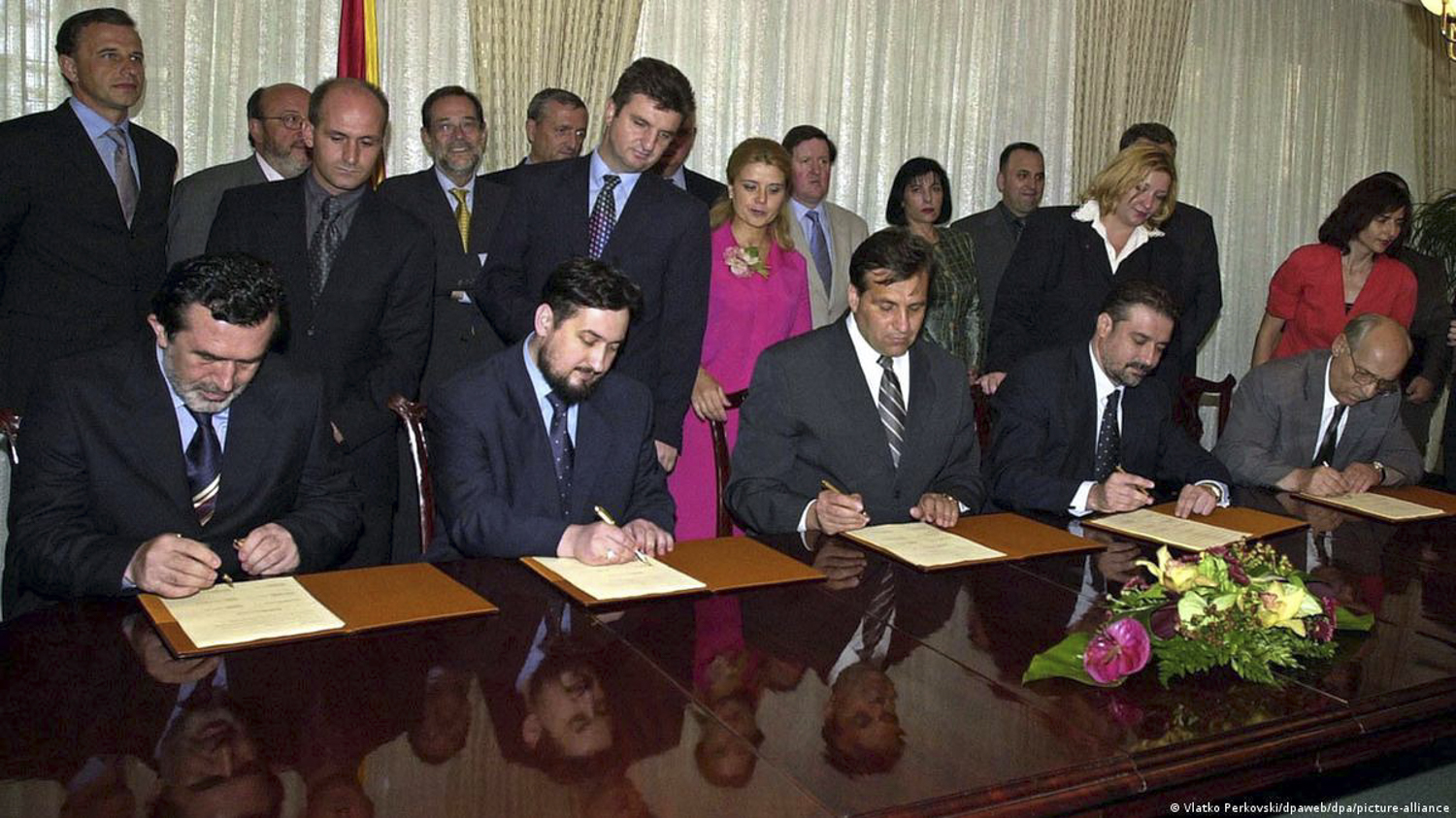
The Ohrid Framework Agreement, signed in 2001, ended the armed conflict in North Macedonia. For 25 years, the country has maintained peace, while two communities that were once at war have been building a common state together. Through joint efforts, North Macedonia has come a long way from a former Yugoslav republic engulfed in fighting to a respected NATO member and a candidate for EU membership. However, the system of government and social relations shaped a quarter of a century ago by the Framework Agreement for the practical purpose of ending the conflict now, after a quarter-century of peace, require reconsideration and improvement.
An Agreement That Silenced the Guns
The Ohrid Framework Agreement was signed on 13 August 2001 by then-President Boris Trajkovski and the leaders of the country’s four largest political parties. Then NATO Secretary General George Robertson said after the signing that it was a “major day for the returning to peaceful and normal life.”
The peace agreement brought an end to months of fighting between Macedonian security forces and ethnic Albanian insurgents of the National Liberation Army (Ushtria Çlirimtare Kombëtare). Seventy-two soldiers and police officers were killed in the fighting, while the number of ethnic Albanian insurgents killed remains disputed, with estimates ranging from around 100 to several hundred. However, unlike the wars in Croatia, Bosnia and Herzegovina, and Kosovo, the armed confrontation was stopped before it escalated into a much greater tragedy, thanks to a political compromise reached through the mediation of the EU and the United States.
The Ohrid Framework Agreement preserved the unitary character of the state, rejecting territorial solutions to ethnic issues. The compromise took the form of constitutional and legislative changes aimed at strengthening the rights and political representation of Albanians.
The implementation of the Ohrid Agreement over the course of a quarter of a century has transformed the country’s political and institutional landscape. The Albanian language has become much more visible in public life and state institutions, while mechanisms of inclusive representation have become part of the political system. Albanians have become significantly better represented in state institutions, the army, and the police, Albanian parties have become a permanent part of governing coalitions, and ethnic Albanian politicians hold the highest offices in the state.
Difficulties of Implementation
The implementation of the provisions of the Ohrid Framework Agreement that envisaged constitutional and legal restructuring did not paralyse the system of public administration or render the state dysfunctional, as happened with other peace agreements in the region (Dayton Agreement in Bosnia and Herzegovina). However, the Ohrid Agreement did not become a final solution to all complex problems and did not provide a comprehensive answer to all contentious issues.
In particular, according to Albanian experts, the interpretation of the Law on the Use of Languages remains a subject of political and legal disputes, while some institutions and municipalities still provide examples of incomplete implementation of legal provisions. In addition, in recent years the principle of proportional representation has not always been applied in a manner that meets the expectations of the Albanian community.
At the same time, many ethnic Macedonians argue that the implementation of the policy of affirmative representation has created unfair conditions in which advantages can be obtained solely on the basis of ethnicity. “There is discrimination that frustrates many in the Macedonian community because Albanians are often given priority in recruitment to meet representation quotas in the public sector,” Stojanče Angelov, a police general during the 2001 conflict, told DW. The existing rules have led to absurd cases in which people changed their ethnic affiliation in order to obtain a job.
In Search of a Common Understanding
Behind the seemingly technical difficulties in implementing the Framework Agreement lie fundamental disagreements. Experts believe that the root of the existing contradictions is that Albanians and Macedonians assess the agreements reached in Ohrid a quarter of a century ago in fundamentally different ways.
“The biggest failure, in my view, is that alongside implementing the Framework Agreement, we did not build a shared understanding of it,” says Vasko Popetrevski, an experienced journalist and editor-in-chief of the programme 360 Degrees, one of North Macedonia’s leading political and investigative journalism programmes. “Over the past 25 years, the focus was on the normative aspects, while very little attention was paid to reconciliation,” he said in an interview with BIRN.
Among Albanian experts, there is a view that part of the Macedonian political establishment and the public accepted the agreement under duress, in the extraordinary circumstances of an armed conflict, while the compromise decisions adopted to expand Albanian rights were and continue to be perceived by the Macedonian majority as a painful loss. “The problem is that even today the Ohrid Framework Agreement does not enjoy broad support among ethnic Macedonians,” journalist and analyst Dželal Neziri explains in a comment quoted by Osservatorio Balcani e Caucaso Transeuropa (OBCT). “There was a perception that Albanians had ‘taken the Macedonian state away from Macedonians’. This duality has accompanied the country for the last 25 years”, researcher and publicist Bekim Adili told OBCT.
Thus, for many ethnic Albanians, Ohrid represents the culmination of a long struggle for greater equality and recognition of rights. Meanwhile, for many ethnic Macedonians, the Framework Agreement remains associated with the armed conflict and with a sense that collective rights and concessions were “forced through the use of weapons.” “One narrative feeds the other,” Popetrevski notes.
However, Macedonians and Albanians have different views not only of the Framework Agreement and the recent history of their country. They have “their own” media, their own political parties, and their own politicians… To describe the current situation, OBCT cites Deputy Foreign Minister Zoran Dimitrovski: “Albanians and Macedonians live divided, although in mutual cohabitation
Through Dialogue
Despite the existing contradictions, the overwhelming majority of experts assessing the 25th anniversary of Ohrid do not predict the outbreak of conflict or destabilisation. Complex and contentious issues related to the implementation of the Framework Agreement and the adaptation of its provisions to present-day realities are noted, but no one disputes the fundamental importance of the Ohrid Agreement for the country’s subsequent development. Attention is drawn to the contradictions that exist between Albanians and Macedonians, but all of them are presented as issues that can and should be resolved through dialogue and the search for mutually acceptable solutions. It is emphasised that the aspiration to join the European Union is a unifying goal for all leading political forces and citizens regardless of ethnic affiliation.
The experts’ conclusions are confirmed by statements made by North Macedonia’s leading politicians on the occasion of the 25th anniversary of the signing of the Ohrid Framework Agreement.
A quarter of a century after Ohrid, its main achievement remains not only the end of the armed confrontation, but also the establishment of coexistence as a necessary condition for the functioning and development of the state and of dialogue as the only acceptable means of resolving disagreements. At the same time, the experience of these years shows that constitutional changes and legal mechanisms are insufficient unless they are supported by mutual trust, fair institutions, and day-to-day cooperation. European integration provides an additional incentive to seek sustainable solutions, but the true resilience of the state will depend above all on the willingness of society, politicians, and state institutions to protect citizens’ rights while preventing the political exploitation of ethnic divisions. Only then will the compromise peace agreement of 2001, having become the foundation of a mature, inclusive, and stable society, fully fulfil its mission and finally become part of history.
CWBS Analytical Group