- Acting High Representative Appointed in Bosnia and Herzegovina
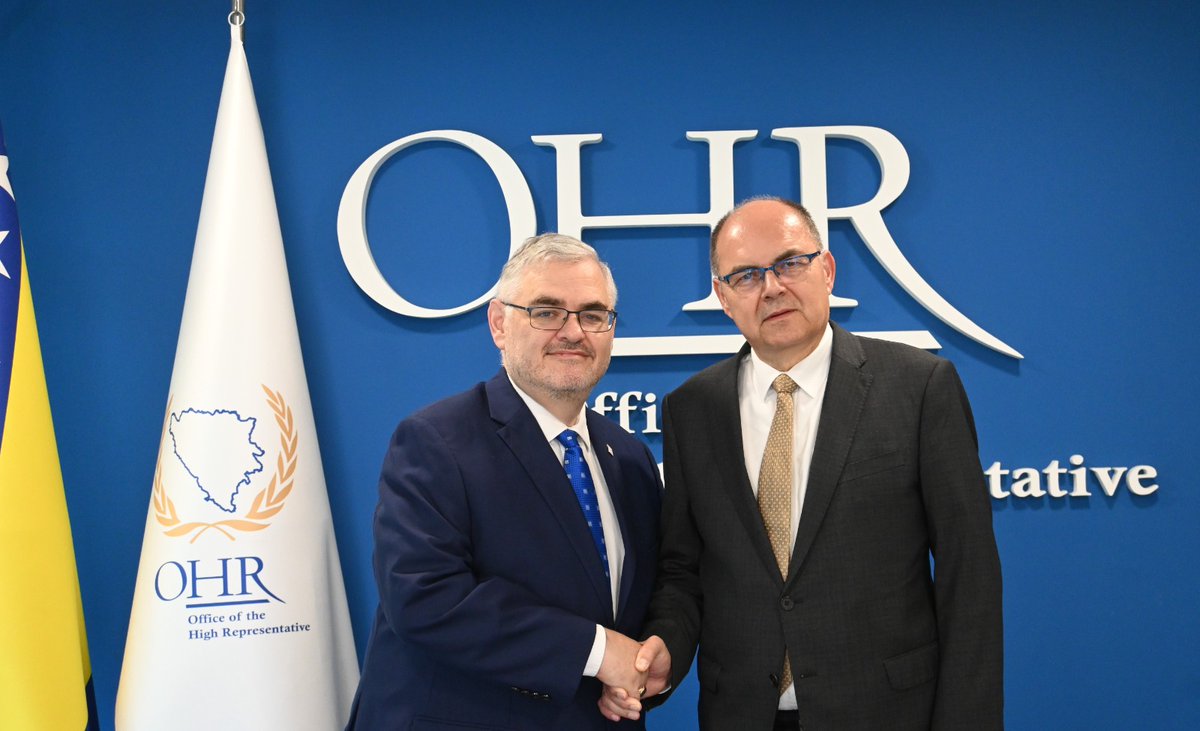
European countries and the United States have failed to agree on a candidate for the High Representative in Bosnia and Herzegovina. At its meeting on 30 June, the ambassadors of the Steering Board of the Peace Implementation Council (PIC) in Sarajevo appointed an Acting High Representative. The position was assumed by the current Principal Deputy High Representative and Brčko District Supervisor, American diplomat Louis Crishock. Crishock assumed the duties of Acting High Representative on 1 July, when the resignation of his predecessor, German diplomat Christian Schmidt, took effect.
Christian Schmidt resigned from the position of High Representative and informed the PIC Steering Board of his decision in May 2026, requesting that the procedure for selecting his successor be initiated.
The PIC Steering Board committed itself to reaching agreement on the appointment of a new High Representative as quickly as possible, with the aim of completing the appointment no later than 14 July 2026. According to Bosnian media, the European members of the PIC do not support the candidacy of Italian diplomat Antonio Zanardi Landi, who was supported by the United States and Italy. For its part, the United States is unwilling to support the candidacy of French diplomat René Troccaz, who has been proposed by Germany and France.
According to experts, since neither of the two proposals has the necessary support, the PIC members have no choice but to seek a compromise solution. According to Klix.ba, a third candidate, also an Italian diplomat, is currently under consideration.
- Serbia Announces Further Purchases of Chinese Missiles
Serbian President Aleksandar Vučić announced a new purchase of Chinese CM-400 quasi-ballistic missiles. “The CM-400 is a formidable missile… We will increase the number” (CM-400 je strašna raketa… Povećaćemo broj), he promised during a visit to military exercises and a demonstration of Serbian Armed Forces equipment on 28 June.
It first became known in March that Serbia had purchased quasi-ballistic missiles from China. However, there is no information about how many of these missiles were purchased or at what price as of yet.
The media note that, according to internationally available arms registers, Serbia is the only country in Europe that possesses these missiles.
The European Union and the United States have repeatedly warned Serbia against deepening military cooperation with China.
In June, the European Parliament’s Committee on Foreign Affairs (AFET) strongly condemned the purchase of Chinese CM-400 missiles, stating that such a procurement runs contrary to common European policy. According to the adopted document, it “raises serious questions regarding Serbia’s geopolitical orientation.”
- Visa-Free Regimes in Certain Western Balkan Countries Pose a Threat to EU Security
Citizens of China, Russia, Turkey, as well as “holders of Jordanian passports of Palestinian origin,” are abusing visa-free regimes in the Western Balkans by first travelling to countries in the region and then attempting to continue their journey into the European Union, Frontex warns in its 2026–2027 Annual Risk Analysis.
The report emphasizes that the incomplete alignment of the visa policies of certain countries in the region (Serbia, Bosnia and Herzegovina, and Montenegro) with EU visa policy continues to facilitate the use of the Western Balkans as a springboard for illegal entry into the EU. For several years, the European Commission has been calling on the Western Balkan countries to align their visa policies with EU rules in order to reduce the risk of irregular migration.
In addition, experts stress that the security risks associated with maintaining visa-free entry, particularly for Russian citizens, must also be taken into account.
“It is known that Russian citizens have engaged in certain hybrid activities both outside the EU, in the Western Balkan countries, but also within the EU. While it is extremely difficult to pass security checks in the EU, whether when issuing visas or entering the country, the situation is different in the Balkans, especially if you have a liberalized regime for Russian citizens,” says Denis Avdagić, a foreign policy analyst at the Institute for New Media Strategies (INMS) (Zagreb).
Montenegro is preparing to align its visa regime with that of the European Union in the near future, as it plans to complete its accession negotiations within a year and join the EU in 2028. Visas for Russian citizens are expected to be introduced in September 2026. On 2 June, Montenegro’s Ministry of Foreign Affairs launched the visa application process through VFS Global in several cities across the Russian Federation.
Serbia categorically refuses to abolish visa-free travel for Russian citizens. In Bosnia and Herzegovina, Republika Srpska maintains the same position, effectively blocking the introduction of visas for citizens of the Russian Federation at the state level.
- Serbia Has Granted Passports to a Record Number of Russians Since the Beginning of the War in Ukraine
In 2025–2026, the Serbian government granted citizenship to a record number of Russian nationals, according to an investigation by Radio Free Europe’s Balkan Service. The number of Russian citizens who received Serbian passports was four times greater than the combined total of all other foreign nationals in the country. Serbia is not a member of the EU or the Schengen Area, but its passport allows visa-free travel throughout the Schengen Area.
In the first five months of 2026 alone, under the accelerated procedure “in the national interest,” the Serbian government granted Serbian citizenship to 44 Russian citizens. Since the beginning of 2022, more than 300 Russians have obtained Serbian citizenship through this procedure. Far more Russian citizens have obtained Serbian citizenship through the standard naturalization procedure.
As journalists note, among the new holders of Serbian passports are Russians who are subject to international sanctions for supporting Russia’s war against Ukraine.
Marko Todorović of the Belgrade-based European Policy Centre believes that by granting citizenship to individuals subject to sanctions, Serbia is jeopardizing its own prospects for European integration and undermining the credibility of the EU, which it seeks to join. “This indicates the existence of Russian influence over certain parts of Serbia’s political and security apparatus, which provide such ‘services’ in the hope that they will go unnoticed—or even with complete disregard for the possible political consequences,” Todorović believes.
A recent informal discussion paper by the European Commission warns that the accelerated acquisition of visa-free access to the EU by an increasing number of Russians through Serbian citizenship constitutes a potential threat to the security of the European Union.