Introduction: “Try to imagine a portrait of Vladimir Putin hanging in the city hall of Hamburg, Kraków, Helsinki, or Lyon. Within hours, the news would spread around the world. Unthinkable, of course! But even if it were hypothetically possible, ministers, ambassadors, European institutions, the media, and human rights organizations would all react. Only one question would be asked: how is it possible that the man responsible for the largest act of aggression on European soil since the Second World War has become the symbol of a public institution? In the Republika Srpska entity, such an image passes almost without any surprise. Moreover, part of the political elite welcomes it with pride.”
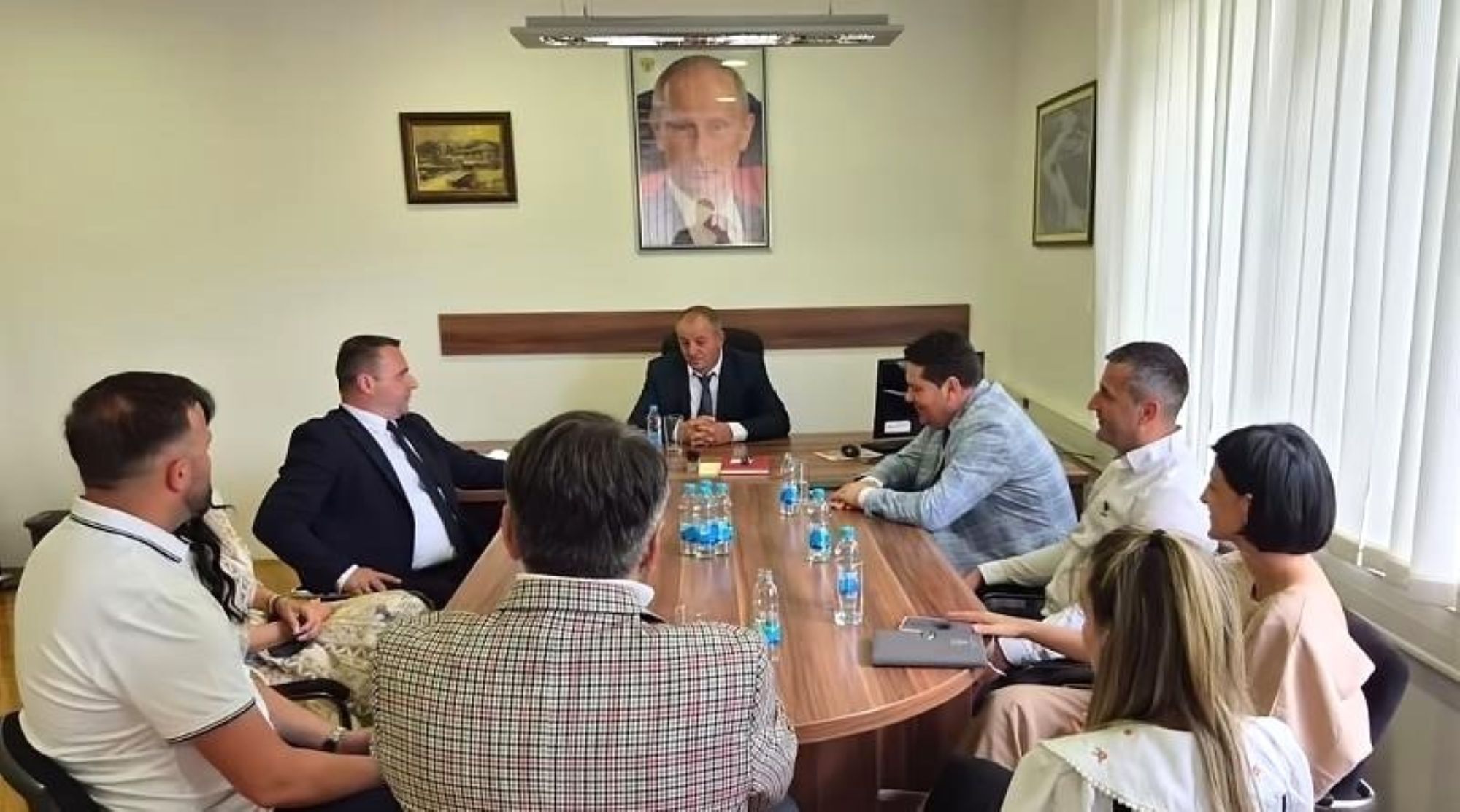
When a person walks through the empty streets of Bileća, a small town in the Republika Srpska entity in southern Bosnia and Herzegovina, past closed shops, dilapidated façades, and houses that are opened only during the holidays for people arriving from Germany or Austria, it is easy to conclude that the town’s greatest misfortune is emigration. However, the real tragedy begins only when one opens the door to the municipal assembly hall. There, from the wall, Vladimir Putin himself watches over everyone present.
And it is precisely at that point that this story ceases to be a story about the small town of Bileća.
The Problem Begins When the Abnormal Becomes Normal and Desirable
The problem is not (only) a single portrait. The problem begins the moment a portrait of a man for whom the International Criminal Court has issued an arrest warrant for war crimes becomes a completely ordinary part of the public space. When it no longer shocks anyone. When local politicians defend it, take pride in it, and present it as a moral and political role model. At that point, we are no longer talking about a single municipality in Herzegovina. We are talking about a process of normalizing crime that is unfolding in the heart of Europe.
Try to imagine a portrait of Vladimir Putin hanging in the city hall of Hamburg, Kraków, Helsinki, or Lyon. Within hours, the news would spread around the world. Unthinkable, of course! But even if it were hypothetically possible, ministers, ambassadors, European institutions, the media, and human rights organizations would all react. Only one question would be asked: how is it possible that the man responsible for the largest act of aggression on European soil since the Second World War has become the symbol of a public institution?
In the Republika Srpska entity, such an image passes almost without any surprise. Moreover, part of the political elite welcomes it with pride.
Delusion as an Instrument of Political Power
The president of the local assembly, Dražen Dunđer, says that he carries Putin in his heart and that “Russia is the motherland of every Orthodox Christian.” One might think he is speaking about a country that has built factories across Herzegovina, created thousands of jobs, renovated schools, financed hospitals, or stopped young people from leaving. None of that exists. There are no Russian investments that are transforming people’s lives in Herzegovina. There are no Russian development projects filling local budgets. There are no Russian factories employing generations of young people.
There is only a fabricated FSB myth.
After all, ask Orthodox Christians in Ukraine what they think of that “motherland.” Ask Georgians who watched Russian tanks roll into their country. Ask Moldovans who have lived with Russian separatism for three decades. Ask Orthodox Romanians, Bulgarians, or Greeks whether they see Russia as their protector or as a state that has spent years trying to destabilize Europe. And soon, ask Armenians as well.
Their answers will be entirely different from what can be heard in Bileća.
For Putin’s portrait has almost nothing to do with reality.
It speaks about the society that hung it on the wall.
It speaks about a political culture that regards an authoritarian leader as an ideal, places force above the rule of law, and turns obedience into a social virtue. That is precisely why Putin hangs in Bileća not despite its poverty, but because of it. He serves as confirmation of a political philosophy that romanticizes destitution, portrays the departure of one’s own children as a necessary sacrifice, and transforms an authoritarian leader into a saviour.
It is a pattern that has long transcended the boundaries of a single town, region, or country.
We see it in the glorification of war criminals. We see it in murals, monuments, decorations, and political speeches. We see it in the fascination with every leader who demonstrates strength, regardless of the price others pay for that display of power. The names change, but the logic remains the same— the leader is worth more than institutions, myth more than facts and reality, and authority more than freedom.
That is why the story of Putin is far more important than Russia itself.
The people who admire him generally have no understanding of reality. What fascinates them is the model of power that Putin represents. A man who answers to no one. A man who decides everything. A man who is permitted what ordinary people will never be permitted.
Such leaders always have their admirers in societies that have long since lost faith in their own institutions.
Because a cult of personality never asks for results.
It demands faith.
Faith does not ask about the number of people employed.
It does not ask about the level of wages.
It does not ask about empty villages.
It does not ask about closed factories.
It demands a symbol.
In Bileća, that symbol is Vladimir Putin.
Why Does Reality Lose to Myth?
The paradox becomes almost painful when we look at reality. The European Union invests millions of euros in the development of local communities in Bosnia and Herzegovina. European economies support thousands of families from Republika Srpska. Germany, Austria, Slovenia, and other countries employ people who could no longer make a living in their own country. European hospitals treat their citizens. European universities educate their children.
At the same time, portraits of a man who is openly waging war against the European order hang on the walls of public institutions.
It is difficult to find a greater political paradox.
A town from which buses carry young people to the West every day — dreams of Moscow. People earn European wages, receive European pensions, and benefit from European funds, while their political gaze remains fixed on the Kremlin. This is no longer geopolitics. It is psychology — or, to be completely frank, the psychopathology of a society that seeks to compensate for its own weakness by identifying with someone else’s power.
That is precisely why the small town of Bileća deserves attention far beyond the local level.
It represents a textbook example of the emerging society that places greater faith in autocracy than in freedom, values myth more than fact, and would rather choose a leader than the future of its own children. Such a society gradually loses the capacity for moral judgment. First, discomfort disappears. Then shame disappears. Finally, the boundary between good and evil disappears. At that point, a man accused of war crimes becomes a perfectly acceptable decoration in a municipal assembly hall.
Perhaps Vladimir Putin’s greatest success is not what he has conquered on the battlefield.
His greatest success is the fact that he has managed to become a completely normal phenomenon in the minds of part of Europe’s marginalized periphery.
When the portrait of a man accused of war crimes ceases to provoke moral shock, then the problem is no longer the portrait, nor even that (non-)man alone.
The problem becomes the society that no longer sees a problem.
When a person leaves the municipal building once again and looks at the empty streets of Bileća, the closed shops, and the buses carrying entire generations toward the West, they realize that the town’s greatest misfortune does not reside in its abandoned houses.
Its greatest misfortune resides in an idea.
In the idea that obedience is a virtue.
That the leader is more important than freedom.
That myth is more valuable than bread.
That authoritarianism is acceptable if it speaks “our language” or is at least “of our faith.”
And that is precisely why Putin’s portrait in Bileća represents far more than a mere photograph of an autocrat.
It is a mirror of a part of Europe in which war crime has become acceptable, authoritarianism desirable, and freedom suspect.
And when that happens, the problem is no longer Vladimir Putin.
The problem is all those people.
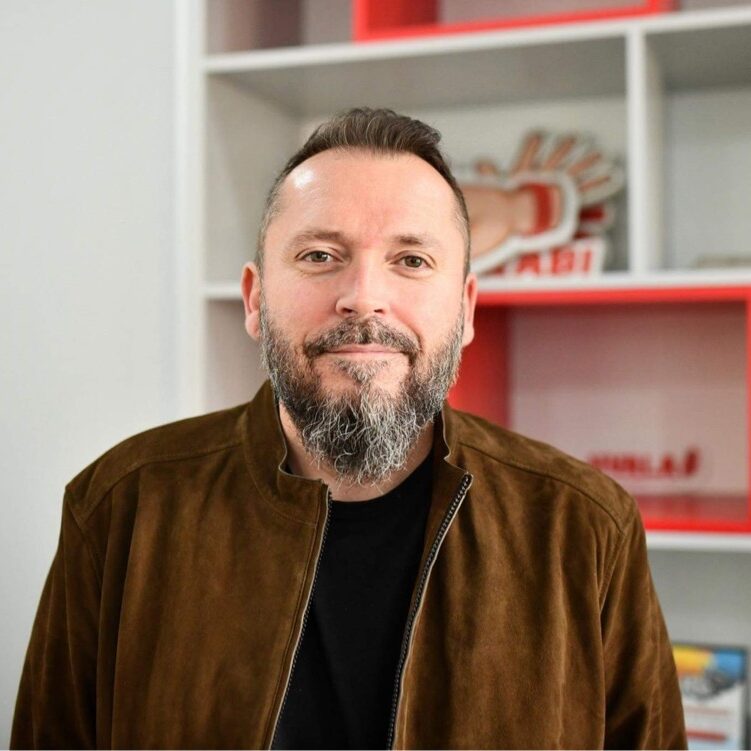
Dragan Bursać. Professor of philosophy, columnist and journalist (BiH).
The articles published in the “Opinions” column reflect the personal opinion of the author and may not coincide with the position of the Center