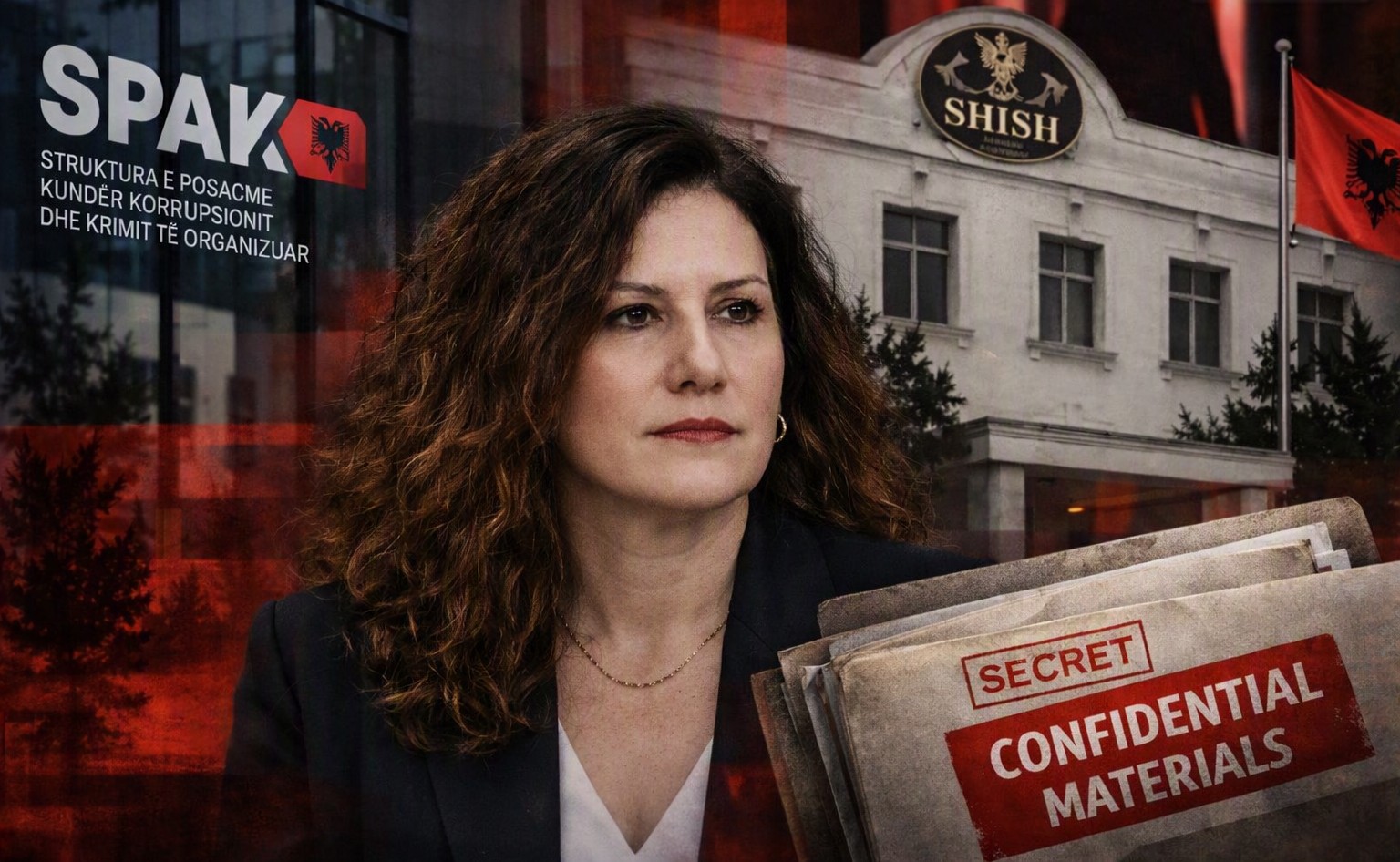
In September 2026, Albania found itself at the center of a major scandal combining suspicions of manipulation of state IT tenders, links to organized crime, and the leakage of classified information. The investigation affected two of the country’s key security institutions — the State Police and the civilian intelligence service – the State Intelligence Service (SHISH).
On 22 September 2026, the Special Prosecution Office against Corruption and Organized Crime (SPAK) published the ruling of the Special Court against Corruption and Organized Crime (GJKKO) dated 21 September. Under the court’s decision, SHISH Director Vlora Hyseni was suspended from office and placed under house arrest. The country’s top intelligence official is suspected of two offenses: aiding a person who committed a crime and disclosing secret acts or data.
At the time the decision was issued, Hyseni was in Baku attending an international counterterrorism forum. After learning of the measure imposed on her, she returned via Pristina on the evening of 22 September and surrendered to the Albanian authorities at the Vërmica–Morina border crossing. That same evening, President Bajram Begaj, acting on a proposal from Prime Minister Edi Rama, signed a decree dismissing her. The duties of acting SHISH director were assigned to the Director of the Operational Department, Elvis Lila.
These events marked the culmination of the investigation into the “AKSHI case,” which began as an inquiry into manipulation of IT tenders but ultimately developed into the exposure of an extensive network involving representatives of business, state institutions, law enforcement agencies, and intelligence services engaged in illegal activities.
Tender Schemes
The National Agency for Information Society (AKSHI) manages Albania’s entire digital infrastructure and the government’s e-Albania portal. Because of its status as critical infrastructure, some of the agency’s tenders were classified for security reasons. As the investigation established, this created fertile ground for corruption.
The public phase of the investigation began in December 2025. AKSHI Director Mirlinda Karçanaj and her deputy Hava Delibashi were placed under house arrest on suspicion of violating equality among tender participants as part of a structured criminal group (in spring 2026, the measures were eased to an obligation to report to the police and a travel ban).
According to SPAK, the agency’s leadership effectively handed control over its budgets to a group linked to businessmen Ergys Agasi and Ermal Beqiri. The case materials refer to 19 tenders with a total value of approximately €59 million. Agasi’s company, EA Solution, received approximately €29 million from tender winners between December 2024 and September 2025. The evidence includes, among other things, footage from a hidden camera in Agasi’s office in which tender procedures were discussed.
Among the winners was, in particular, the company Soft & Solution, linked to Beqiri. At the same time, it showed signs of being a sham company: it operated from Beqiri’s residence, while its employees did not even know that they had been formally registered as employees of Agasi’s company.
In April 2026, SPAK seized assets belonging to individuals involved in the case worth more than €40 million. Beqiri himself was detained in France on 24 July 2026 after flying a light aircraft over the Penly Nuclear Power Plant. French authorities discovered that he owned a château, two apartments, and more than €2 million in bank accounts.
Links to the Police
However, these are not the most scandalous details of the case. Suspicions concerning the creation of an organized criminal group arose after 12 August 2025, when Gerond Meçe, co-owner of a technology company, was abducted by individuals posing as officers of the National Bureau of Investigation (BKH). Through threats, including threats involving weapons, they demanded that he withdraw his complaints concerning AKSHI tenders.
The scheme also extended into law enforcement agencies.
The central figure in the investigation, Ergys Agasi, was detained in Durrës on 26 August 2026 — law enforcement officers stopped a vehicle driven by former Elbasan deputy police director Uljan Shpataraku, with Agasi in the same vehicle. It emerged that Agasi, who had been wanted by SPAK for about eight months, had throughout that period avoided arrest by hiding in private villas near Durrës with the assistance of individual police and intelligence service employees.
As part of this episode, a former head of a sector of the Scientific Police (Policia Shkencore) was taken into custody. He is accused of leaking investigation materials and disclosing classified data, which helped Agasi avoid detention for an extended period. One employee — a senior waiter — of a complex of state government villas near Durrës was also detained; he interfered with video-surveillance systems and deleted camera footage recording visits by senior officials and influential individuals to Agasi while he was hiding from justice.
Intelligence Service Under Suspicion
A turning point in the investigation came with the search of Agasi’s car on 22 July 2026, during which nine pages of classified SHISH diagrams were found.
In addition, according to data obtained from phones seized from individuals involved in the case, Hyseni informed Agasi about closed government meetings and meetings of law enforcement agencies.
The prosecution is also examining information that Agasi used SHISH vehicles while in hiding.
When SPAK questioned Vlora Hyseni on 18 September 2026, she stated that Agasi was allegedly a “classified SHISH collaborator.” The prosecution rejected this version, establishing that no authority inside or outside the service had been informed about such an “informant.”
Another detail is that Agasi’s company, EA Solution, was registered 48 hours before Hyseni was appointed head of SHISH in April 2023.
Refuting the Serbian Connection
Hyseni’s appointment in 2023 was accompanied by controversy. She had previously served as deputy director of the Kosovo Intelligence Agency (AKI), but in 2021 she was dismissed over a “loss of trust.” Some local experts and media outlets later made unsubstantiated allegations and assumptions about a possible leak of information to Serbia, although officially the reason cited was a lack of coordination and trust on the part of the government. Despite this, Rama appointed her as his national security adviser and later as head of SHISH.
In addition, the events of 2026 revived allegations made by the opposition and opposition media in May 2023 that, at the beginning of her tenure at SHISH, Hyseni had allegedly made a secret visit to Belgrade. However, in 2023, the independent fact-checking portal Faktoje refuted the claim that the head of SHISH had spent 10 days in Serbia: on 22 May 2023, Hyseni was in Tirana at the “Defender Europe 23” ceremony. An official SHISH response dated 6 June 2023 also denies that Hyseni made any foreign visits after taking office in the spring of that year.
As of September 2026, SPAK’s criminal proceedings contain no information indicating that information was transferred to Serbia; therefore, the Serbian connection can probably be regarded as a political narrative of the opposition.
Conclusions
Analyzing the situation surrounding the scandalous case, three key consequences for Albania can be identified.
1. A Crisis of Trust on the Part of NATO
In 2025, Hyseni chaired NATO’s Civilian Intelligence Committee (CIC). Following the high-profile accusations, the reputational damage to both the Albanian intelligence service and the NATO structure is significant. It cannot be ruled out that NATO allies will be forced to reconsider the level of trust and the volume of operational intelligence shared with Albania.
2. A Test for the Law Enforcement System
The case represents a difficult challenge for Albania’s anti-corruption system, which must prove instances of systemic corruption within the government, including within security institutions, and punish those responsible regardless of their positions and connections.
Ensuring European rule-of-law standards and fulfilling obligations to combat organized crime and high-level corruption will also be an important test in view of the European integration process.
3. Political Review and Personnel Changes
First and foremost, the Albanian government will be forced to conduct an in-depth audit of personnel policy in the security sector. At the same time, the main conclusion from the AKSHI–SHISH case is that the state must convincingly demonstrate its ability to protect security institutions from the penetration of private and criminal interests. If the authorities fail to meet this challenge, not only the country’s further progress toward the EU but also the stability of the current government will be called into question.
CWBS Analytical Group