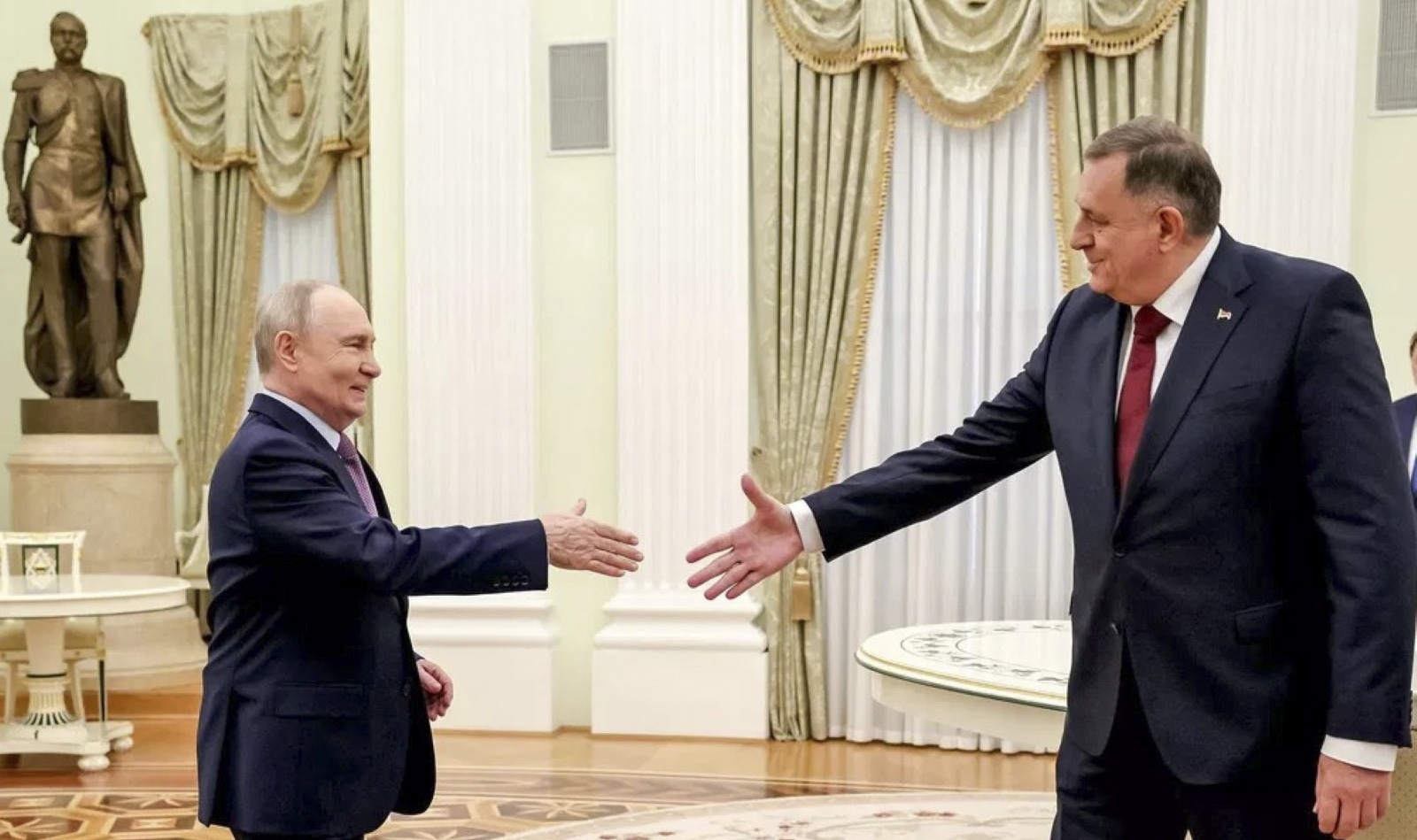
Milorad Dodik was not a candidate in these elections. A court barred him from holding public office for attempting to undermine the constitutional and legal order of the state. And then election night came, his party celebrated, his people won, and he thanked Trump and Putin. If you are looking for a picture of Bosnia and Herzegovina after the elections, you will be hard-pressed to find a better one.
To begin with, this needs to be said: Bosnia and Herzegovina’s electoral system looks like something Franz Kafka came up with after several sleepless nights, so it is worth explaining it briefly.
After the 1992–1995 war, Bosnia and Herzegovina was divided by the Dayton Peace Agreement into two entities: the Federation of Bosnia and Herzegovina, where Bosniaks and Croats make up the majority, and Republika Srpska, where Serbs make up the majority. At the top of the state is a three-member Presidency with a Bosniak, a Croat and a Serb member. Below that come the state parliament, entity parliaments, ten cantons in the Federation, houses of peoples, governments and an entire jungle of mechanisms by which forming a government in this country is difficult, while blocking it is astonishingly easy.
The Dayton Agreement stopped the war in 1995. Thirty-one years later, we can see ever more clearly how many of the war’s political consequences it froze in place.
And then came the elections on 4 October 2026.
The voters sent a message that many will find hard to swallow.
Three Peoples, Three Political Realities
Željko Komšić, the outgoing Croat member of the Presidency and leader of the pro-civic Democratic Front, said one of the most important things of this election night after the heavy defeat of his candidate Slaven Kovačević: perhaps the citizens and peoples of this country simply do not want a civic Bosnia and Herzegovina.
That sentence hurts anyone who, over the past three decades, believed that Bosnia and Herzegovina would one day outgrow the Dayton ethnic and ethnonational divisions.
The ballot box, however, knows no sentimentality.
The SNSD of Putinist Milorad Dodik remained the dominant political force in Republika Srpska. Željka Cvijanović, his closest associate, remains the Serb member of the Presidency of Bosnia and Herzegovina, while SNSD candidate Savo Minić won the race for president of Republika Srpska.
Dragan Čović’s HDZ BiH regained the Croat seat in the Presidency. Darijana Filipović defeated Slaven Kovačević, thereby ending a period of several years during which the Croat member of the Presidency did not come from HDZ.
Among Bosniaks, the picture is completely different. Denis Bećirović of the SDP won a second term in the Presidency, while Bakir Izetbegović’s SDA achieved a strong result at the parliamentary level.
Bosniak Pluralism as an Absurdity
Here we come to one of Bosnia and Herzegovina’s greatest paradoxes.
Bosniaks are today the only one of the three constituent peoples among whom serious political pluralism still functions. Their votes are scattered among the SDA, SDP, NiP, Our Party and an entire range of smaller political options that fight one another for every seat. Among Bosnian Serbs, Dodik’s SNSD has for years functioned as the political centre of gravity. Among Bosnian Croats, HDZ BiH holds an almost hegemonic position.
Thus, the people with the greatest internal political pluralism often have the least negotiating discipline, while homogenised national blocs convert votes into institutional power far more efficiently.
And that is precisely what is yet to become apparent.
Čović Has Only Just Begun
After the elections, an almost touching hope emerged among part of the Sarajevo public: HDZ got the Croat member of the Presidency, Dragan Čović achieved what he had demanded for years, and now, presumably, he will be satisfied.
Anyone who thinks that HDZ’s and Čović’s appetites have been satisfied by a seat in the Presidency does not understand politics.
Because Čović got what he had for years presented as the central proof of the political discrimination of Croats: an HDZ candidate in the Presidency. With that, his most effective argument — that the more numerous Bosniaks elect a political representative for the Croats — also disappeared.
And now comes the bill.
HDZ will demand amendments to the Election Law, additional institutional guarantees, even greater influence over the political system and the preservation of all the mechanisms that allow it, with a relatively small number of votes, to wield enormous negotiating power.
Čović is probably the biggest winner of these elections precisely because he is a master of political bargaining in which he gives the least and takes the most.
His victory ended on 4 October.
Cashing in on it is only beginning.
And Then We Return to Dodik
For years, Milorad Dodik has been the Kremlin’s most reliable political ally in Bosnia and Herzegovina. His relationship with Vladimir Putin has long gone beyond the bounds of diplomatic cooperation. Dodik travels to Moscow, meets with Putin, supports Russian policy, opposes Bosnia and Herzegovina’s integration into NATO and systematically works to ensure that the state remains stuck between Brussels and Moscow.
Just a few days before the elections, he was with Putin again.
Then the elections came and showed one very important thing: a court ruling can strip Dodik of office, but by itself it cannot strip him of political power.
The man who was not allowed to be a candidate showed that he can still control most of the political life of Republika Srpska. His party won, his people secured the most important offices, and his political machinery remained standing.
And after all that, Dodik thanked Trump and Putin.
Those two names say more than ten analyses of the elections in Bosnia and Herzegovina.
Russian Tanks Do Not Have to Reach the Balkans
Russian imperialism in Ukraine is showing its most brutal face: missiles, drones, occupation, destroyed cities, mass graves and an attempt to change borders by force.
For now, it needs much less in the Balkans.
Moscow does not need tanks here. A political system that can be blocked is enough. A local leader who will repeat every morning that the state in which he lives is impossible, temporary and doomed to disintegration is enough. A government that will portray NATO as the enemy, the European Union as a colonial power, Russia as the protector of the Orthodox world, and war criminals from the 1990s as national heroes is enough.
Russian interests in the Balkans have never required the creation of some great pro-Russian empire. That would be expensive, complicated and unnecessary.
It is much cheaper to produce instability.
Bosnia and Herzegovina is an almost perfect country for such a policy: weak central institutions, ethnic vetoes, unresolved war traumas, Serbia refusing to sever its ties with Moscow, and the Putinophile political elite of Republika Srpska linking its own survival to permanent crisis.
Putin does not have to conquer Sarajevo.
It is enough for him that Sarajevo never becomes a fully functional European capital.
Farewell, Civic Bosnia
The second major result of these elections is much more unpleasant for those of us who have for years spoken of Bosnia and Herzegovina as a future civic and multiethnic state.
The civic political option suffered a heavy defeat. A fiasco and a debacle.
We can talk about Dayton, ethnonational elites, the international community, Željko Komšić’s political mistakes, the Democratic Front’s weak cadre, the compromises of the Troika and the catastrophically low turnout of around 42 per cent.
All of that stands.
But so does the ballot box.
It tells us that in 2026, politically active citizens of Bosnia and Herzegovina largely voted within national political spaces.
Perhaps civic Bosnia today has more intellectual advocates than voters.
That realisation is painful, but useful. A civic state will not come into being because we repeat the phrase “civic state” enough times, nor will nationalism disappear because we find it intellectually repugnant.
People have to be won over again.
Because a person in Mostar, Sarajevo, Banja Luka or Srebrenica must have equal rights whether his name is Ivan, Emir or Aleksandar, or whether he belongs to those whom our constitution humiliatingly classifies as “Others”.
The elections merely showed how far we are from that.
The State as a Mistake
Here the Bosnian story ceases to be merely Bosnian.
Russian policy rests on one old imperial idea: some states are historical mistakes.
According to Putinist mythology, Ukraine is an artificial creation. In the rhetoric of Dodik and Greater Serbian nationalism, Bosnia and Herzegovina is likewise an impossible state, a historical accident and a temporary arrangement that will one day disappear.
The methods differ; the pattern is chillingly familiar and identical.
First, you explain to people that the state in which they live makes no sense. Then you convince them that their ethnic identity is worth more than the common state. You declare a neighbouring country to be their true motherland. You turn their own state into the enemy, its institutions into organs of occupation, and every decision you dislike into an attack on your people.
And then you wait for a favourable historical moment.
Bosnia and Herzegovina has been attending this school for thirty years.
That is why the results of these elections should not be read as yet another exotic Balkan story about Serbs, Croats and Bosniaks quarrelling for the umpteenth time.
This is a European story.
The European Union is weakening. Nationalism is growing. The liberal political centre is losing strength. Washington is changing its priorities. Putin is looking for every crack through which he can expand Russian influence without firing a shot.
And Bosnia and Herzegovina is made entirely of cracks.
Putin Can Be Satisfied
After these elections, we will get new parliaments, a new government and endless coalition negotiations. Dragan Čović will cash in on his victory. The SDA will try to regain as much power as possible. The Troika will try to survive its own defeats. Milorad Dodik, without a formal office or with some new political arrangement, will continue to run Republika Srpska and will control Bosnia and Herzegovina.
And above all of that, one image from election night remains.
Dodik celebrates the victory of his people and thanks Trump and Putin.
That is where all the grand philosophy of Bosnian elections ends.
Because Putin’s victory in Europe does not have to look like a Russian flag flying over a conquered city. Sometimes it looks like an election night in Banja Luka, in the middle of a state to which the European Union has been promising a European future for twenty years, while the man who dreams of breaking it apart celebrates and thanks the Kremlin.
Not a single Russian soldier had to travel even one kilometre.
Moscow still got a reason to raise a glass.
Dragan Bursać. Professor of philosophy, columnist and journalist (BiH).

The articles published in the “Opinions” column reflect the personal opinion of the author and may not coincide with the position of the Center