- For the first time, military exercises with NATO are being held in Serbia
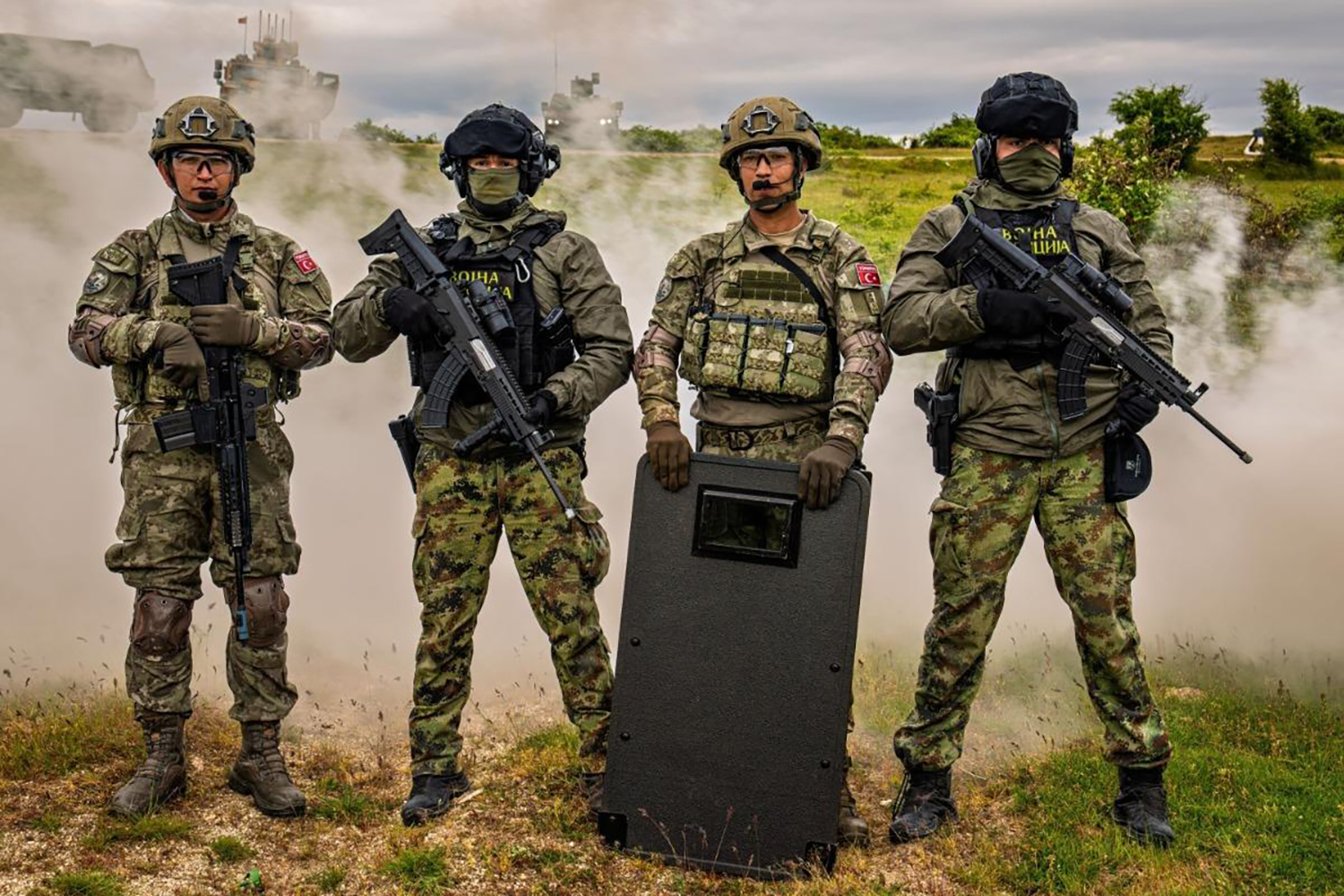
The first joint military exercises of Serbia and NATO (NSE26) are being held at the “South” military base and at the “Borovac” training ground near Bujanovac. The exercises involve servicemen of the Serbian Armed Forces and six NATO countries: Italy, Romania, Turkey, as well as France, Montenegro, and the United States.
The first phase of the exercises lasted from May 13 to 17 and included tactical training activities in support of real peacekeeping operations. The second phase, from May 18 to 22, envisages practicing the scenario of a fictional peace support operation.
NSE26 are the first joint military exercises of NATO and Serbia, organized by the Serbian Armed Forces and the Allied Joint Force Command Naples with the aim of enhancing the level of operational interoperability between the participating troops, intensifying practical cooperation between NATO and Serbia, as well as contributing to the strengthening of regional stability.
The exercises are being conducted on the basis of a decision by the Government of Serbia and are a continuation of cooperation between Serbia and NATO within the framework of the “Partnership for Peace” program, “with respect for” the country’s military neutrality, the Serbian Ministry of Defence stated. “Participation in international exercises improves the ability of the commands and units of the Serbian Armed Forces to carry out a wide range of tasks, including participation in peacekeeping operations, and at the same time confirms the determination of the Republic of Serbia to cooperate with all partners and preserve peace and stability,” the Ministry emphasized.
- The EU Council allocated 15 million euros to strengthen the army of Bosnia and Herzegovina
On May 12, the Council of the European Union approved an assistance measure worth 15 million euros for the Armed Forces of Bosnia and Herzegovina. The funding is being allocated within the framework of the European Peace Facility (EPF).
The main purpose of this step is to strengthen the military and defense potential of Bosnia and Herzegovina. The new decision will complement the support that the European Union had already provided to Bosnia and Herzegovina within the framework of bilateral assistance measures in 2021 and 2022.
Using funds from the European Peace Facility, the Bosnian military will procure personal protective equipment; radiological, chemical, biological and nuclear defense (CBRN) equipment; night vision devices; and cargo transport vehicles.
“If necessary, the funding will also cover related goods and services, including operational training for military personnel,” the EU Council noted.
The European Union emphasizes that this assistance will increase the operational readiness and interoperability of the Armed Forces of Bosnia and Herzegovina.
In addition to defending their own country, this will strengthen their potential for participation in EU Common Security and Defence Policy (CSDP) missions, as well as in international coalitions.
“The EU remains a very reliable partner of Bosnia and Herzegovina and makes the largest financial contribution to the security sector,” Luigi Soreca, the European Union Special Representative and Head of the EU Delegation to Bosnia and Herzegovina, stated on May 13 during a roundtable organized by the commander of EUFOR. The Head of the EU Delegation emphasized: “Just yesterday, the EU approved 15 million euros for the Armed Forces of Bosnia and Herzegovina, and since 2021 this support will reach 50 million euros, which is a clear signal of the strategic importance that the EU attaches to engagement in Bosnia and Herzegovina.”
- Serbia and North Macedonia joined the Vertical Gas Corridor
This was announced at a meeting of the heads of the energy ministries of Greece, Serbia, North Macedonia, and Bulgaria in Athens.
“We agreed on the expansion of the Vertical Gas Corridor with North Macedonia and Serbia, as well as on the institutionalization of cooperation among the four countries,” said Greek Minister for the Environment and Energy Stavros Papastavrou.
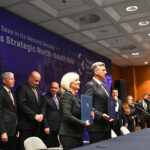
The meeting was attended by Greek Minister of Environment and Energy Stavros Papastavrou, Serbian Minister of Mining and Energy Dubravka Handanović, North Macedonian Minister of Energy, Mining and Mineral Resources Sanja Božinovska, Bulgarian Deputy Minister of Energy Kiril Temelkov, as well as the heads of the electricity and natural gas transmission system operators of Greece, Serbia, North Macedonia, and Bulgaria.
The Vertical Gas Corridor unites the infrastructure of the countries of Southeastern Europe, ensuring the transportation of gas from sources alternative to Russian ones. The accession of Serbia and North Macedonia creates the possibility for a full-fledged gas flow from south to north, which allows the countries of the region to receive larger volumes of gas not from Russia.
The main topic of the meeting of high-ranking energy officials from Serbia, Greece, North Macedonia, and Bulgaria in Athens was the Greece–North Macedonia and North Macedonia–Serbia gas interconnector projects. The first pipeline is under construction, and its completion is planned for this year. It will make it possible to supply natural gas northward from Greek liquefied natural gas (LNG) terminals, as well as pipeline gas, for example from Azerbaijan.
Minister of Mining and Energy Dubravka Handanović emphasized that construction of the gas pipeline between Serbia and North Macedonia is planned to be completed by the end of 2027. The section will have a capacity of one and a half billion cubic meters.
Minister of Energy, Mining and Mineral Resources Sanja Božinovska emphasized that North Macedonia, for its part, is working on a connection with Greece. “By the end of next year we will be ready, and the Greece–North Macedonia–Serbia connection will become operational,” she noted.
- The Brdo–Brijuni Process summit will take place in North Macedonia
The annual Brdo–Brijuni Process summit, which was supposed to take place in May in Croatia but was cancelled due to the deterioration of relations between Zagreb and Belgrade, has been moved to North Macedonia and is scheduled for October. This was stated by Slovenian President Nataša Pirc Musar during a joint press conference with President of North Macedonia Gordana Siljanovska-Davkova.
The Brdo–Brijuni Process was launched by Slovenia and Croatia in 2013 as a platform for promoting the European integration of the Western Balkan countries and supporting regional cooperation. The participants are Serbia, Montenegro, Bosnia and Herzegovina, Kosovo, North Macedonia, and Albania, as well as the initiators — Slovenia and Croatia.
Croatian President Zoran Milanović at the end of March cancelled the summit that was to take place in Croatia because of the “political statements and actions of the President of Serbia,” which “contradict the goals of the Brdo–Brijuni Process, worsen interstate relations, and threaten the stability of the region.” Before that, Aleksandar Vučić had for more than a year accused Croatia of interfering in Serbia’s internal affairs and of Zagreb planning to attack Serbia.
Holding the summit in North Macedonia will allow Skopje once again to draw attention to the problem of the country’s lack of progress on its European path because of the demands of neighboring Bulgaria.
- The EU puts forward conditions regarding Kosovo’s European integration
In Pristina, it is believed that Kosovo should receive official candidate status for accession to the EU and begin accession negotiations. “41 months after we applied for EU membership, it is time for Kosovo to receive its candidate status and open the accession negotiations,” Acting Prime Minister Albin Kurti wrote on social media following meetings with EU Commissioner for Enlargement Marta Kos.
Kosovo declared independence from Serbia in 2008, submitted its application for EU membership in 2022, and currently has the status of a potential candidate.
During her first official visit to Kosovo, Kos stated that Kosovo’s progress in negotiations on accession to the European Union would depend on the implementation of reforms, progress in negotiations on the normalization of relations with Serbia, and political stability. “There is a place for Kosovo in the European Union and in the accession process,” Kos said, but noted that “Kosovo urgently needs to catch up on EU-related priorities” and that “Kosovo needs stable institutions and an effective government.”
Marta Kos’s visit took place on the eve of the early elections (June 7), which were called after parliament was dissolved due to the inability to elect a president. These will already be the third parliamentary elections in the past year and a half and the second early elections in six months. The absence of political stability and fully functioning institutions, among other things, stands in the way of adopting the decisions necessary for European integration.
Other significant obstacles on Kosovo’s path to the EU are the lack of progress in the dialogue with Belgrade and the fact that five EU countries — Spain, Greece, Romania, Slovakia, and Cyprus — still do not recognize Kosovo as a state.
- A Montenegrin municipality “withdrew” recognition of Kosovo
Deputies of the local council (Assembly) of the municipality of Zeta near Podgorica adopted a Declaration on revoking recognition of Kosovo’s independence on the territory of this administrative unit. The decision was supported by representatives of the Democratic People’s Party (DNP), New Serb Democracy, one representative of the Democrats, and three independent deputies. Representatives of the opposition Democratic Party of Socialists (DPS) did not participate in the session, and two deputies from the Democrats left the hall before the vote.
The leader of the Democratic People’s Party of Montenegro, member of parliament Milan Knežević, welcomed the step taken by the municipality of Zeta, emphasizing the historical context of this decision.
The head of the municipality, Mihailo Asanović (DNP), stated that all undemocratic decisions should be corrected not only at the local but also at the state level. He noted that other cities should also adopt such a declaration.
The Democratic People’s Party, known for its loyalty to official Belgrade, until recently was part of the ruling coalition.
Montenegro recognized Kosovo in 2008. Experts noted that such acts by local self-government bodies have no legal impact on the international obligations of the state, because municipalities are not vested with the constitutional right to confirm or revoke recognition of foreign states, since these matters are by law under the jurisdiction of the central government and the Ministry of Foreign Affairs of Montenegro.
The local branch of the opposition Democratic Party of Socialists called this act an absurd and politically motivated decision.
Montenegrin Minister of Public Administration Marash Dukaj, who is a member of the Albanian Alternative party, called the decision of the Assembly of the municipality of Zeta a political act that has no legal force and is a step backward in Montenegro’s process of integration into the European Union.