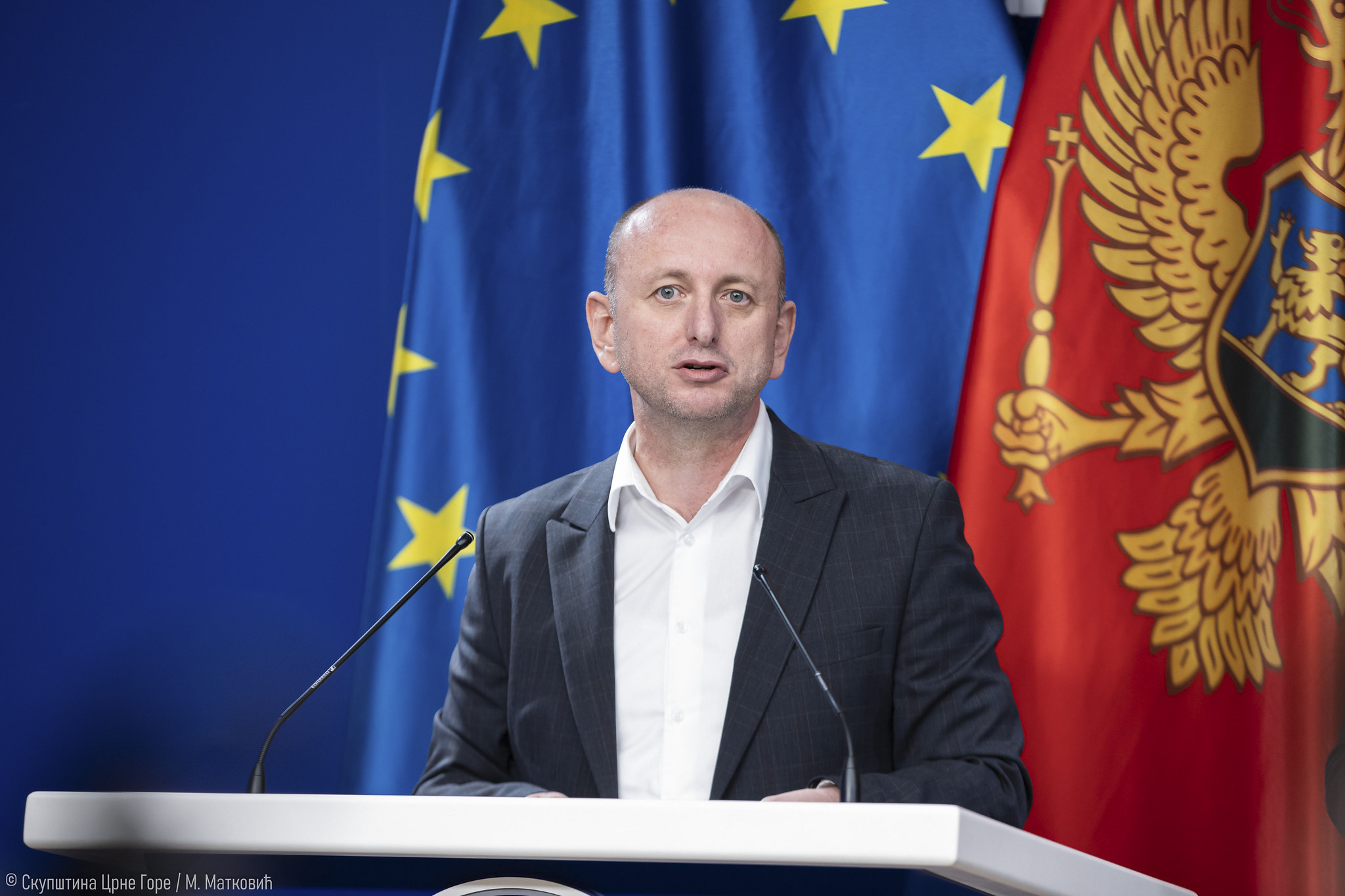
“The newly formed territories of the Russian Federation on the former territory of Ukraine” — this is how Montenegro’s Democratic People’s Party (DNP) described the Ukrainian territories occupied by Russia in a statement by its leader Milan Knežević following the Russian parliamentary elections of 18–20 September.
On 21 September, Knežević congratulated the Russian people, United Russia party, Vladimir Putin and Russian Ambassador to Montenegro Alexander Lukashik on the voting results. According to the DNP, the elections supposedly demonstrated popular support for the “affirmation of Russia in the world” both on its own territory and in the aforementioned “newly formed territories.” Knežević also spoke about the restoration of Russia’s international standing, the “peaceful atmosphere” of the elections and Russians’ support for Putin’s domestic and foreign policy.
Knežević’s favourable attitude towards Moscow is absolutely nothing new in Montenegrin politics. He has long opposed sanctions against Russia, sharply criticised Podgorica’s policy regarding the war in Ukraine and made no secret of his own contacts with Russian political circles. This time, however, another element appeared. One that is qualitatively new and highly unpleasant for Ukraine. This is no longer about an assessment of Russian policy, sympathy for Russia’s political leadership or attitudes towards sanctions, but about the territorial status of the occupied Ukrainian regions.
The phrase “former territory of Ukraine” practically reproduces Russia’s approach to the annexed territories. Moscow organised voting in occupied Crimea and Sevastopol, as well as in the occupied parts of the Donetsk, Luhansk, Zaporizhzhia and Kherson regions. Even before voting began, Ukraine’s Ministry of Foreign Affairs emphasised that holding it in the occupied territories created no legal grounds for extending Russian jurisdiction there. On 21 September, the EU published a similar position, stating that it recognised neither the holding of Russian “elections” there nor their results.
The Ukrainian Embassy in Montenegro, meanwhile, responded to the DNP statement almost immediately — on the morning of 22 September. The Ukrainian diplomatic mission emphasised that it generally refrains on principle from commenting on the domestic political debates of the host country, but that this time it could not remain silent. The phrase “newly formed territories of the Russian Federation on the former territory of Ukraine” was described in the Embassy’s statement as an open denial of Ukraine’s territorial integrity and a justification of the Russian occupation. Kyiv’s position on the legal nullity of voting in the occupied territories and the need to respect Ukraine’s internationally recognised borders was also reiterated separately.
Knežević’s statement, of course, does not affect Montenegro’s state policy. Podgorica remains one of the EU’s most consistent partners in the region on matters of common foreign and security policy. In its latest annual report, the European Commission noted Montenegro’s full alignment with EU foreign-policy statements and sanctions decisions, including all restrictive measures against Russia and Belarus related to the war against Ukraine. In July 2026, the government adopted a new Foreign Policy Strategy for 2026–2029, which once again established the European and Euro-Atlantic direction as the foundation of the country’s course.
What is more interesting is what this story says about Montenegro’s own political scene.
Since January 2026 the DNP has no longer supported the government of Milojko Spajić and has been in opposition. The party withdrew its support for the Cabinet after a conflict over a number of domestic political issues, while its representatives Milun Zogović and Maja Vukićević announced their resignations from government posts. Among the DNP’s demands were changes concerning the status of the Serbian language, citizenship and the use of the historic tricolour.
This has given Knežević considerably more freedom than Andrija Mandić and his New Serb Democracy, which has recently been trying in the public sphere to position itself as a formally pro-European party, albeit with a clear Serbian national orientation. Both parties emerged from the same former pro-Russian and pro-Serbian Democratic Front and for years jointly represented the pro-Serbian political bloc. But their positions are no longer identical. As President of the Parliament and one of the key partners of the current majority, Mandić increasingly acts within the framework of the official European integration course. Knežević, who has left the governing arrangement, faces fewer such constraints.
This difference is becoming particularly noticeable against the backdrop of Montenegro approaching the final stage of its negotiations with the EU. By July, the country already had 18 provisionally closed negotiating chapters, while the authorities continue to declare their intention to complete the negotiations by the end of 2026. For part of the political elite, the European process has become a practical constraint: any sharp foreign-policy initiative is immediately assessed also in terms of its possible consequences for relations with Brussels.
The DNP is now in a different position. The party can work more aggressively with the pro-Serbian and pro-Russian segment of the electorate without bearing direct responsibility for negotiations with the European Union. That is why the statement about the “former territory of Ukraine” is interesting not only in terms of Ukrainian-Montenegrin relations. It demonstrates one possible line of competition within Montenegro’s own Serb political camp.
There is another revealing aspect here. On the issue of Ukraine’s borders, Knežević this time effectively went beyond even Belgrade’s official position.
Serbia has indeed not imposed sanctions on Russia and continues to maintain special political and economic relations with Moscow. This remains one of the key contradictions in its relations with the EU. At the same time, however, Belgrade formally does not recognise Russia’s annexation of Ukrainian territories. On 8 August, during Volodymyr Zelenskyy’s official visit to Serbia, Aleksandar Vučić again publicly stated that his country supports the territorial integrity of all UN member states — “and that also means the territorial integrity of Ukraine.”
Therefore, the DNP’s position should hardly be automatically explained simply as “pro-Serbian policy.” Belgrade leaves itself room to balance between Moscow, Brussels and Kyiv and, at least formally, does not question Ukraine’s borders. In his 21 September statement, Knežević used a much more unequivocal formulation.
In the Western Balkans, however, such rhetoric already has precedents. The most prominent is Milorad Dodik.
The Bosnian Serb leader has long spoken about the war in language that is almost identical to Russia’s official rhetoric. In April, he stated that Republika Srpska would not agree to the introduction of sanctions against Russia and “understands” Russian actions in the so-called special military operation as justified. On 8 September, Dodik spoke even more directly: Republika Srpska, he said, supports the “special military operation” because it understands Russia’s “legitimate motives,” with Russia allegedly having been forced to respond.
There is, of course, a significant difference between the cases of Dodik and Knežević. Dodik’s political weight in Bosnia and Herzegovina is incomparably greater, while for years he has used relations with Russia as one of his resources in conflicts with Sarajevo, the High Representatives of the international community and Western states. The DNP is a much smaller party in a NATO country and does not determine Montenegro’s foreign policy.
The similarity lies elsewhere. Russia’s war against Ukraine is increasingly being used by some Serbian political forces in the region not as a separate foreign-policy issue, but as a marker of a broader attitude towards the West, NATO, the EU and Russia itself. Within this system of coordinates, attitudes towards Moscow are gradually becoming an element of domestic political identity.
For Montenegro, this process is particularly contradictory. The country is now perhaps closer to EU membership than at any time since negotiations began in 2012. The European and Euro-Atlantic course is not formally disputed by the government. At the same time, there is a political space within the country where sanctions against Russia remain an unpopular issue and friendship with Moscow is an important element of political positioning.
Knežević’s statement does not create a foreign-policy crisis and, by itself, changes nothing in Podgorica’s policy towards Ukraine. It will be much more interesting to see whether the phrase “former territory of Ukraine” remains a one-off episode or becomes part of the DNP’s permanent rhetoric.
And even more importantly — how the rest of the pro-Serbian political camp will respond to this. If Mandić and the NSD continue to remain more cautiously within the framework of the state’s EU course, while Knežević consistently moves in the opposite direction, attitudes towards Russia may become one of the genuine dividing lines between forces that until recently acted virtually as a single bloc.
For now, there is only one statement. But its wording is clear enough to mark the moment: in Montenegrin politics, the dispute over Russia is no longer only about sanctions, NATO or traditional Russophilia. It has reached the question of where exactly Ukraine’s borders lie.
CWBS Analytical Group